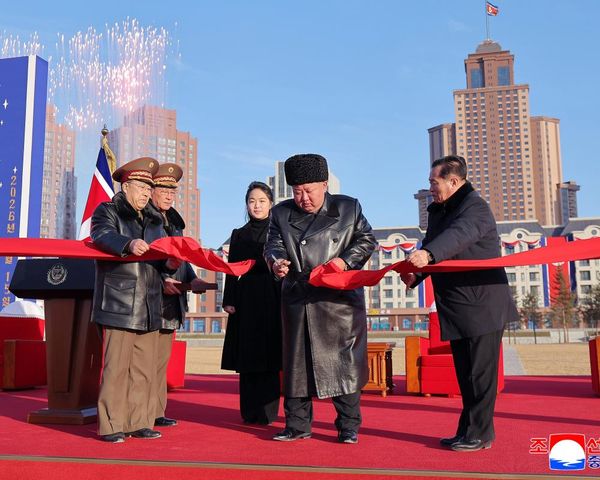
Preparations for a planned U.S.-North Korea summit are in full swing. While accurately assessing the ever-changing situation, the Japanese government should boost policy coordination with the United States and South Korea.
Prime Minister Shinzo Abe was briefed on the April 27 inter-Korean summit during telephone talks with South Korean President Moon Jae In.
Moon conveyed to Kim Jong Un, chairman of the Workers' Party of Korea, Abe's intent to seek a solution to the issue of Japanese nationals abducted by North Korea. Kim was quoted as saying that he is "ready to have dialogue with Japan at any time" over their bilateral relationship.
As international interest concentrates on the nuclear and missile issue, it is highly significant that Japan's position of aiming to solve the abduction issue has been conveyed to Kim.
How can the North be urged to unravel the entire picture of the abductions and make a political decision on the abductee's early return to Japan? A meticulous strategy is called for on the part of the Japanese government. The North unilaterally suspended a reinvestigation into the victims of the abductions, despite an earlier promise to investigate. An insincere response from Pyongyang can no longer be allowed.
Given the progress in the North's negotiations with the United States and South Korea, there is a view that Japan has been "left behind." Considering the peculiarity of Japan-North Korea relations, a slapdash approach should be avoided.
The North has been calling on Japan to totally resolve issues regarding its past colonial rule of the Korean Peninsula.
Adequately resolving the various pending issues to which both countries attach importance, and thereafter normalizing bilateral relations, was the framework of the 2002 Japan-North Korea Pyongyang Declaration. The declaration refers to various economic cooperation projects to be implemented by Japan following the normalization of bilateral ties.
U.S. collaboration vital
Japan should not be swayed by the North's dialogue offensive. Assessing the development of the planned U.S.-North Korea summit and repeatedly holding working-level talks with the North could be a realistic option.
Collaboration with the United States is also indispensable.
In the wake of the inter-Korean summit, Abe held telephone talks with U.S. President Donald Trump, in which they shared the view that it is important for the North to take concrete action toward denuclearization. It was appropriate that the two leaders confirmed anew their goal of having the North dismantle its nuclear weapons.
Dismantling all of the North's ballistic missiles with varying ranges, in addition to its nuclear arms, is indispensable to the stability of the region. Abe needs to take advantage of various occasions and repeatedly communicate this to Trump.
Foreign Minister Taro Kono met with U.S. Secretary of State Mike Pompeo during his visit to Jordan, and they have agreed to maintain maximum pressure on North Korea.
It was also agreed that surveillance of ship-to-ship cargo transfers on the high seas -- conducted by the North to evade sanctions -- will be stepped up.
It is laudable that Kono has already exchanged views in person with Pompeo, who only recently took office.
Arrangements for discussing the North Korean issue must be made quickly between the foreign policy authorities of both countries.
(From The Yomiuri Shimbun, May 2, 2018)
Read more from The Japan News at https://japannews.yomiuri.co.jp/