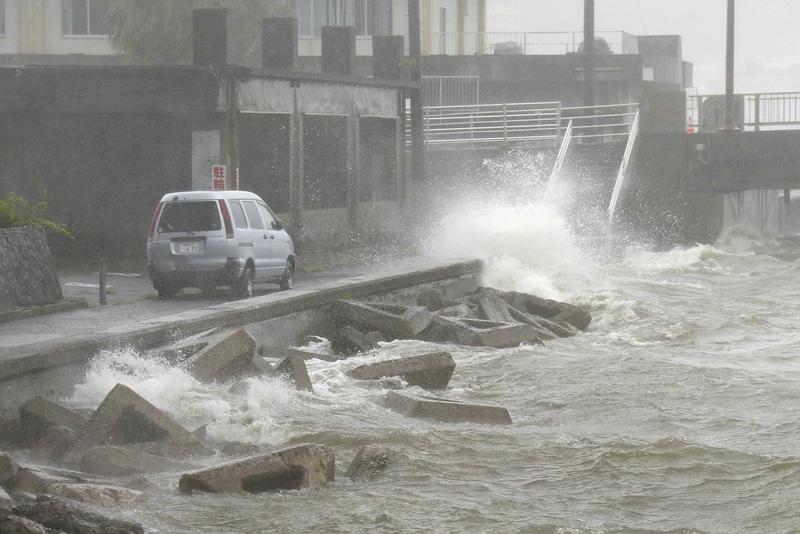
Powerful Typhoon No. 10 moved north Sunday morning, bringing strong winds to Amami, Kagoshima Prefecture, and other areas.
The typhoon is likely to keep moving northward through southern Kyushu and the Amami area on Sunday night, and to approach or land on Kyushu on Monday. The Japan Meteorological Agency is calling for the highest level of vigilance, as serious damage may result from unprecedented heavy rain, storms, high waves and storm surges.
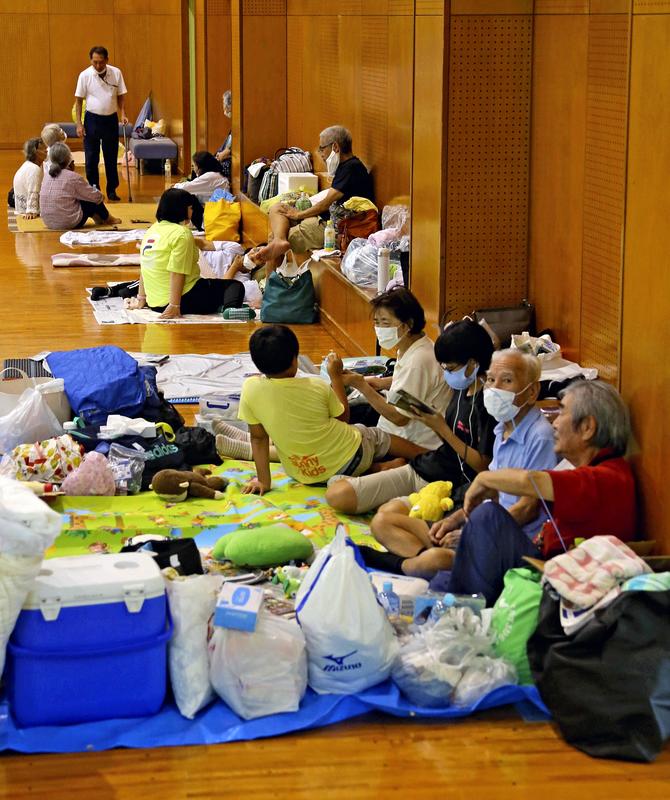
According to the Fire and Disaster Management Agency, a total of 410,000 people in Kagoshima, Nagasaki and two other prefectures had been ordered to evacuate as of 1:30 p.m.
The meteorological agency held a press conference at 9:30 a.m. Sunday to explain that a special typhoon warning is unlikely to be issued for Kagoshima Prefecture as had been expected, because the central atmospheric pressure is no longer predicted to reach the forecast level.
However, there have been no major changes in forecasts of maximum instantaneous wind speeds and precipitation, according to the agency. "Regardless of whether a special warning is issued, please exercise the strictest caution," an agency official said.
The agency also called for an alert against record-setting storm surges in western Japan.
The Kagoshima prefectural government announced that as of 8 a.m. Sunday, about 6,600 people had evacuated after evacuation orders were issued to about 9,700 residents in Nishinoomote and other cities. According to Kyushu Electric Power Co., about 7,970 households on Amami Oshima and Kikaijima islands were without power as of 9 a.m.
In Okinawa Prefecture, about 1,850 people were ordered to evacuate. As of 10 a.m., about 3,400 households in the prefecture had suffered power outages. At Kitadaitou Airport in Kitadaito, Okinawa prefecture, parts of a shutter were found damaged.
In Kuma and Tsunagi in Kumamoto Prefecture, which were hit by heavy rains in Kyushu in July this year, evacuation orders were issued to a total of about 3,600 people.
In response to the typhoon, the government upgraded its liaison office in the crisis management center at the prime minister's official residence to a countermeasures office. Chief Cabinet Secretary Yoshihide Suga and Japan Meteorological Agency Director General Yasuo Sekita met with others to discuss how to deal with the situation.
Central Japan Railway Co. announced Sunday that some Tokaido Shinkansen bullet trains will be operated on Monday with different destinations.
As some operations on the Sanyo Shinkansen will be suspended, a total of 100 Tokaido Shinkansen bullet trains going between Tokyo and Hiroshima or Hakata stations will be changed to shuttle between Tokyo and Okayama or Shin-Osaka stations.
Read more from The Japan News at https://japannews.yomiuri.co.jp/