The government has decided to join forces with India in the race to discover water on the moon, with the two countries planning to try to land an unmanned rover on the moon's south pole as early as fiscal 2023.
Frozen water is believed to exist inside craters and other areas of the moon's poles where sunlight does not reach. The government plans to use the rover to excavate in such areas and discover water on the moon for the first time. The Japan Aerospace Exploration Agency (JAXA) and Indian Space Research Organization (ISRO) have already held meetings on the project, and Japan's Committee on National Space Policy and other bodies are set to begin discussions before making an official announcement.
The government's Strategic Headquarters for National Space Policy, led by Prime Minister Shinzo Abe, decided last month to make the Japan-India lunar mission a priority item on the schedule of its Basic Plan on Space Policy when it is revised at the end of this year.
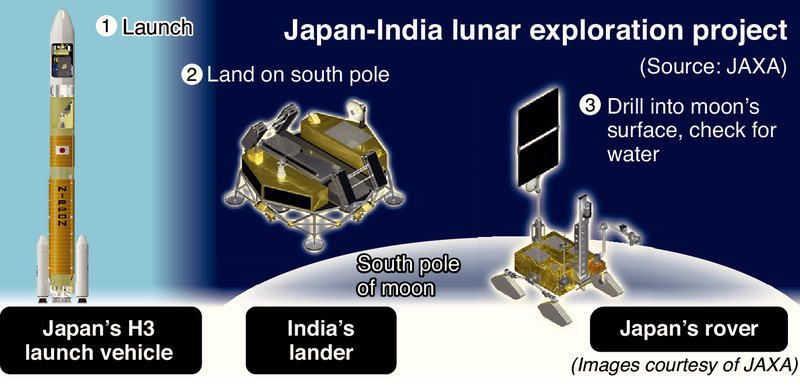
Japan will be in charge of launching the rocket and developing a lunar rover, while India will develop a lander for the mission.
Japan's H3 launch vehicle, which is under development, will send the rover-equipped lander to the moon sometime around fiscal 2023. The lander is expected to touch down on the moon's south pole, where water likely exists. The rover will then explore within an about 500-meter radius of the lander and try to detect water using onboard analysis equipment.
On July 22, India launched the unmanned spacecraft Chandrayaan-2 in an effort to land in the vicinity of the moon's south pole. Japan, meanwhile, plans to launch its own lander, SLIM, in fiscal 2021 to make an accurate landing on the moon's surface. The government decided that integrating the results of these projects would give the two countries the lead in the race to discover water.
The moon has a radius of about 1,700 kilometers, or about one-fourth the radius of the Earth. A series of recent uncrewed probes conducted by India and the United States have revealed that water is highly likely to exist on the moon's north and south poles. However, a water sample has not yet been collected. Besides providing drinking water, the hydrogen and oxygen extracted from water could be used to fuel rockets, transforming the moon into a base for man's future development of space.
As a result, many countries are joining the race to explore the moon's poles. The U.S. National Aeronautics and Space Administration is trying to send astronauts to the moon's south pole by 2024 under its Artemis lunar exploration program, which would mark the first manned moon landings since the historic Apollo missions. China is also aiming to land an uncrewed probe on a lunar pole and bring moon rocks back to Earth in 2020 or later.
Takeshi Hoshino, a principal engineer at JAXA, said: "We want to get ahead of the world in confirming the presence of water on the moon. Finding water on the moon would lead to broadening the range of activity for humankind, and make lunar exploration more active than ever."
Read more from The Japan News at https://japannews.yomiuri.co.jp/