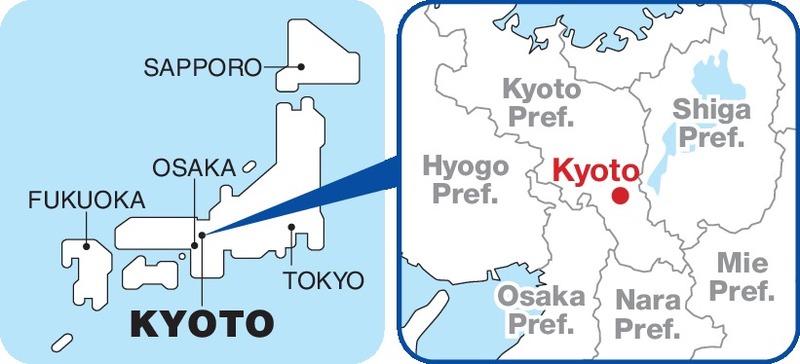
KYOTO -- An experiment was recently conducted in Arashiyama, a famous tourist area in Kyoto, that gauged how crowded it was in various spots and published that information on a website.
The Kyoto Arashiyama Travel Guide website was put up through Dec. 17 by the Land, Infrastructure, Transport and Tourism Ministry, the Kyoto city government and the Kyoto City Tourism Association. These organizations sought through the site to disperse tourists and guide them to non-congested spots, because they tend to concentrate at specific times and places.
The ministry and other parties intend to examine how much impact the website had on tourists' behavior, giving them such information as how to get to sightseeing spots and when they were not crowded.
During the experiment, "ease of sightseeing" was indicated in one-hour increments for eight areas in the Arashiyama district, such as the Togetsu-kyo bridge area, the Daikakuji temple area and the Okusaga area. The indexes were expressed in blue circles of different sizes, which turned red when the areas were most crowded. Users could also check hourly changes in congestion.
The degree of congestion was estimated by using sensors to detect the number of smartphones on which Wi-Fi was activated.
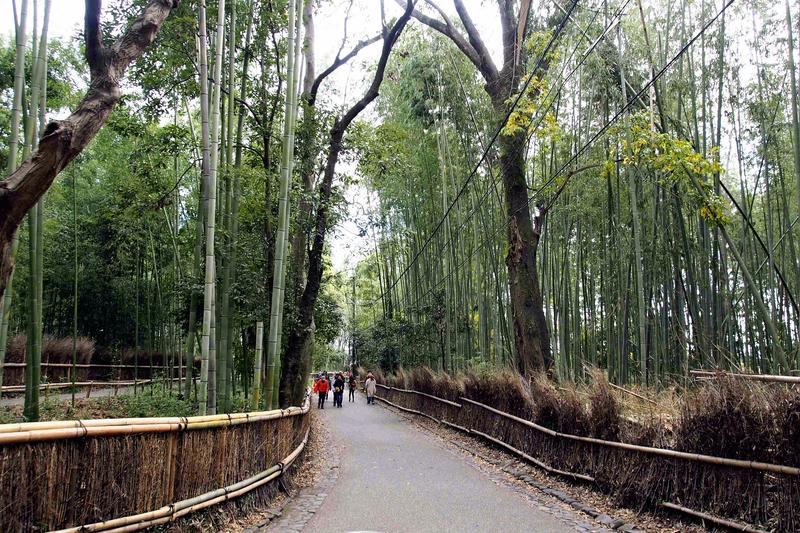
On Nov. 15, I checked the congestion on Chikurin-no-komichi, or the Bamboo Grove Path, one of the most popular tourist spots in Kyoto. All the circles were red for 10 a.m. to 4 p.m. So I visited at 9 a.m., when I saw only scattered visitors.
One of the tourists was a high school student from Fukushima. "We can enjoy the atmosphere better when it's not crowded with people," the 16-year-old girl said.
The number of people gradually increased after that, and when it passed 10 a.m., the spot became crowded with many tourists. Many took photos with cameras on sticks, and an American tourist lamented that there were more people than bamboo.
The website also introduced uncrowded spots on such recommended routes as "Collecting goshuin," "Ladies' trip" and "Viewing autumn leaves." Goshuin are red ink stamps that mark a visit to a temple.
I went to Otagi Nenbutsuji temple in Ukyo Ward, which was featured on one of the site's recommended routes, "Photogenic spots in Arashiyama." This temple boasts 1,200 rakan Buddhist statues created by devotees. The head priest and other staff post photos of the unique Buddhist statues and the four seasons on Instagram.
Although the number of foreign tourists is increasing, few people go much beyond Togetsu-kyo and the Bamboo Grove Path. Head priest Koei Nishimura, 63, expressed hope that "the experiment will bring more tourists."
Local shopping streets would also like to see the diversification of tourists and less crowded conditions. They have serious problems caused by congestion, such as people having difficulty shopping and trash being scattered on the streets by people who eat as they walk.
The Saga-Arashiyama Omotenashi Vision Promotion Council comprises the five shopping streets in this area. It cooperated in the experiment by displaying posters about it in shops and using Twitter to encourage people to visit the website.
"If our tourist spots are very crowded, people might call them a letdown," said Keisuke Ishikawa, vice chairman of Arashiyama Shopping Street.
"I want to promote the enjoyment of going around Arashiyama, which has many attractive temples and shrines and scenery," said Ishikawa, 49.
Complaints of 'too many people'
Congestion is one of visitors' biggest complaints about Kyoto, with dissatisfaction especially high among Japanese domestic tourists. In an annual survey conducted by the Kyoto city government, "crowded with too many people" has ranked first among the disappointments of tourism there for three consecutive years since 2015.
The percentage of people dissatisfied in this way increased from 13.8 percent in 2015 to 17.1 percent in 2017. There were comments such as "There are many people, so we can't relax and enjoy ourselves," and "The buses are always full, so we can't ride them."
In a recent survey, 40-50 percent of Japanese respondents answered that they had "unfortunate experiences." In addition to congestion, numerous opinions were given about non-compliance with traffic rules, and public transportation such as train and bus systems being too complicated to use without difficulty.
Among foreign tourists, on the other hand, about 80 percent said they had had "no unfortunate experiences." In the 2017 survey, the most common answers among foreigners were "not enough time" at 26.8 percent and "too many people or congestion" at 6 percent.
Read more from The Japan News at https://japannews.yomiuri.co.jp/