The National Astronomical Observatory of Japan (NAOJ) has state-of-the-art observation and research facilities at home and abroad for studying the mysteries of the universe.
But it has not been widely known that it is headquartered in Mitaka, western Tokyo.
Why are the headquarters of the organization, which plays a central role in Japan's astronomical studies, located in the city?
The headquarters is about 15 minutes by bus from JR Musahsisakai Station. Also called Mitaka Campus, it is a vast plot of land in the Osawa district, and is surrounded by forests. It is about 260,000 square meters -- about 5.5 times the size of Tokyo Dome.
NAOJ's predecessor, the Tokyo Astronomical Observatory, was first established in the Azabu district in Minato Ward. The location was about 20 kilometers east of the current location. It was an organization belonging to the then Tokyo Imperial University, the present University of Tokyo.
The predecessor observatory was established in 1888. Researchers in those years observed stars, measured latitude-longitude locations, made calculations for calendars and decided precise clock times.
However, the Azabu district and nearby areas gradually became urbanized, and light pollution in the night sky increased. Thus, conditions for the researchers to conduct observations worsened.
Relocation of the observatory was considered, and the candidate site at the time was Mitaka, which was full of forested areas, rice paddies and other agricultural fields.
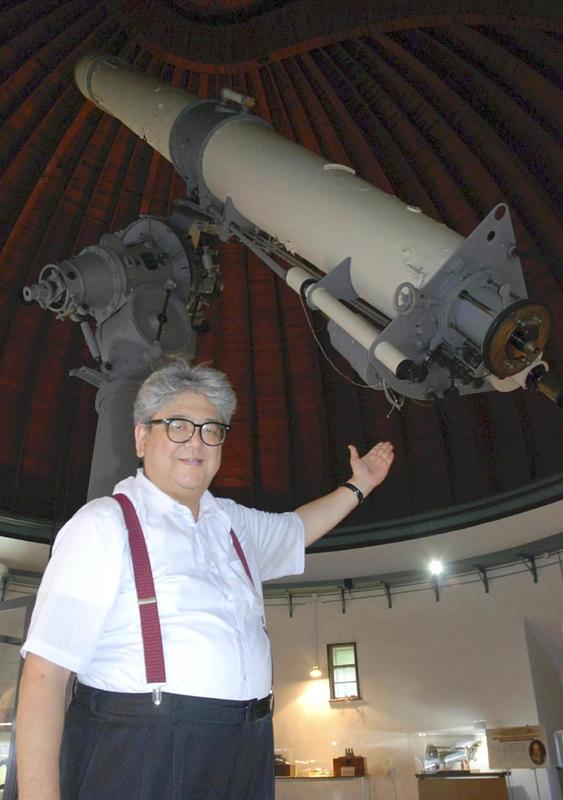
Hitoshi Yamaoka, 53, an associate professor at the NAOJ, said, "Good traffic access was the main reason that Mitaka was chosen."
In 1889, the operation of a section between Shinjuku and Tachikawa stations on the Kobu Tetsudo line (present JR Chuo Line) started, and the Sakai railroad depot (present Musashisakai Station) had also begun services.
In 1914, construction of the new astronomical observatory began in Mitaka. But there were many researchers and their family members who disliked living in the rural area.
The situation was largely changed by the Great Kanto Earthquake in 1923. After that, researchers and others concerned who suffered damage from the earthquake in central Tokyo began to move to Mitaka one after another.
Urbanization strikes again
From 1924, the year after the disaster, observation activities started in Mitaka and achievements were soon produced.
From 1927 to 1929, Okuro Oikawa (1896-1970), an astronomer of the Tokyo Astronomical Observatory, became the first Japanese to discover an asteroid with a method by which starry skies were photographed.
He discovered eight asteroids -- one was named Mitaka and another named Tama.
Eijiro Hiei, 87, a professor emeritus at the NAOJ who joined the Tokyo Astronomical Observatory in 1955, recalled those years. "When I walked during the night, I confirmed the direction by watching stars through the spaces of trees," he said.
At the time, only rice paddies surrounded the Tokyo Astronomical Observatory, and there were not even any street lights. Thus, the observatory was in complete darkness at night, he said.
However, after those years, residential areas began to pop up around the observatory. Light pollution rose at night, and the location became unsuitable for observing the night sky again.
In 1960, in order to seek "dark skies," the NAOJ built an astrophysical observatory in Okayama Prefecture and the Nobeyama Solar Radio Observatory in Nagano Prefecture in 1969.
In 1988, it changed its name to the current NAOJ and began negotiations with the United States. As a result, the NAOJ established the Subaru Telescope atop Mt. Mauna Kea in Hawaii. Observations with the telescope started in 1999.
Vast amounts of data
Currently, about 500 researchers and officials work at the Mitaka Campus. It conducts solar observation among other activities and accommodates the Advanced Technology Center and other important facilities for research and development.
The facilities analyze huge volumes of data daily that are sent from more than 10 observation locations in Japan, Hawaii and Chile.
"Now we are in an era where we can see observation data that is sent from all over the world, regardless of where we are, through networks. There are no difficulties with our research," Yamaoka said.
Another feature of the Mitaka Campus is the 65-centimeter Telescope Dome built in 1926, which accommodates Japan's largest-diameter refracting telescope, and the Solar Tower Telescope built in 1930, with the whole building encasing the body of the telescope.
Including these two, there remain precious historical facilities designated as national tangible cultural properties on the Mitaka Campus, even though their roles for observation research have ended.
To promote astronomy, the Mitaka Campus is open to the public, with no reservations required.
The Mitaka Campus also holds events and exhibitions, such as one to observe the moon, Jupiter and other stars, and a 4-D planetarium that displays stereoscopic images of planets and galaxies. To participate in the events, prior applications are necessary.
Read more from The Japan News at https://japannews.yomiuri.co.jp/