KYOTO -- Tadao Ando, the renowned architect whom I have known for many years, is based in Osaka, which is near Kyoto. His architecture has often been covered by overseas media, usually with emphasis on the elements of "wabi" and "sabi." Yet I've never heard him use these two words when explaining his own work. In general, the Japanese media does not evaluate his work based on its wabi or sabi features, either.
One of the typical characteristics of Ando-san's work is bare concrete walls. (Please allow me to write his name with an honorific suffix as he is older than I and I know him personally.) His designs are usually minimalist and geometric. In particular, his early small houses look like boxes that are closed to the outside world.
Architectural journalists and critics overseas probably find that that appearance is ascetic and symbolizes wabi and sabi, which is an important concept underlyng the Japanese sense of beauty.
Although wabi and sabi are often used together as a set phrase, they are a little different from each other. Originally, wabi means finding and enjoying tasteful elements in life in poverty, while sabi describes the beauty of things in nature or human life that have passed their prime and withered.
In Kyoto during the Muromachi period (early 14th century to late 16th century), renga poet Shinkei cited a work by ancient waka poet Saigyo, of which the latter part reads, "kareno no susuki, ariake no tsuki" (silver grass in a withered field, wan morning moon), as a manifestation of sabi. Shinkei highly praised this part, saying that the withered field mentioned in the poem represents a winter scene and also hints at flowers that have passed the peak of their beauty and withered maple leaves that used to be vivid red, further referring to the passage of time and Saigyo's view of life as transitory, although Saigyo did not mention these in this poem.
Today, Donald Keene, a renowned scholar of Japanese literature, understands wabi as evoked by Saigyo to be "the discovery of beauty within the old, the faded, the forlorn." He interprets that it is the idea of appreciating travel to distant parts of the country and life in hermitages, such as mountains and forests, and discovering the simple, austere beauty.
It was the Zen sect of Buddhism that regarded the spirit of wabi and sabi as ideal. Guided by the idea, Zeami developed his own style of noh drama and Sesshu started his distinctive ink painting in the Muromachi period, followed by the tea ceremony established by Sen-no-Rikyu from the Sengoku warring states period to the Azuchi-Momoyama period before the start of the 17th century. Various genres of art originated by these artists still form a core of Japanese culture today.
Here, I'll return to architecture.
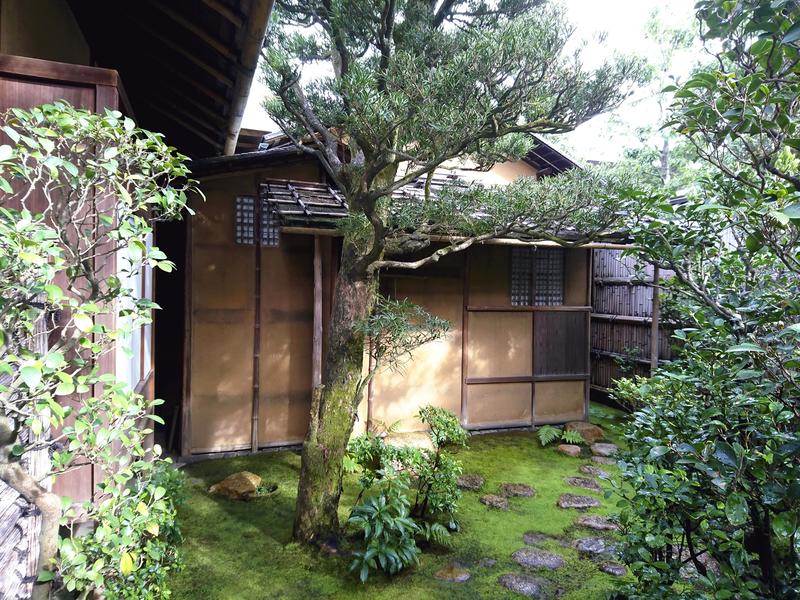
When it comes to wabi and sabi structures, I immediately think of chashitsu teahouses for the tea ceremony, which are usually small. It is known that Rikyu built a teahouse in Kyoto with a two-tatami-mat room to make and serve tea. Due to its small size, the room can accommodate only two people -- a host and a guest.
The room's interior wall is finished with the arakabe shiage method, in which no coating is applied. The alcove pillar and some other important wooden parts are processed, but only a little.
As its doorway is small on purpose, guests had to leave their katana swords outside and crouch and bend their heads to enter. Rikyu received ruling daimyo Toyotomi Hideyoshi in this small room.
The surfaces of the bare concrete walls of Ando-san's architecture are in fact finished with time-and-energy-consuming polishing work. I felt they could be left rough, without such an elaborate finish, if following the tea room style. His buildings that are more than 40 years old still look new due to good maintenance work.
In his early years, the architect sometimes designed small houses to fit small sites. Later, he worked on a number of large museum buildings.
His architecture may have wabi and sabi elements partly because they are minimalist. However, we are rather encouraged to compare his work not with teahouses but with those of Le Corbusier and Mies van der Rohe in the West, whom Ando-san acknowledges as great influences.
* * *
This column, which appears once a month, is about various aspects of the culture of Kyoto.
Mori was born and raised in Kyoto. He has 30 years of experience in reporting about Kyoto culture. He has extensively covered scholars of the New Kyoto school, the heads of tea ceremony and flower arrangement schools, as well as maiko in the Gion area of the city.
Read more from The Japan News at https://japannews.yomiuri.co.jp/