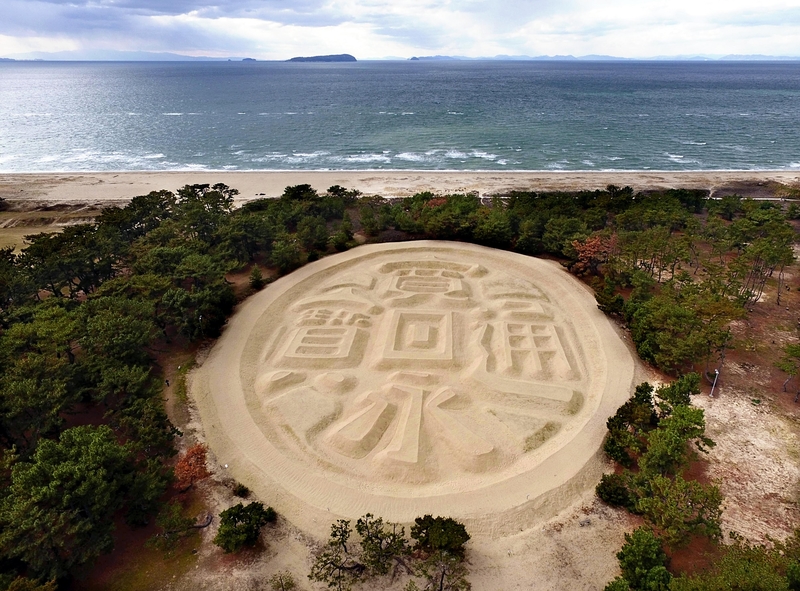
KANONJI, Kagawa -- On a beach in Kanonji, Kagawa Prefecture, is a giant sand sculpture in the shape of a Kanei tsuho, a coin from the Edo period (1603-1867).
Legend has it, one glimpse of the sculpture will grant you a life free from money problems.
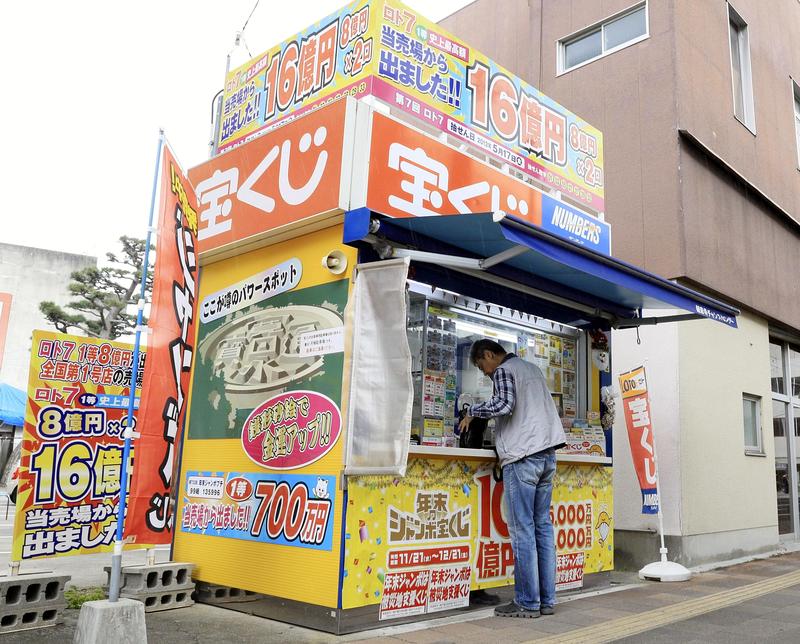
In fact, in May 2013, just one month after the launch of the LOTO 7 lottery, not one but two grand prize-winning tickets for 800 million yen were sold in the city. The story was featured on television and in magazines, bringing many visitors to the sand sculpture.
'Jackpot path'
The Zenigata Sunae (coin-shaped sand sculpture) is an oval measuring 122 meters east to west and 90 meters north to south. When seen from an observation platform near the 58.3-meter peak of Mt. Kotohiki to the east, it looks like a perfect circle. The sculpture is not only enormous, it is exquisitely designed.
"How in the world did they make it?" wondered Taiki Yamaguchi, 24, who works for an organization in Matsuyama.
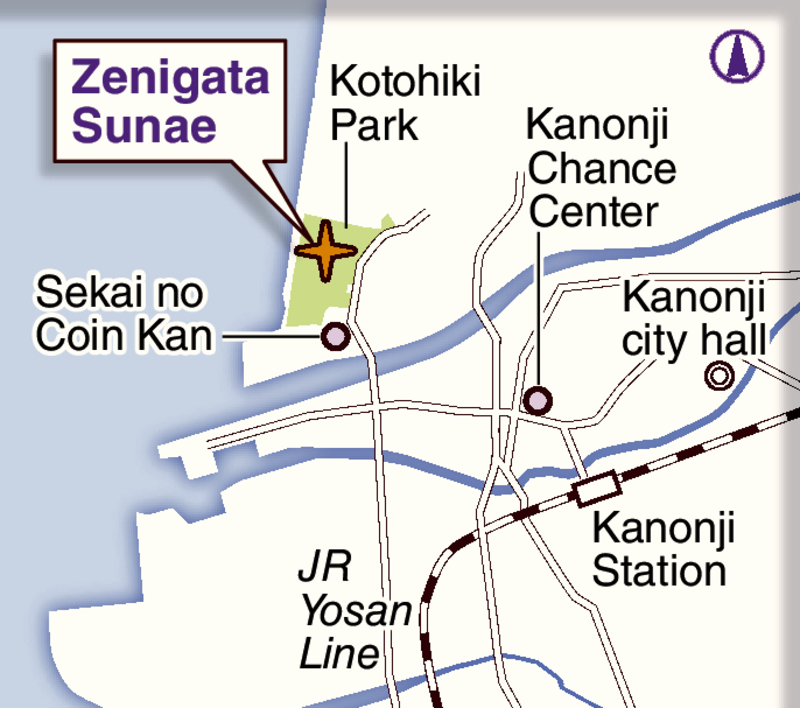
The LOTO 7 grand prize tickets were sold at the Kanonji Chance Center, a small lottery shop near JR Kanonji Station decorated with a flashy sign boasting of the 2013 winners and a drawing of the sand sculpture.
Chie Osaki, 52, who has been working at the shop since before 2013, said: "Customers from Hokkaido to Okinawa Prefecture would come almost every day. Even now that the boom has died down, people still come from the Kansai region."
Some follow a "prescribed route" that involves viewing the sand sculpture from the observation deck before going to the chance center to buy a lottery ticket.
"It's beautiful, with the view all the way to the sea. I felt the power," said Nahomi Yamanaka, 58, a certified caregiver from Kameoka, Kyoto Prefecture. "I'll win the jackpot and visit here again to give thanks for the blessing I received."
Maho Miyata, 37, a part-time worker from Tatsuno, Hyogo Prefecture, stopped by on her way home from the Kotohira-gu shrine in Kotohira, Kagawa Prefecture. "It's been a while, but maybe I'll buy a lottery ticket," she said.
Mysterious history
Though the sand sculpture is now a "power spot" for luck with money, its origins are unclear.
Materials from the city's tourism association say the sculpture "was created in one night to welcome the feudal lord Ikoma Takatoshi in the 10th year of the Kanei period (1633)." However, Kanei tsuho coins did not appear until 1636.
Other origin stories include that it was made by the army during survey training in the Meiji era (1868-1912), or that it was a UFO base.
Masakiyo Fujiwara, 62, secretary general of the tourism association, said he knew of no definite explanation. Nor is there any relationship between the city of Kanonji and Kanei tsuho coins.
The oldest photograph of the sculpture in the city's possession is from around 1900. Today, parts of the sculpture are dug out to as much as three meters to make the characters stand out, but back then it seems to have been much more shallow.
"It gets deeper and deeper every year," Fujiwara said.
The secret to this is the "suna zarae" work carried out every spring and autumn. Using no chemicals or other substances, locals gather to compress and shape the sand with shovels.
Doing this over and over deepens the grooves in the sculpture, which are now about twice the height of an adult in some places. Yet going too deep would ruin the balance, so lately they have only been shaping the tops.
During the work, different colored flags are placed around the sculpture. To gain an overall view, someone stands on the observation deck giving directions via a transceiver. For example, the people on the ground might be told, "The corner by the red flag is becoming rounded." It is only the time people are allowed to enter the sculpture.
It is unclear when suna zarae started. "We'd like to offer it as a tourist experience," Fujiwara said.
After reporting this story, I visited the Kanonji Chance Center to buy a LOTO 7, my first lottery ticket ever.
Waiting for the drawing, I fantasized about my coming life of leisure, but it was no wonder my fantasy didn't become reality with just one lottery ticket. Like the volunteers who patiently shape the sand sculpture, I guess I have to keep working.
-- Access
The Zenigata Sunae and observation deck are in Kotohiki Park, which is a five-minute taxi ride from JR Kanonji Station. The park is also home to the Sekai no Coin Kan, a museum with about 2,000 pieces of currency from all over the world. Kanonji Station is about two hours from Shin-Osaka Station. Change from the bullet train to the Shiokaze limited express at Okayama Station.
Read more from The Japan News at https://japannews.yomiuri.co.jp/