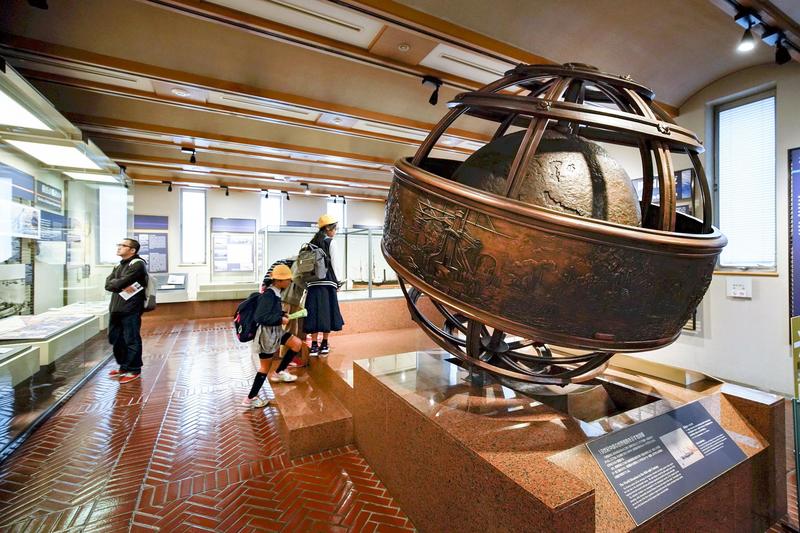
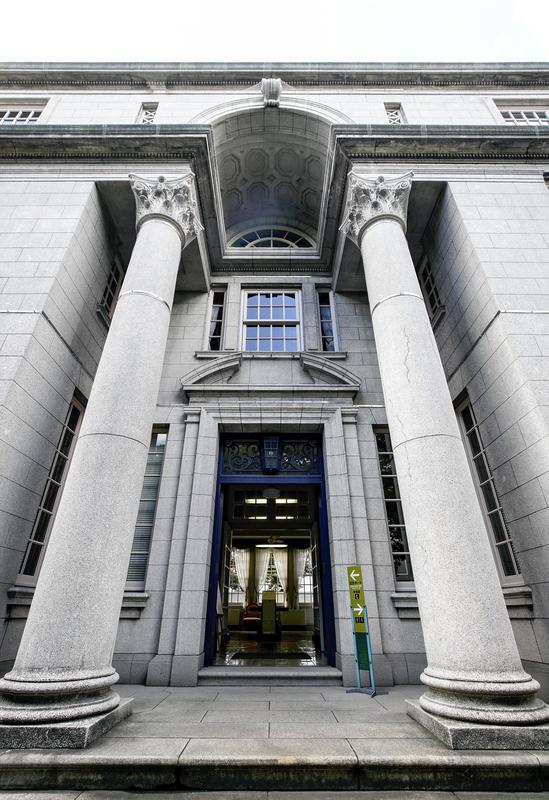
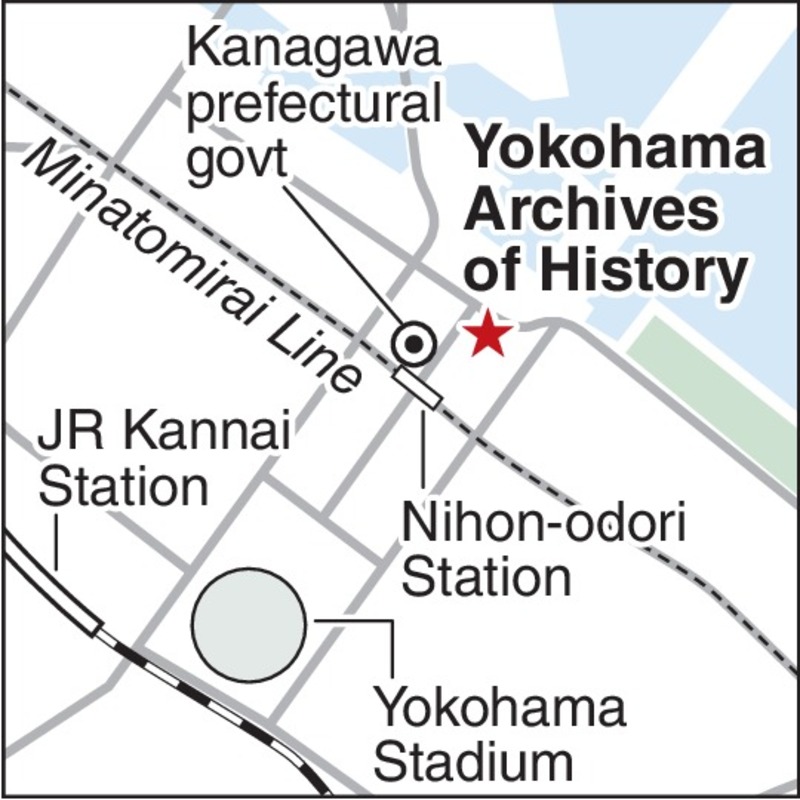
YOKOHAMA -- Occupying a graceful white building, the Yokohama Archives of History is located in Yokohama's administrative district, where the Kanagawa prefectural office, courts, prefectural police headquarters and other agencies can also be found.
The building was originally built and designed by the British government in 1931 to be the country's Yokohama consulate general. After the functions of the consulate were transferred to the British Embassy in Tokyo, the Yokohama city government assumed management of the building and opened it as an archive in 1981.
Now, the museum educates visitors on Yokohama's history since its establishment as a port city. About 260,000 items, including paintings and miniature models from the late Edo period (1603-1867) to the Showa era (1926-1989) are stored at the archives.
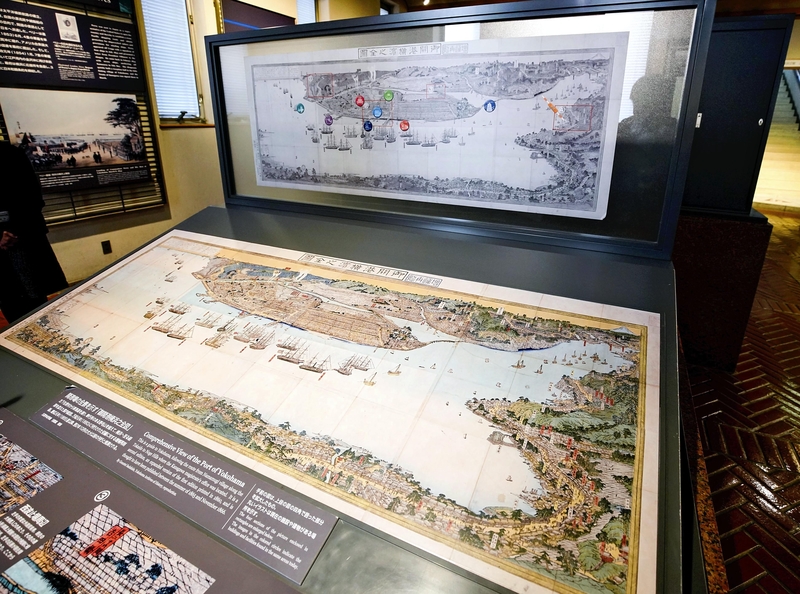
Upon entering one of the exhibition rooms, visitors are greeted by "Yokohama Joriku Zu" (The landing at Yokohama), a captivating painting that depicts the arrival of U.S. Commodore Matthew Perry's fleet in Japan in 1854. In the painting, armed U.S. sailors stand in orderly lines facing Tokugawa shogunate bureaucrats, with a large throng of bystanders curiously looking on.
In another painting, a samurai prods his horse to run faster as he seeks to quickly relay information about the ships.
Another impressive work depicts a scene in which commoners tranquilly observe the Black Ships while drinking tea and smoking pipes.
Did commoners' anxiety dissipate because they saw the ships every day during the two months they were anchored offshore? The paintings are interesting because they contrast the reaction of the shogunate, which grew anxious following the arrival of outsiders, with that of commoners, who seemed to blithely accept the drastic changes.
An exhibit titled "Perry no Kao Iroiro" showcases various portrayals of the commodore. One portrait depicts Perry as having long, pointed nails, while another depicts him as having an absurdly long nose, like that of a tengu long-nosed goblin from Japanese folklore.
In an ukiyo-e painting, carts and pedestrians crowd sections of a road.
When the port of Yokohama opened to the rest of the world, it was unknown whether Japan would be able to trade with other countries. Nevertheless, merchants from across the country were said to have gathered in the port city.
"People who were sensitive to changes in society headed to Yokohama en masse. Many books similar to modern travel guides sold well in those years," Takeomi Nishikawa, 63, director of the archives, said.
The museum is a precious place where visitors can experience the atmosphere of Yokohama when Japan opened up to the world, as much of the city was destroyed during the 1923 Great Kanto Earthquake and 1945 air raids.
"Using the Tokyo Olympics as an opportunity, we want to convey more information so [the city's] history of international exchanges will attract more attention," Nishikawa said, voicing his expectation that Yokohama would get a further boost toward 2020.
-- Yokohama Archives of History
The archives opened on June 2, 1981, a day commemorating the opening of Yokohama Port. In addition to the permanent exhibitions, special exhibitions are held four times per year. Kaiko Hiroba square, where the Japan-U.S. Treaty of Peace and Amity was signed, is located near the archives. The archives are a two-minute walk from Nihon-odori Station on the Minatomirai Line.
Address: 3 Nihon-odori, Naka Ward, Yokohama
Open: 9:30 a.m. to 5 p.m. Closed mainly on Mondays.
Admission: 200 yen for adults, 100 yen for elementary and junior high school students
Information: Call (045) 201-2100
Read more from The Japan News at https://japannews.yomiuri.co.jp/