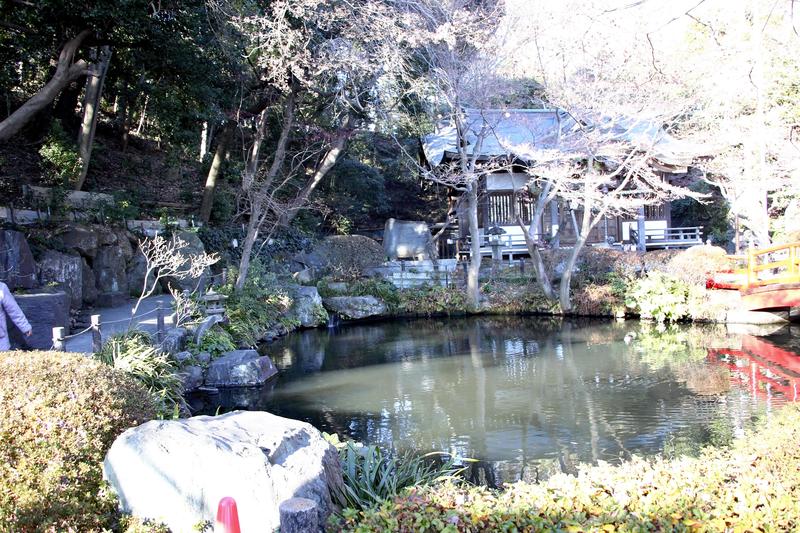
What does "hake" mean?
The story of "Musashino Fujin" (A Wife in Musashino), a romantic novel written by Shohei Ooka in 1950, starts with a sentence saying that residents in and around what is now the western Tokyo city of Koganei don't know why the area was called hake.
The setting for the novel is Koganei and its neighboring areas. There are many spots around the city whose names bear the word hake, such as Hake-no-Mori-Bijutsukan, an art museum; Hake-no-Komichi, a narrow street; and Hake-no-Oishii-Asaichi, a morning market.
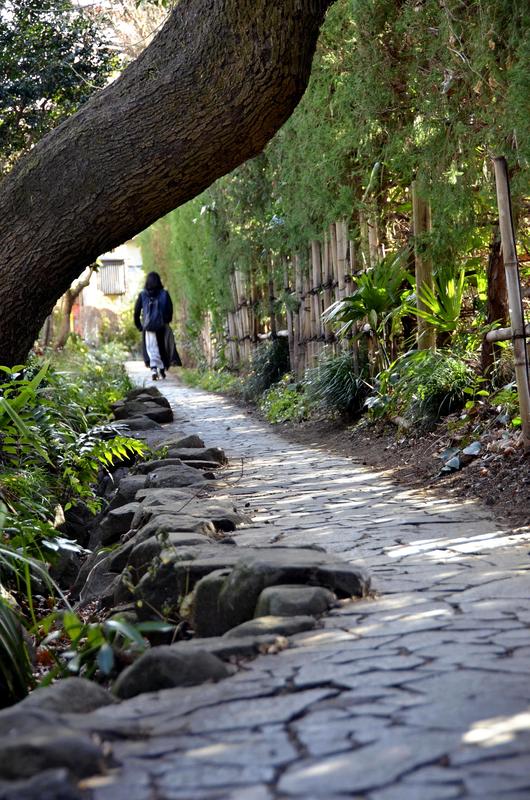
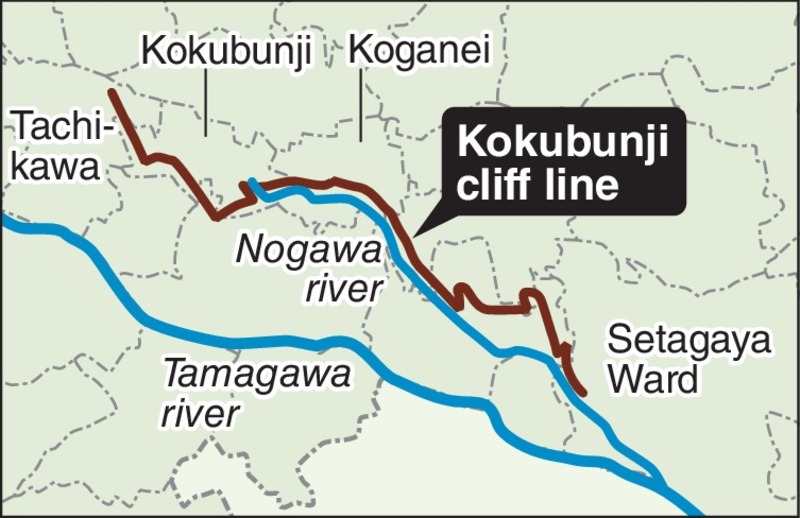
Hake-no-Michi is a two-kilometer path running east to west in Koganei. It extends along the Nogawa river and the Kokubunji gaisen, a cliff line that stretches about 20 kilometers from the city of Tachikawa to the Seijo area of Setagaya Ward. Bluffs were formed by the erosion of the Musashino tableland by the ancient Tamagawa river.
A walk along the path offers a landscape with green tracts of land and thickly wooded zones that stretch across the sloping surface of the bluffs. With many slopes, stairways and springs dotting these zones, the road offers a sense of refinement.
One guidebook for visitors to Koganei explains that hake is synonymous with the Kokubunji cliff line. However, Ooka's Musashino Fujin character writes that the probable meaning of hake is a hollow that has been created at the foot of a slope, cutting deep into its interior, upstream along a spring flowing onto a path below.
"As 'Musashino Fujin' states, 'hake' is a word meaning a hollow in a cliff line," said Hiraku Haga, 69, a visiting professor of cartography at Tokyo Keizai University. He is known as an expert on cliffs.
According to Haga, a hake hollow can be formed after a rainwater-soaked stratum that lies on top of a water-impermeable stratum appears at a cliff's surface, which is then eroded by spring water. Although similar geographical features can be seen in various places nationwide, hollows on slopes in the Musashino area are called hake. The name is said to originate in a verb that phonetically resembles hake -- that is, "haku" (drain away). A hake is a place where water drains away.
In fact, there are many places and roads believed to be associated with hake in and around the Musashino district, such as "Hakeshita" and "Hakeue" in the city of Fuchu and "Hakeshita-dori" in the city of Chofu. There are also cliffs near these places.
According to the Koganei municipal government, the place name "Koganei" is derived from the fact that the area has an abundance of spring water that can be likened to kogane, or gold. Springs at three locations in the city -- including at Nukui shrine, which stands in a hake zone -- have been listed as renowned springs in Tokyo.
The ruins of many Stone Age villages have also been discovered along rivers in the city, indicating that from ancient times the area has been a home for people as they gathered around springs.
The Nogawa river, which runs through Koganei, Setagaya Ward and elsewhere, came into being after a cluster of springs located along the Kokubunji gaisen formed a stream. The basin of the river is a rich green environment and there are sources of spring water, where genjibotaru fireflies live.
Many people have become fascinated with hake areas and the natural beauty of the Nogawa river, including a volunteer group in Setagaya Ward. Its members carry out bird-watching outings and cleanup activities along the river. "I want to ensure that a rich natural environment nurtured by hake is passed down through the generations," group leader Seishi Nakagawa, 79, said.
"I hope to convey information about the attractiveness of hake," said Yukiko Noguchi, 70, of Kokubunji, who is an official at nonprofit organization Green Necklace. She is seeking to publish a book to achieve that purpose.
"Hake is most beautiful in winter. There are sunny spots along the bluff and fallen leaves and the surface of the water shines brightly," Noguchi said. "I feel good walking around there."
Now is the best time for a stroll around some areas where hake are found.
Read more from The Japan News at https://japannews.yomiuri.co.jp/