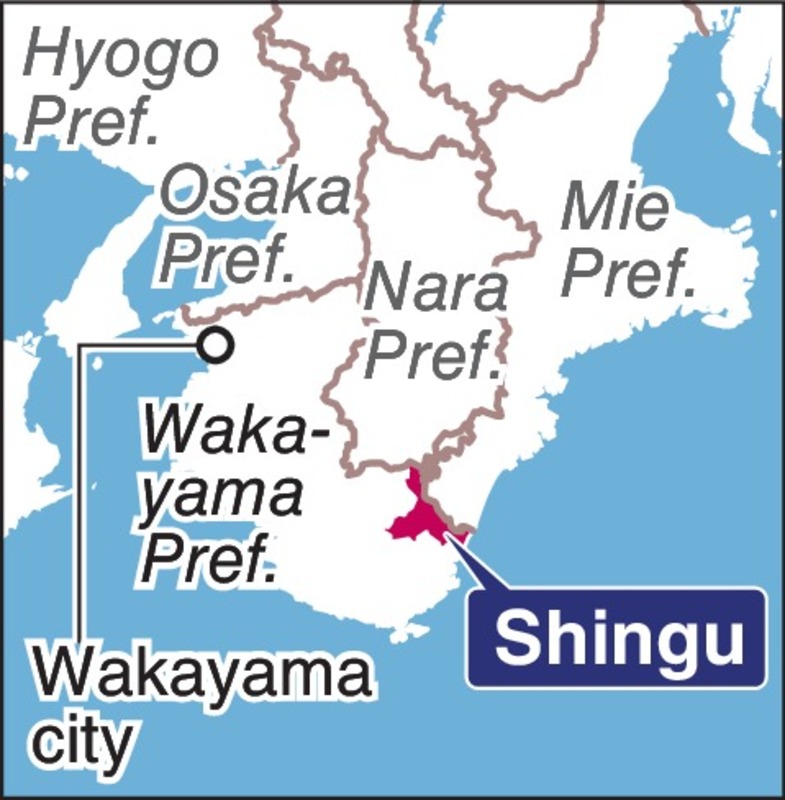
SHINGU, Wakayama -- Deep in the mountains of Shingu, a city in the southeastern part of the Kii Peninsula, a red-roofed building has undergone a remarkable transformation that is injecting life into a small, secluded community.
The building now houses "bookcafe KUJU," a bookshop and cafe open on weekends and national holidays. It opened five years ago in what was formerly Kuju Elementary School, which was scheduled to be demolished until cafe owner Tetsuya Shibata had a flash of inspiration and came to the rescue. Getting to Kuju from JR Osaka Station takes about five hours by train and car, and its reputation as "Japan's most out-of-the-way bookshop" has become a magnet for visitors. Each year, about 5,000 people travel to this settlement with only about 30 residents.
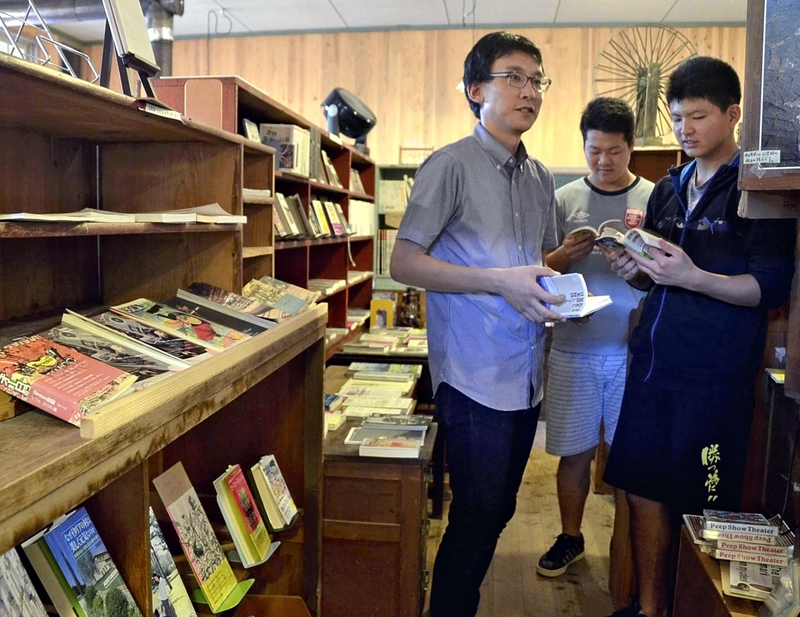
The old wooden school desks and shelves inside the bookshop are filled with about 1,000 titles in diverse genres ranging from philosophy to outdoor activities to lifestyle. Visitors can browse through these books while drinking coffee made with beans roasted in the adjoining cafe.
"It's like coming to a different world," said Yosuke Tatsumi, a 27-year-old company employee who drove for seven hours from Shizuoka Prefecture to visit the bookshop in early October. "It was a long way to come, but I'd like to come again."
Shibata, 34, was born in Wakayama and studied regional vitalization at Hitotsubashi University's graduate school. In April 2011, he moved to Shingu, where a friend was living. "Rather than making proposals from a big city, I want to put what I learned into action in a rural area," Shibata said.
In September that year, 88 people died or went missing in floods that devastated parts of Wakayama, Nara and Mie prefectures. Shibata helped the many volunteers who flocked to the region from across Japan to help clean up houses affected by the floods. During the cleanup in Shingu, Shibata heard about the plan to demolish the wooden school building, which had been flooded almost to its ceiling.
The school closed in 2005 due to a decline in the number of students. As Shibata looked out a classroom window at the river and mountains, an idea jumped into his head: This would be a great place to read books. By chance, he stumbled on a plank bearing the names of 60 residents who had made donations to build the school in the Meiji era (1868-1912). The thought that he had apparently been entrusted to carry on the sentiment of these donors filled him with emotion.
"The school building supported the area's community spirit. If we make it into a comfortable space, people will come here," Shibata said. He negotiated with the city government to have the demolition plan canceled and urged residents to help him make effective use of the building. With the backing of residents, including local district head Kazuo Jo, Shibata established Yama no Gakko, a nonprofit organization that operates the facility.
"It would be great if some life returned to the area," recalled Jo, 69, a former student of the school.
The organization borrowed the building for free from the city government for use as a regional center for exchanges and activities.
The city budget and other sources covered the cost of materials for the building's transformation, but most of the work itself was done by Shibata, student volunteers and architects and other acquaintances. The makeover took about one year to complete.
A bookstore in Kyoto helps choose which books to display, and makes an effort to select titles that are not available in central Shingu, which is a 40-minute drive away.
The cafe opened in November 2013 and the bookshop followed suit in May 2014. This unique shop has been featured in magazines, which has attracted young visitors from the Tokyo metropolitan area and even tourists on long-distance motorcycle trips. The facility gained another attraction when Shuji Hayashi and his wife opened a bakery inside. Hayashi, 35, also is a resident who moved to Shingu.
The facility's growing popularity encouraged local farmers to start selling vegetables and pickles on the site. A flea market is held every April, and this year's event featured 38 stalls from the prefecture -- and even further afield -- selling food and various goods.
"The school building is still standing, and everyone has been cheered by its transformation into a stylish bookshop," said Harumi Shimoji, a 68-year-old farmer.
Although sales at the bookshop are not exactly booming, profits from the cafe enable operations to continue.
"Keeping this building alive is the most important thing," Shibata said. "We're the latest chapter in this area's history. I want to make sure we pass this on to future generations as a place where locals relax and interact."
Seclusion a selling point
Some facilities and local governments are exploiting their remote locations far from big cities and other landmarks to promote themselves and attract visitors.
Kaiyodo Hobby Museum Shimanto in Shimanto, Kochi Prefecture, features a collection of popular character figurines and invites people to "make a journey all the way to this remote museum." Although the museum is a 1-1/2-hour drive from Kochi city, about 400,000 people have visited since it opened in July 2011.
The Nagano Prefecture city of Saku's claim to fame is that its mountains are home to the point in Japan furthest from any coastline. The city issues a certificate to people who visit this point 115 kilometers from the coast. The view is not especially wonderful, but more than 3,000 people have traveled there and received a certificate since records were first kept in 1997.
"Being able to claim we are Japan's No. 1 for this has been great for attracting tourists," a Saku government official said proudly.
-- Shingu, Wakayama Pref.
Situated near the mouth of the Kumanogawa river, which flows along the boundary between Wakayama and Mie prefectures, Shingu developed as a town surrounding Kumano Hayatama Taisha, one of the three Kumano Sanzan grand shrines on the Kii Peninsula. In 2004, Kumano Hayatama Taisha, the Kumano Kodo Nakahechi route that passes through Shingu and other locations were registered as a UNESCO World Heritage site under the name "Sacred Sites and Pilgrimage Routes in the Kii Mountain Range."
In recent years, Shingu has turned its lack of convenient road links, such as expressways to major cities including Osaka, to its advantage and invited more cruise ships to dock at Shingu Port. In fiscal 2017, the number of passenger ships calling at the port was double the average from the five previous years. Shingu's population was about 28,900 as of the end of September.
Read more from The Japan News at https://japannews.yomiuri.co.jp/