More than one month has passed since a foreign tourist was confirmed to be infected with measles in Okinawa Prefecture, and the disease spread to Aichi Prefecture. Overall, at least 106 people have been infected with measles nationwide since January this year.
The measles virus that originated in Japan has been eliminated. The government does not believe measles will spread across the country but has urged the public to take preventive measures, such as vaccination.
The recent spread of measles started with a male tourist from Taiwan.
"Even if he was in bad physical shape, he might have forced himself to go out because he came to Japan on a sightseeing tour," an official of the Okinawa prefectural government speculated.
The Taiwan man, who developed a fever after a trip to Thailand and then entered Japan, was confirmed to be infected with measles on March 20. The disease spread mainly to people who used tourist facilities that he had visited, and the number of infected individuals was 76 as of Friday.
With the start of the Golden Week holidays from the end of April to early May, the prefectural government put on its website an unusual message calling for people to carefully consider whether they should go to Okinawa Prefecture. The warning was particularly aimed at pregnant women and infants under 1 year old.
However, tourists to Okinawa Prefecture have already spread the disease to Honshu. The infection spread from a boy in his teens, who caught the disease in Okinawa Prefecture, to an employee of the Japanese Red Cross Nagoya Daini Hospital in Nagoya. From there it was passed on to hospital patients and people connected with the hospital.
As of Thursday, there were 11 people infected with measles in Aichi Prefecture.
The hospital has restricted its time for seeing inpatients and decided to cancel an event scheduled for May 12.
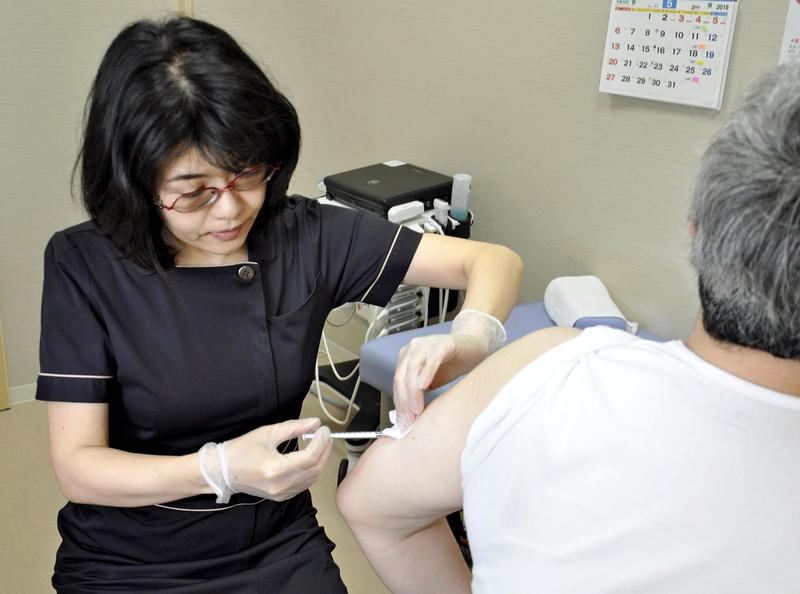
With the spread of the infection, an increasing number of people are seeking a measles vaccination. About 60 people who were planning to travel came to be vaccinated on one day at Navitas Clinic Shinjuku in Shinjuku Ward, Tokyo, according to the clinic.
A 37-year-old male company employee living in Tokyo said, "[I visited the clinic] to receive a vaccination shot so I wouldn't pass the disease on to my eldest son, who attends nursery school, or to a pregnant acquaintance."
Measles is a highly infectious disease that can be fatal in severe cases.
About 11,000 people were infected with it in 2008, but the central government strengthened its countermeasures and succeeded in wiping out the virus that originated in Japan. As a result, Japan was recognized by the World Health Organization as having eliminated measles in 2015.
The main reason for its success was the fact that the government increased the regular vaccination from one to two times. Thanks to the double vaccinations from 2006, more people developed sufficient immunity to the measles virus.
Another factor was that the government established a new system to carry out an epidemiological survey and gene test for all the cases, to confirm infection routes and the species of the spreading virus.
However, there are still many regions in the world where measles is rampant.
In Japan, measles appeared in some parts of the country due to a virus brought from abroad. In 2017, for example, a group infection of measles broke out after a man who had returned from Indonesia participated in an intensive course for a driving license at a school in Yamagata Prefecture.
More than 90 percent of the Japanese people are currently said to be immune to measles because they have been vaccinated or caught the disease at some point. The central government does not expect a nationwide outbreak of measles this time, but it is critical for people who do not have sufficient immunity to be cautious.
Some people's antibodies will not increase through a single vaccination, so it is important to be vaccinated twice.
Read more from The Japan News at https://japannews.yomiuri.co.jp/