Japan spent much of the year confronting familiar demons: its wartime conduct and economic stagnation.
The New Year celebrations had barely ended when it became embroiled in a bizarre row with China over the toxic legacy of its wartime conduct in mainland Asia.
The 26 December 2013 visit by the Japanese prime minister, Shinzo Abe, to Yasukuni – a Shinto shrine in Tokyo that honours the country’s war-dead, including 14 class A war criminals – prompted China’s ambassador to the UK to use the pages of the Daily Telegraph to charge its former enemy with revisiting its militaristic past like a “haunting Voldemort”.
The Harry Potter symbolism continued days later when his Japanese counterpart accused China of using coercion to push its claims to the Senkaku, a chain of uninhabited islets in the East China Sea (known as the Diaoyu in Chinese) at the centre of a bilateral territorial dispute. China, he said, could either observe the rule of law or “play the role of Voldemort in the region by letting loose the evil of an arms race and escalation of tensions”.
With some observers predicting a conflict that could easily draw in Japan’s main ally, the US, Tokyo and Beijing ended the year on marginally better terms when Abe held brief talks for the first time with his Chinese counterpart, Xi Jinping, on the sidelines of the Apec summit in November. Xi’s grimace as the leaders shook hands suggested, however, that tension over the Senkaku will continue to cast a shadow in 2015.
At home, Abe celebrated early successes in his quest to revive the world’s third-biggest economy – a weaker yen brought relief to exporters and share prices soared – only for Japan’s notoriously cautious consumers to refuse to stay on-message.
A controversial rise in the sales tax in April that Abe’s Liberal Democratic party had agreed to while in opposition battered consumer spending and, by November, sent the economy back into recession for the first time since 2012. Abe promptly postponed a second planned rise in the sales tax until 2017, and called a snap early election, in which he won a comfortable majority.
While Abe described the election as a referendum on his decision to focus on growth rather than Japan’s huge public debt and rising welfare costs, others spied an attempt to secure four more years in office before even more bad economic news filters through.
Early in 2015 Abe is expected to give the final go-ahead for the restart of two nuclear reactors in the country’s south-west, despite opinion polls showing that most voters, still traumatised by the March 2011 Fukushima accident, are opposed.
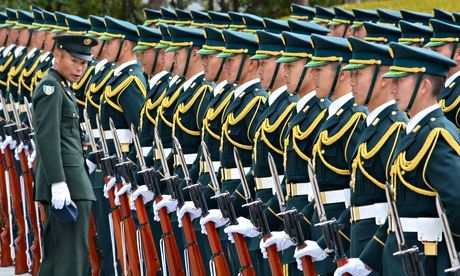
He is likely to court controversy again later in the year with plans to re-interpret Japan’s pacifist constitution to allow troops to fight alongside allies overseas for the first time since 1945. Having abandoned outright revision of the US-authored constitution, Abe insists that there is room for legislation that would lift the country’s self-imposed ban on collective self-defence, or coming to the aid of an ally under attack. A more robust military posture, coupled with a significant rise in defence spending, fuelled concerns that Japan has embarked on an unstoppable lurch to the right.
Geopolitics aside, there was plenty else to exercise the country’s embattled liberals. This month saw the enactment of a state secrets act that its supporters say will enable Japan to safely share intelligence with the US amid rising regional tensions. Under the new law, public officials and private citizens who leak “special state secrets” face prison terms of up to 10 years, while journalists who seek to obtain the classified information could be jailed for up to five years. Critics say the law will be abused to prevent disclosure of potentially embarrassing information, including any hiccups in the decommissioning of the Fukushima Daiichi nuclear power plant.
The release, in March, of Iwao Hakamada, who spent 45 years on death row for a crime he did not commit, was a reminder that Japan is one of a shrinking number of countries that enthusiastically impose the death penalty. Japan is set to defy international opinion on another contentious practice: the slaughter of whales in the Antarctic. Months after the international court of justice in the Hague halted its “scientific” whaling programme, Japan has unveiled a revised programme that could see its whaling fleet return to the Southern Ocean in pursuit of minke whales as early as the end of 2015.
The coming 12 months are likely to be marred by continued tensions between Japan and its neighbours. Abe has still not held a summit with the South Korean president, Park Geun-hye, amid a row over Japan’s use of tens of thousands of mainly Korean sex slaves before and during the second world war. Abe has stopped short of revising an official apology issued in 1993, but he and his conservative allies in politics, the media and academia deny there is any evidence that the women were coerced by Japanese imperial forces.
Relations between Tokyo and Washington will be complicated by the fraught relocation of a US marine air base in the centre of a densely populated city in Okinawa to a more remote location on the island’s unspoiled north-east coast. The relocation was thrown into doubt in November when voters in Okinawa elected a new governor who has vowed to block the move.
Abe is expected to issue a “forward-looking” statement next August to mark the 70th anniversary of the end of the Pacific war. Depending on how he addresses Japan’s conduct on the Asian mainland in the first half of the 20th century, the statement could either herald an era of regional detente or send relations with Beijing and Seoul back into the diplomatic deep freeze.