The National Governors' Association has started to participate in efforts dealing with the novel coronavirus pandemic by holding online meetings, consolidating the opinions of member governors and repeatedly making proposals to the central government. As the association's confrontational attitude toward the government has disappeared, some are concerned it will become more dependent on the government, posing a question on the decentralization of power.
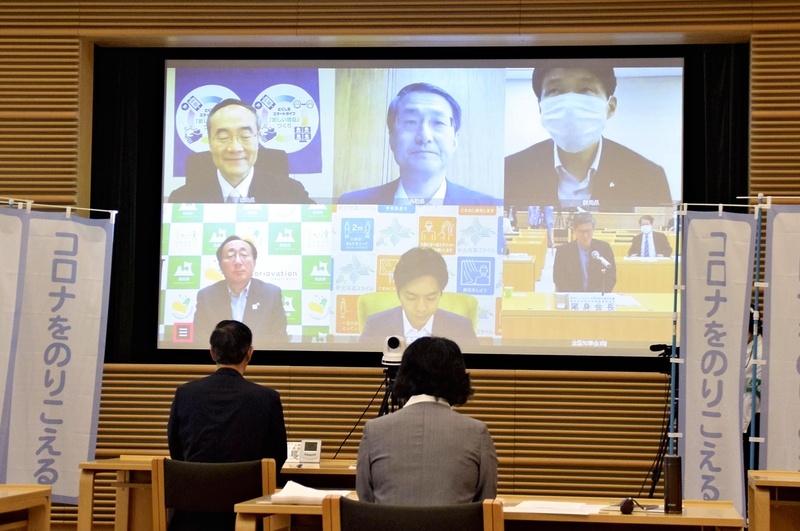
The association's coronavirus emergency task force held an online meeting on July 19 that was attended by 43 governors, who shared their opinions on a draft proposal for the government.
During the session, which lasted for at least four hours, their opinions varied from "[the government's tourism subsidy campaign] 'Go To Travel' should cover short distance trips in the beginning," to "I strongly propose that payment of subsidies to businesses for their cooperation of suspending operations be an established system."
After the meeting, on July 27, the president of the association and Tokushima Gov. Kamon Iizumi made a proposal -- based on the 43 governors' opinions -- online to Yasutoshi Nishimura, the minister in charge of economic revitalization.
Governors nationwide usually gather for only two or three meetings a year, but due to the pandemic a task force was set up in late February, with Iizumi as director-general. Ever since, according to the association's secretariat, as many as 10 meetings had been held as of Aug. 6 as an "irregular measure."
From the fifth session the meeting was transformed into a full-scale online format, which resulted in a sharp increase of governors who participated because they do not have to travel.
In dealing with the pandemic, local governments are inevitably required to take initiative, which has brought the governors working on the front line into the spotlight.
The revised law on special measures against new strains of influenza grants governors authority to ask local residents to refrain from going out, and ask or instruct operators to limit the use of facilities under a state of emergency declared by the government.
The association of governors has also attracted attention to its role of collecting opinions from front-line workers, who deal with problems related to the virus, increasing governors' motivation to attend its meetings.
Never missing a chance to submit requests to cabinet members, the association drafts a proposal for the government after each meeting and its task force alone has submitted 11 to date.
The association proposed that the compensation payment to businesses that comply with the request to suspend operations should be a package, which was approved as cooperation money to be allocated as special local governments subsidies for regional revitalization. The central government's second supplementary budget for fiscal 2020 added 2 trillion yen in special subsidies to local governments for regional revitalization, securing a total of 3 trillion yen.
--'We are of the same mind'
The association, originally known as the National Federation of Local Government Councils in 1947, was renamed the current name in 1950.
Then Gifu Gov. Taku Kajiwara, who became president of the association in 2003, increased the association's presence under the slogan of "The Association of Fighting Governors" in discussions on the so-called trinity tax reforms and fiscal reform of the central and local governments.
The association confronted the central government with an increase in "reformist governors," including then Iwate Gov. Hiroya Masuda, and submitted a list of central governmental subsidies that it believed should be abolished, starting a movement to demand the transfer of tax revenue sources to local governments.
However, in recent years and to a certain degree, the association's movements have become formalities that are sometimes cynically dubbed as "salon-like gatherings" and "routine office meetings."
Although member governors occasionally bear different opinions to the central government, the association rarely opposes in response to the virus. Thus, the association has made a cooperative alliance with the central government under the slogan of "We are of the same mind as that of the central government."
"Our role is to make practical policy proposals to the central government and realize them together," Iizumi said.
However, there is a critical view on the association's attitude toward the central government as indicated by the remark "Why not stop being dependent on the central government, up to detailed matters?" said Wakayama Gov. Yoshinobu Nisaka.
Looking back on the association's efforts to pursue decentralization of authority, some people say the association should share local governments' proactive, independent projects and support them, rather than be dependent on the central government.
"The purpose of the association is not to repeatedly present detailed petitions to the central government," said Yoshihiro Katayama, a Waseda University professor specializing in local autonomy and then governor of Tottori when the association dubbed itself as The Association of Fighting Governors.
Katayama also said: "The association should return to the principle of equal decentralization of authority for state and local governments and present legal basis for measures to deal with the pandemic, and demand that the government bear expenses under Local Government Finance Law."
--Conflicting opinions, ambiguous proposals
The National Governors' Association has not always been monolithic. Member governors sometimes have conflicting opinions, which mainly stem from whether they represent urban or rural areas.
The association manages to maintain its unity in efforts dealing with the pandemic by incorporating minority opinions into proposals, which however, tend to make them ambiguous.
"It reads, '[The coronavirus pandemic] has revealed risks mainly caused by a unipolar concentration of everything in large cities.' But this is a matter that must be tackled by every party concerned. I request this part be deleted," Tokyo Gov. Yuriko Koike said in a strong tone at an online meeting that the association held on May 20, referring to the contents of a draft for an urgent proposal to the central government.
Although many other governors requested that the excessive concentration of population and other elements in Tokyo be rectified, the draft was toned down to state: "Considering the influence on social and economic activities by the coronavirus pandemic, we have recognized once again the importance of reducing and avoiding risks caused by a unipolar concentration of everything in large cities among other problems."
With regard to introducing a school year that starts in September in response to school closure during the spread of the virus, 17 governors adopted a message on April 28 that demanded the central government to consider introducing the new school year system. The message, however, was downplayed as many governors were cautious about introducing it at an association meeting held the next day. The association, as a result, only requested that the government conduct "a solid discussion on a nationwide scale."
Iizumi said, "There is a method of compiling opinions that only have a point of compromise. But regarding the virus, we should consolidate the opinions and needs of all governors who are directly responsible, so the central government can more easily deal with it. I don't think taking this approach makes the points of our proposals ambiguous."
A thorough review of the association's work will be necessary when infections are brought under control.
Read more from The Japan News at https://japannews.yomiuri.co.jp/