China, Russia, and North Korea’s de facto alliance risks creating a "new world order” which could lead to Tokyo facing a three-front contingency in the future, a report released by a think tank of Japan’s defence ministry said.
The China Security Report 2026, released by the National Institute for Defence Studies (NIDS) in Tokyo, argued that the strategic partnership among the three countries is becoming increasingly assertive, though marked by internal imbalances.
It noted that “although a formal military alliance among the three countries has not been formed, they have already built a de facto coordinated relationship that functions as a strategic bloc in key areas”.
It comes as Japan’s relations with China deteriorated to its worst levels in years. Japan’s new prime minister Sanae Takaichi recently sparked a controversy after she said a Chinese attack on Taiwan threatening Japan's survival could trigger a military response. Beijing demanded she retract the remarks and urged its citizens not to travel to Japan, resulting in mass cancellations that could deal a sizeable blow to the world's fourth-largest economy.
The report noted that China is expanding its political and military influence while Russia’s war in Ukraine has driven Moscow into a tighter embrace with both Beijing and Pyongyang.
North Korea, meanwhile, is leveraging the geopolitical turbulence to advance its nuclear ambitions and gain greater independence from any single patron.
“North Korea has become capable of confronting the United States on its own by securing more independent options through enhanced deterrence,” it said.
The report quoted Zhang Tuosheng, a senior research fellow at the Grandview Institution, saying that North Korea developing its nuclear capabilities will “trigger a domino effect” in the medium to long term.
It will lead to the nuclearisation of Japan and the South and, as a result, an “all-out collapse” of the international nuclear non-proliferation regime, he said.
“By conducting joint military exercises and patrols with Russia, China has sent signals to other parts of the world while examining its own military and operational capabilities,” said Masayuki Masuda, the lead author of the report.

These joint military actions by Russia, China and North Korea may create “worrisome situations for Japan” through their coordinated actions, it said.
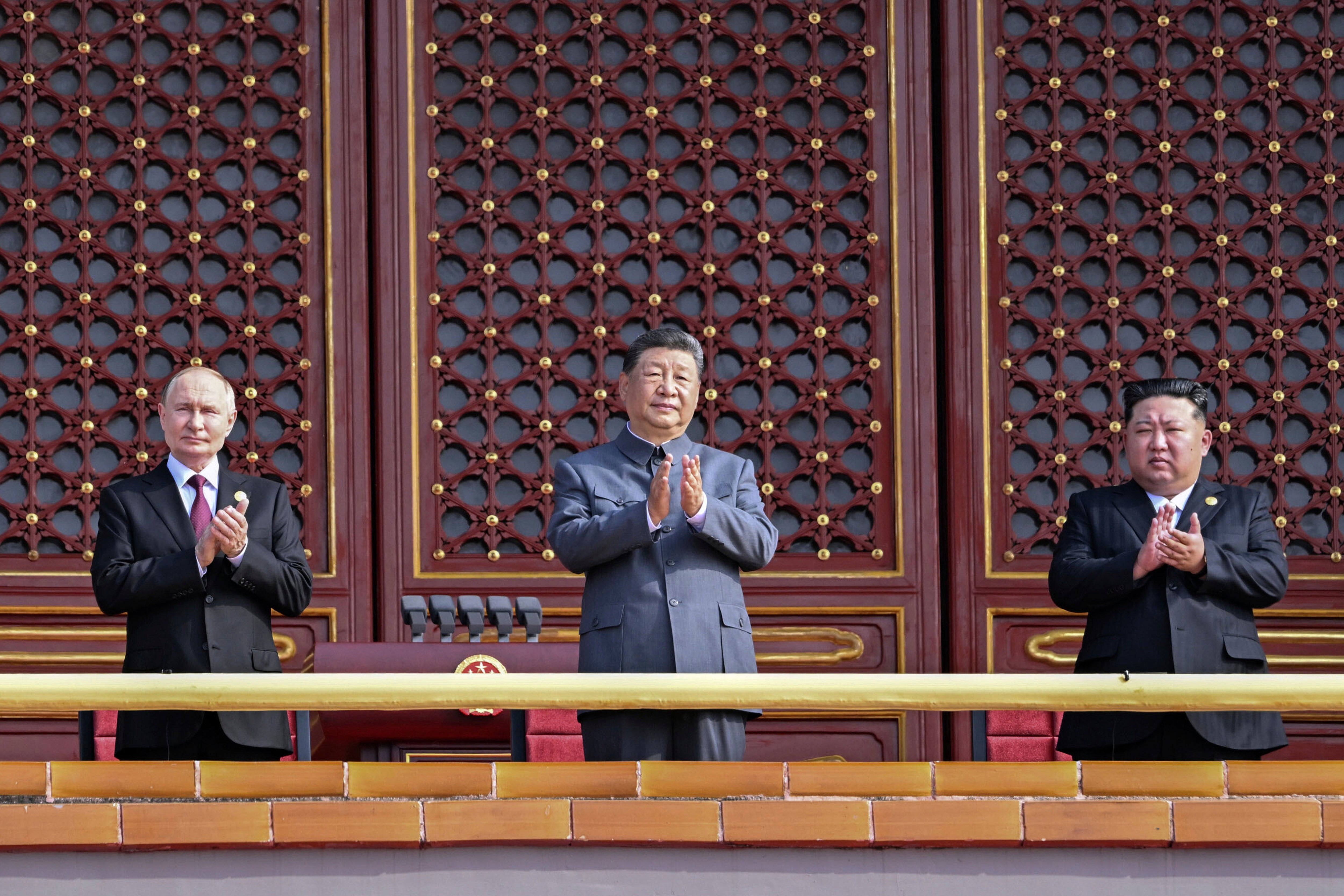
Chinese leader Xi Jinping, North Korean dictator Kim Jong Un, and Russian president Vladimir Putin stood shoulder-to-shoulder for the first time on 3 September as they attended a massive military parade in Beijing.
It was the first time for Mr Kim, Mr Xi and Mr Putin, all key challengers of the US, gathered at the same venue.
Russia has become North Korea’s foreign policy priority since Moscow launched a full-scale invasion of Ukraine and has been supplying troops and ammunition to support the war in exchange for economic and military assistance.
Analysts say that Mr Kim is also seeking to restore ties, as China is North Korea's biggest trading partner and aid benefactor, and he would want to brace for the end of the Russia-Ukraine war.
“The joint appearance of the Chinese, Russian, and North Korean leaders at the Tiananmen viewing platform on September 3 is anticipated to act as a momentum for trilateral strategic coordination,” the report said.

“As a result, Northeast Asia may see an intensification of a Japan-US-ROK versus China-Russia-North Korea bloc confrontation dynamic,” it said, referring to South Korea with its official name.
The report urged policymakers to prepare for a world where China exerts greater global influence, Russia remains unpredictable and militarised, and North Korea operates with increasing confidence under the protection of two major powers.
The report warns that Japan must now prepare for a potential three-front contingency, with simultaneous pressure from China, Russia and North Korea.
It says the three states are expanding military coordination and acting more assertively around Japan’s periphery, creating the risk of overlapping crises. This emerging security environment, it argues, could stretch Japan’s defences in ways not seen since the Cold War.
Underground Christian pastors arrested in China during latest religious crackdown
China used India-Pakistan conflict to conduct ‘first real-world’ test of its weapons
China announces blanket ban on all Japanese seafood imports
China and Japan relations ‘on knife’s edge’ over Taiwan, experts warn
Oysters are dying off in huge numbers in Japan. Nobody knows why
One killed and at least 170 homes damaged as huge fire tears through southern Japan