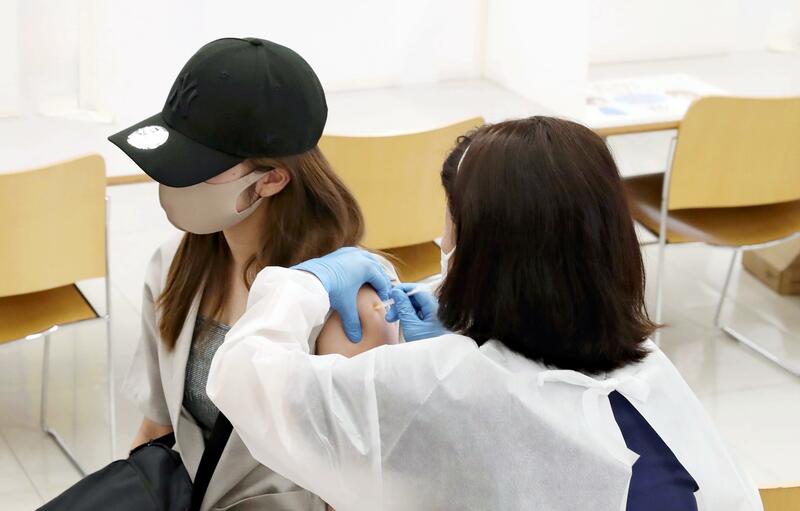
The government has put the brakes on coronavirus vaccinations at companies, due to a rush of applications for the program that exceeded expectations. This has led to a dilemma in which companies and universities are calling for applications to start being accepted again soon, but municipalities are increasingly dissatisfied with what they see as the negative impact on their distribution of vaccines.
"We should consider accepting applications for workplace vaccinations again as soon as possible," a Liberal Democratic Party team working on vaccine-related measures said Friday in a proposal to the government.
Team leader Toshiharu Furukawa, a member of the House of Councillors, stressed the significance of the proposal, saying, "If more and more people are vaccinated at their workplaces, local governments will not have to administer as many shots. "
Municipalities give top priority to the vaccination of the elderly. Expectations are high for the program to vaccinate the working generations at workplaces, as the percentage of young people among those newly infected with the virus is increasing in Tokyo and elsewhere.
The Japan Chamber of Commerce and Industry also asked the government on Thursday to hasten inoculations at small and midsize firms, which are still waiting for their applications for the program to be approved.
The government began accepting applications for workplace vaccinations on June 8. Demand was initially estimated at only "tens of thousands of shots per day," according to a Cabinet Secretariat official.
Inoculations by municipalities using vaccine manufactured by U.S. firm Pfizer Inc. were considered as the main pillar of inoculation efforts, while workplace vaccinations using vaccine made by U.S. firm Moderna, Inc. were seen as secondary.
However, the government was ultimately flooded with applications for workplace shots, as companies were highly concerned about their employees possibly becoming infected. There also were municipalities that set up vaccination venues using Moderna products, in response to the government's target of 1 million shots per day.
With applications exceeding the 50 million doses of Moderna vaccine that it had secured by the end of September for use at workplaces and municipal facilities, the government was forced to stop accepting applications after about two weeks.
Applications were received for 36.42 million doses to be administered at workplaces, and the government is scrutinizing those that had not yet been approved. It plans to reduce the number of vaccinations if necessary.
The government plans to use Pfizer vaccine instead of Moderna for applications related to vaccination venues set up by municipalities. On June 30, Prime Minister Yoshihide Suga summoned Taro Kono, the minister for regulatory reform who is also responsible for the vaccination program, and ordered him to increase the number of Pfizer doses to 12 million from 7 million.
Local governments are concerned about a shortage of Pfizer products. Hidekiyo Tachiya, mayor of Soma, Fukushima Prefecture, and the head of the Japan Association of City Mayors, submitted an urgent request on Thursday to the government, saying, "There is a problem of competition between inoculations by local governments and workplace vaccinations."
The request emphasized that "priority should be given to municipal vaccinations, which would be distributed more widely and more fairly."
Municipalities are apparently concerned about moves related to workplace vaccinations, as the number of Pfizer vaccine doses sent to local governments is expected to decrease from this month.
Osaka Gov. Hirofumi Yoshimura and others met with the prime minister Friday and asked for the priority supply of vaccines to urban areas where the risk of infections spreading is high. The intensified bargaining over vaccines shows that efforts to inoculate the public through various channels are now in full swing.
-- Companies, universities affected
Universities, companies and organizations that have applied for the workplace vaccination program are busy dealing with the stoppage.
A total of 392 universities have applied for the inoculation program, according to the education ministry, and the government has ordered enough vaccine for the schools. However, the timing for shipping vaccine to the universities is unknown as the government is unsure when the vaccine will be imported.
Seijo University in Tokyo was planning to start vaccinations in mid-July, but was informed by the health ministry on June 24 that "it might be difficult for the university to start inoculations as projected."
A university employee in charge of public relations said, "Students have only four years of college life. We hope to resume face-to-face classes as soon as possible [by fully vaccinating the students]."
Nihon University in Tokyo postponed vaccinations that were scheduled for June 29 to July 2.
"I'm wondering if I can visit my family during the holidays," said a 20-year-old junior studying law.
Japanet Holdings Co., a major mail order company based in Sasebo, Nagasaki Prefecture, suspended new reservations for workplace inoculations at venues in Fukuoka and Nagasaki cities because the government did not deliver some vaccine the firm had requested. Japanet Holdings was vaccinating workers at four sites and said it will halt the inoculation program altogether when the vaccine runs out.
Workers at small and midsize companies are also being affected.
According to the Japan Chamber of Commerce and Industry, 99 chambers of commerce and industry nationwide as of Friday have applied for the workplace vaccination program encompassing about 560,000 people, including employees of member companies.
The requests of seven chambers have been green-lighted, while approval is pending at 92 others, covering about 500,000 people.
Some are blaming the government for a lack of foresight.
"The government should have known that many companies would apply for the vaccination program," said an employee at a major tech company. "I wonder why the government couldn't have foreseen vaccine shortages."
Read more from The Japan News at https://japannews.yomiuri.co.jp/