The government has created its first manual to clarify the division of responsibility among the central government, local authorities and other parties regarding the removal of waste generated as a result of typhoons and other disasters.
The move was prompted by the massive flooding that has repeatedly occurred in recent years, in which the disposal of large amounts of waste, including inundated homes and furniture, has interfered with communities' swift recovery.
By clarifying different parties' roles, the government is seeking to facilitate the smooth disposal of waste and lighten the burden on the Self-Defense Forces.
The manual lays out the operations to be carried out by parties including municipal and prefectural authorities, related ministries and agencies, and volunteers. It also names their responsibilities in different time periods, such as 1) before a disaster occurs; 2) from a disaster's occurrence through one week later; and 3) from a disaster's occurrence through one to three weeks later.
Municipal authorities are stipulated as the central figure in the disposal of disaster-generated waste, and the manual is based on the premise that municipal authorities will coordinate with relevant organizations.
Specifically, municipal governments will select in advance candidate sites for the temporary disposal of waste, and within one week of a disaster's occurrence will form a contract with a private waste-removal company. This measure was prompted partly by past disasters when municipal authorities prioritized the burden on their finances, and the formation of a contract with a private company was delayed as a result.
Regarding the volunteers who enter a municipality after a disaster, they will be asked to concentrate their efforts in regions where work can be carried out using small vehicles on community roads and elsewhere.
Prefectural governments, for their part, will be responsible for supervising such matters as coordination with other local governments and the overall progress of waste disposal.
In cases where large amounts of waste are expected to be generated, the Environment Ministry will handle such tasks as dispatching "on-site support teams" and advising municipal governments about fiscal relief measures.
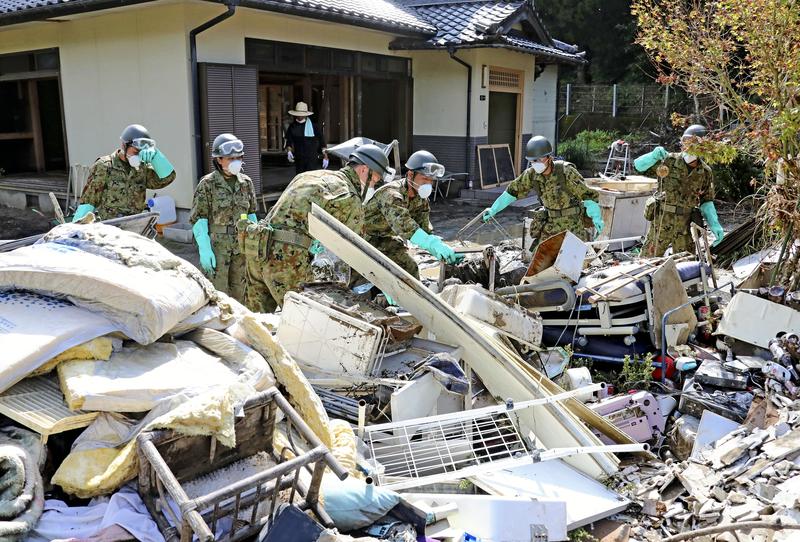
The SDF focuses on rescue efforts immediately after a disaster. It generally transitions after about a week to measures such as removing waste from major roads and other locations where large vehicles can be utilized, and helping to transport large waste that is difficult to move around, such as tatami mats and furniture.
The manual was created partly to ease the burden on the SDF, which has been increasingly dispatched to disaster sites in recent years. In fiscal 2018 an aggregate of 1.19 million personnel were dispatched, and 1.06 million were sent out in fiscal 2019, marking the first time for this figure to exceed 1 million for two consecutive years.
Disaster-related dispatches typically increase around autumn, which overlaps with the period during which the SDF holds large-scale exercises. There have been concerns that if the SDF's operational duties continue to increase, it may be difficult to maintain its proficiency.
Read more from The Japan News at https://japannews.yomiuri.co.jp/