Japan's leading gas companies have been making serious efforts to reduce their CO2 emissions.
In one of the most recent cases, Osaka Gas Co. and INPEX Corp. announced on Oct. 15 that they will jointly conduct a trial run of "methanation," which involves the production of synthetic methane using retrieved CO2. The resulting methane will be supplied to general households and factories.
The gas industry has set a goal of bringing the net CO2 emissions from city gas to zero in 2050. Gas companies are therefore expediting their efforts to introduce technological innovations to produce environmentally friendly next-generation gases.
-- 8% of all CO2
According to the Environment Ministry, the city gas industry currently emits 81 million tons of CO2 annually, accounting for 8% of the national total. Gas is used widely, including by ordinary households, so how much emissions can be reduced will be key to progress in the decarbonization efforts.
The industry will put particular effort into the production of synthetic methane through methanation. It will use a catalyst to synthesize CO2 that has been retrieved from factories and elsewhere with hydrogen produced through renewable energy, and thereby manufacture synthetic methane, the main component of city gas.
Although CO2 will be emitted when city gas is combusted, methanation can be viewed as effectively offsetting CO2 emissions because carbon dioxide is used as a raw material. The Japan Gas Association has set a target of replacing 90% of gas with synthetic methane by 2050.
-- Enough for 10,000 households
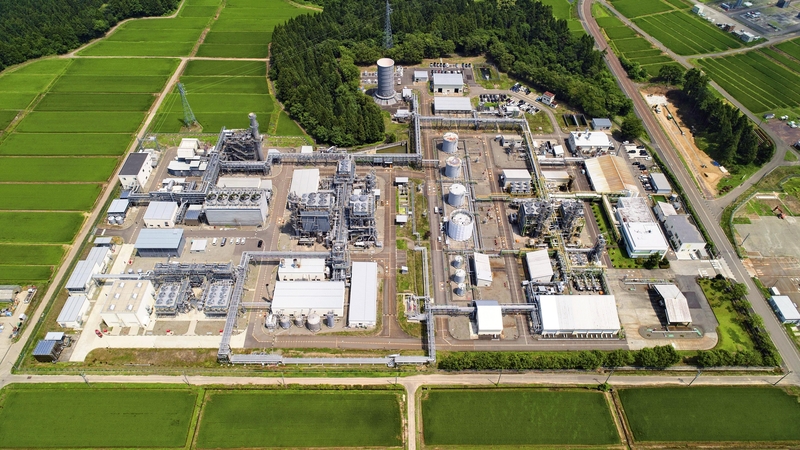
The joint scheme by INPEX and Osaka Gas will use CO2 extracted from INPEX's gas field in Nagaoka, Niigata Prefecture. Osaka Gas will cooperate with INPEX regarding the technology related to the catalyst needed to produce synthetic methane, drawing on the knowledge it has accumulated through its production of city gas.
The production of synthetic methane will begin as early as the second half of fiscal 2024, supplying gas to general households and factories. The production capacity of the CO2 methanation facility to be developed for the joint endeavor is expected to reach approximately 400 cubic meters per hour, or enough to supply about 10,000 households.
This would be one of the largest operations in the world under current standards.
"We want to take a step forward in concrete technical development, thereby bringing it to commercial application," Tadashi Miyagawa, an executive vice president of Osaka Gas, said at a press conference.
Tokyo Gas Co. has been conducting research on synthetic methane in Tsurumi Ward, Yokohama. The company plans to use CO2 retrieved from factories and offices in local communities, and aims at annually supplying 140 million cubic meters of synthetic methane. This is expected to constitute 1% of the total amount of gas it will sell in 2030.
In addition to the production of synthetic methane, Toho Gas Co. is also tackling the use of hydrogen as fuel, deemed effective in decarbonization. In May, the company launched a trial run in which hydrogen is used as fuel in a heat treatment process for manufacturing metal components at automobile plants and elsewhere.
Hydrogen does involve the risk of combustion, so the company is aiming to determine how it can be utilized safely.
-- Cost reduction
The production cost of synthetic methane is about 350 yen per cubic meter, eight times that of natural gas, while hydrogen costs about 100 yen per cubic meter. To enable wider use, it is vital to cut production costs through technological innovation.
International University of Japan Prof. Takeo Kikkawa, an expert in the energy industry, said: "For the propagation of synthetic methane and hydrogen, technologies that go beyond the framework of gas companies will be needed -- in order to utilize renewable energies, for example. There will have to be concerted efforts that transcend such industrial boundaries as oil and electricity."
Read more from The Japan News at https://japannews.yomiuri.co.jp/