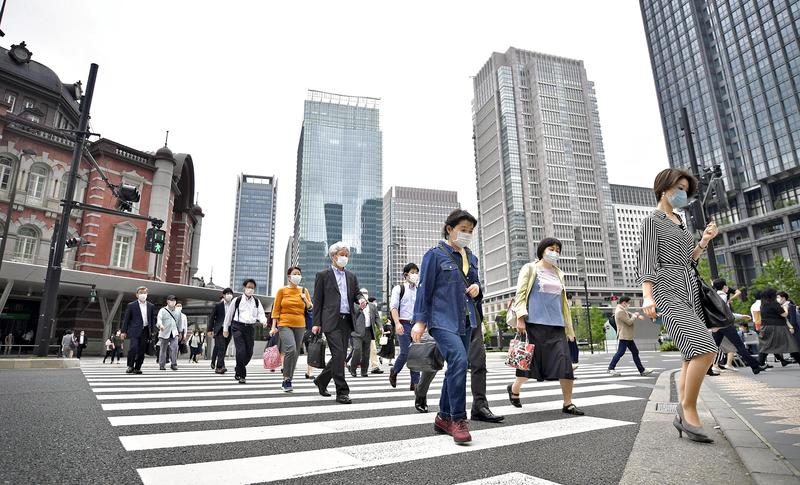
Although the state of emergency put into place amid the spread of coronavirus infections has been lifted across the board, the way that corporations carry out their day-to-day activities may never return to their former state. The sudden, widespread implementation of teleworking has led to companies exploring new modes of operation, meaning that working from remote locations could be here to stay.
Beyond a precaution against a possible new wave of infections, some corporations are recognizing that working remotely could enhance their employees' performance even after the coronavirus is brought under control.
Hitachi, Ltd. announced on Tuesday that it will make the practice of teleworking the new standard mode starting next April. The company aims to accelerate its shift toward better human resourcw es management by attaching more emphasis to actual performance and expected results.
By the end of July, employees will go to the office only once or twice a week. Meanwhile, a nesubsidy will be established to provide each worker 3,000 yen a month to offset heating and lighting expenses incurred by working at home in June. The company will also support workers' purchases of equipment such as monitors and desks needed for them to telework.
Hidenobu Nakahata, a representative executive officer who held a press conference online Tuesday, pointed out, "In order to become a company with global leadership, it is indispensable for workers to enhance their productivity without being tied down by time and place."
LINE Corp. will introduce on a trial basis a new system in which all of its employees go to the office "once a week" starting June 8. The company said the move is aimed at exploring new modes of working, through which employees will be able to work efficiently and achieve greater results.
Fujitsu Ltd. has announced that from May 26 it will institute the practice of teleworking as a basic workstyle for the time being, with the number of workers coming to the office held down to a maximum of around 25%.
Fujitsu President Takahito Tokita, in a message to the employees, said, "Even after the infections are deterred, we will not return to our former state," emphasizing the company's intention of reexamining how its offices should be run and reviewing the commuting practices of workers.
Toshiba Corp. will raise the upper limit of workers in its offices to 60% from the hitherto 40%, while continuing to have employees "work at home as a principle."
Nissan Motor Co., Mitsubishi Chemical Corp., and Sumitomo Corp. will also recommend their employees to work at home.
Sapporo Holdings Ltd. will stagger its employees working in the office by days of the week and time periods during the day to halve the number present in each section starting in June. NYK Line has set a target of lowering the number of people in the office to less than 20% until June 14.
Softbank Corp. has approved visits between those in charge of sales and marketing and corporate clients traveling directly from and to their home without going to the office.
Companies in the insurance industry, whose sales and marketing activities have always been basically conducted face to face, are hurrying up their switchover to more internet usage.
Mitsui Sumitomo Insurance Co. from May 26 onward adopted a sales method mainly utilizing the internet and telephones to make proposals for new contracts and cultivate new clients. Meiji Yasuda Life Insurance Co. has decided for fiscal 2020 to not set sales targets for its sales and marketing staff. The company aims to explore new sales and marketing methods that make wider use of the internet.
Along with the spread of teleworking, however, there are inevitable changes afoot in the demand for office space in urban areas.
According to Sanko Estate Co., a leading office brokerage company, the vacancy rate of offices in five wards in central Tokyo in April stood at 0.48%, up by 0.07 percentage point from the previous month. This accounted for companies that returned their negotiations on new contracts back to square one and those that have reduced their office floor space.
The Japan Research Institute, Ltd. has made a provisional calculation that if 10% of all workers continue teleworking, the vacancy rate of offices in urban areas could rise to nearly 15%.
Read more from The Japan News at https://japannews.yomiuri.co.jp/