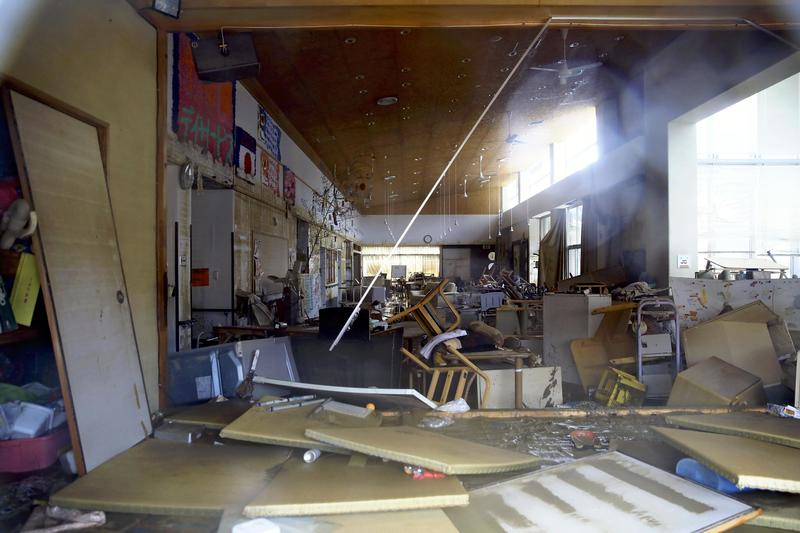
KUMAMOTO/TOKYO – The deaths of 14 residents in a special nursing home for the elderly in the village of Kuma, Kumamoto Prefecture, once again sheds light on the importance of prompt evacuation.
Fourteen people living in the facility, called Senjuen, were killed by flooding caused by torrential rains in the prefecture. For facilities that house many people who find it difficult to evacuate on their own, responding to disasters present a challenge.
"I participate in disaster drills every year, but I couldn't save everyone. The rains were unprecedentedly heavy," said a 72-year-old man from the neighborhood, who helped evacuate the facility's residents early Saturday.
The special nursing home was founded in 2000. It is a two-story building located near a branch of the Kuma River. According to an official of the home, two officials on night shift sensed danger when they heard the roar of the river. They started to evacuate the 65 residents, many of whom were wheelchair users. Neighbors who support the home arrived, and several people worked together to lift each resident in his or her wheelchair to the second floor using the stairs. In the midst of the evacuation, a window suddenly broke and water flooded in. Elderly people waiting on a table on the first floor were swept away.
The special nursing home is located in an area where as much as 10 to 20 meters of flooding can be expected, and the flood control law requires that it have an evacuation plan to specify evacuation routes and other issues and conduct disaster drills. According to the Kumamoto prefectural government and the Kuma village office, the facility had created an evacuation plan and conducts disaster drills involving neighbors twice a year to evacuate to a higher place outside the building.
The second floor where residents were being evacuated to has a space of about 130 square meters, smaller than the first floor, which is about 2,230 square meters. There was no ramp connecting the first and second floors, so it apparently took longer to evacuate residents. "We couldn't do anything," a nursing home official said sadly.
--Elevator stopped
When there are wheelchair users, bedridden people and those with dementia at facilities for the elderly, evacuation takes time.
During Typhoon No. 19 last October, about 70 residents on the first floor of a special nursing home for the elderly in Nagano were forced to evacuate to the second and third floors as the water level rose in a nearby branch of the Chikuma River.
Most of the residents could not move on their own, so the staff used an elevator to move them upstairs on beds. However, the elevator stopped due to a power outage. For this and other reasons, it took about 2-1/2 hours to evacuate all of them. The first floor of the building eventually flooded to waist height.
--Immediate response needed
In August 2016, river floods caused by Typhoon No. 10 killed all nine residents in a group home for people with dementia in Iwaizumi, Iwate Prefecture. Following the incident, the central government revised the flood control law. Under the revised law, in areas that can expect flooding, facilities for the elderly, people with disabilities and others that are designated by relevant municipal governments as facilities for persons requiring special care are required to create evacuation plans and conduct evacuation drills.
The central government set a goal of having all designated facilities create evacuation plans by the end of fiscal 2021. However, as of the end of March 2019, of 67,901 facilities that are obliged to make such plans, only 35.6% have done so.
Read more from The Japan News at https://japannews.yomiuri.co.jp/