Despite being a liquor indigenous to Okinawa Prefecture, most brands of awamori are now actually distilled from Thai rice. The central government has decided to promote awamori made from rice harvested in Okinawa Prefecture, hoping to start shipping in 2020.
It also will promote branding of awamori made with domestic rice and sell it abroad in the future.
Production of the distilled liquor is believed to have begun sometime in the late 15th century under the Ryukyu Kingdom, using locally cultivated short-grain rice. That production lasted until around the Meiji era (1868-1912).
However, long-grain rice creates a more full-bodied, aromatic awamori than the short-grain variety. In the Taisho era (1912-1926), long-grain Thai rice began being imported to Japan, and the production of awamori from that rice became mainstream starting in the Showa era (1926-1989). Currently, over 90 percent of more than 1,000 awamori brands are made from Thai rice.
As part of efforts to promote the prefecture's agriculture, in fiscal 2018 the central government used its budget for the development and promotion of Okinawa Prefecture to launch a trial cultivation of the long-grain Yumetoiro rice variety, which is considered to be good for making awamori, to verify whether the crop is suitable to Okinawa's climate. Since December last year, awamori distillers in the prefecture have been making awamori with the rice on a trial basis.
The government hopes local farmers can begin cultivating Yumetoiro this summer. Mitsuhiro Miyakoshi, minister of state for Okinawa and northern territories affairs, will soon visit the prefecture to ask local agricultural cooperatives, brewers' associations and municipalities for cooperation.
Although Yumetoiro has a higher yield per unit area than more commonly used rice, it also fetches a lower price. For that reason, the government must obtain farmers' understanding to move ahead with production.
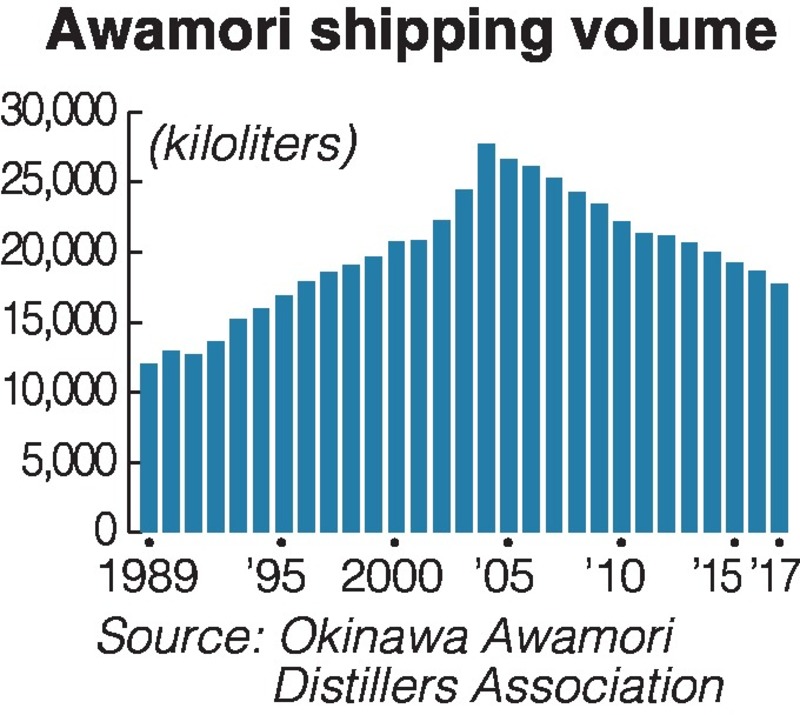
According to the Okinawa Awamori Distillers Association, shipment of awamori peaked at 27,688 kiloliters in 2004 during an awamori boom. Volumes have since declined to 17,709 kiloliters in 2017, or 60 percent of the 2004 peak, due to such factors as awamori's declining popularity among young people.
Read more from The Japan News at https://japannews.yomiuri.co.jp/