International students and technical intern trainees with permission to stay more than three months in Japan have been again allowed to enter the country as the Japanese government on Thursday eased entry restrictions for foreigners that were imposed due to the novel coronavirus outbreak.
Despite some arrival quarantine requests that may be problematic for some, the move is a welcome break for international students who have not been able to enter Japan for a long period of time. Japanese language schools and other accepting organizations have also hailed it.
--Hope is in sight
For new arrivals, entry permission has been restricted to part of those coming for business purposes from eight countries and regions including Thailand and Vietnam. From Thursday, foreigners permitted to stay more than three months can enter Japan regardless of where they come from.
Regarding international students, only government-financed students had been allowed to enter Japan since August. Now privately financed international students will be able to enter.
"I am very glad that the border is now open," said an 18-year-old Thai student in her first year at the Ritsumeikan Asia Pacific University who is currently taking online classes from home in Bangkok. "I can finally study in Japan."
She was supposed to begin studying at the university's campus in Beppu, Oita Prefecture, in April, but has not been able to enter Japan since outbreak-related clamps were put in place.
While the young woman is strongly hoping to come to Japan as soon as possible, it is likely to take some more time.
This is because the government asks foreign entrants not to use public transportation for two weeks after their arrivals, and it will be difficult for her to reach the university from the airport by herself without using public transportation.
The university plans to pick up international students at Fukuoka International Airport and other places starting in late November.
In another case, a 28-year-old Filipino who aims to work in Japan as a technical intern trainee in welding said that hope was in sight now. This summer, he planned to start his training at a shipyard in Ehime Prefecture but gave up the plan due to the entry restrictions. Following the recent lifting of restrictions, he will apply for technical intern training again. "For my future, I put importance on working in Japan," he said.
--More govt information wanted
Japanese language schools and other organizations across the country welcome the lifting of restrictions.
The Narita International Japanese Language School in Tomisato, Chiba Prefecture, planned to accept 12 new students in April; 10 of them have not been able to enter Japan.
For the two new students, the school holds in-person classes, but these do not generate enough revenue to meet labor and other operating costs.
"Without tuition fees, we are in a very difficult financial situation," a school official said. Due to this uncertainty, the school has refrained from recruiting new students for the next fiscal year.
"Now that we can expect foreigners to enter Japan, we would like to make preparations for recruiting new students," the school official said.
At the Sendai International School of Japanese in Sendai, where about 180 international students are enrolled, about 100 of them have stayed in their own countries and other places.
"International students have no access to detailed information," the principal of the school said. "I hope the government will provide more and detailed information."
Foreign workers with the residence status of specified skilled worker will be sequentially allowed to enter Japan. According to the Agriculture, Forestry and Fisheries Ministry, about 4,100 foreign workers, including technical intern trainees, in the fields of agriculture and fisheries, have not been able to enter Japan.
The JA Yotei agricultural cooperative in Kutchan, Hokkaido, planned to hire 17 Vietnamese workers with the specified skilled worker status in May.
"We cannot secure enough workers from local residents alone, so we really appreciate the lifting of entry restrictions," an official said.
A vegetable sorting factory, which was supposed to accept foreign workers, coped with the busy season in August by hastily hiring local residents and others. In the winter skiing season, many of the workers are highly likely to flow to resort areas.
"We are relieved that there are prospects of foreign workers entering Japan," a factory official said.
--Airport strengthens quarantine
The government basically asks foreigners entering Japan to take tests for the coronavirus, self-isolate for two weeks at hotels and other places and secure accepting companies and organizations, among other requests. Because of the present limitations on coronavirus testing capacity, the government has capped the number of foreigners entering Japan to about 1,000 per day.
According to the Health, Labor and Welfare Ministry, prior to the lifting of the entry restrictions, three major airports -- Narita, Haneda and Kansai -- have established a system to conduct a total of 10,000 tests a day. In addition, New Chitose Airport, Chubu Airport and Fukuoka Airport are enhancing testing equipment and making other preparations.
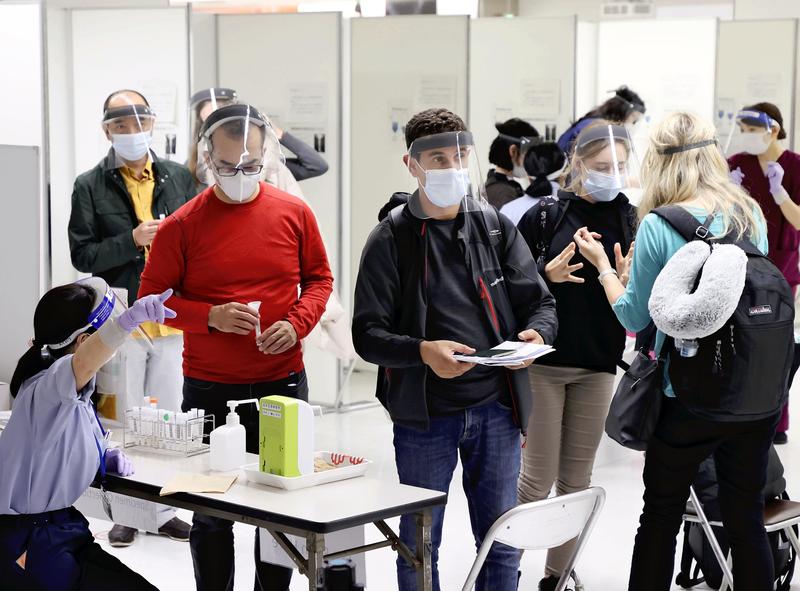
At the end of July, Narita Airport started to implement saliva-based antigen tests. Pictures of lemons and umeboshi salted plums are put up at the testing booth to help passengers create saliva more easily.
The health ministry asks foreign entrants to self-isolate for two weeks at hotels and other places and check their health conditions using the free communication app Line, but ensuring the effectiveness of these measures is an issue.
"If they fail to follow the self-isolation request, the government could disclose the names of accepting companies and organizations concerned," said Health, Labor and Welfare Minister Norihisa Tamura at a press conference on Sept. 25.
Read more from The Japan News at https://japannews.yomiuri.co.jp/