This is the third installment of a series.
In China, a professional soccer club uses as its guiding principle the "Okada Method," a manual based on the team-building philosophy of Takeshi Okada, 61, the former manager of the Japan national soccer team.
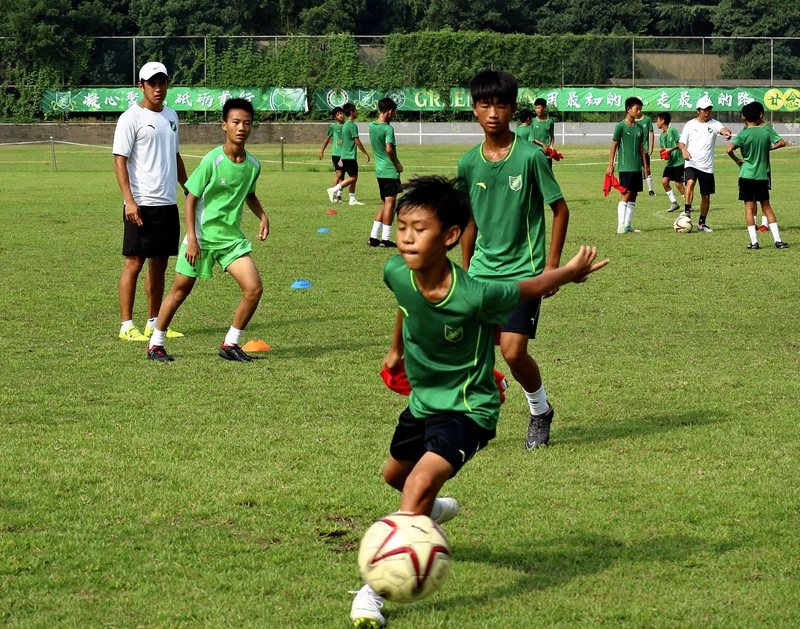
The club is Zhejiang Greentown FC based in Hangzhou, Zhejiang Province, which Okada managed for two years through 2013. The team is the only Chinese club to have a contract with the Japan Football League club owned by Okada, FC Imabari, based in Imabari, Ehime Prefecture. Thus, Zhejiang Greentown employs six full-time Japanese assistant coaches to instill in the team the Okada Method, which emphasizes players thinking for themselves.
Chinese President Xi Jinping, who is known to be an enthusiastic soccer fan, has been implementing soccer reforms (see below) at the level of national policy to turn the country into a soccer superpower.
However, Tomoyoshi Ikeya, 56, who became the assistant coach of Zhejiang Greentown's under-age-13 team two months ago, was shocked by the many issues he encountered upon his appointment. Even the U-13 players, who are supposed to be elite soccer players among children their age, "had not been seriously taught the fundamentals and appeared to have never thought about the meaning of plays and tactics."
Japanese assistant coaches believe that in the background lies the adverse effects of cramming for competitive entrance exams, which has been spurred on by the country's reform and opening up policy. Takeshi Ono, 56, who supported Zhejiang Greentown along with Okada, felt that coaching in China was often dictatorial.
"This is especially inappropriate for soccer as it is important for players to think and move on their own," Ono said clearly.
Wang Weisheng, 29, who is responsible for player development for the U-13 team, feels the effects of the Okada Method. It is the third year since the method was introduced and the youth teams can now match up competitively against Japanese teams of the same age group.
In addition to Zhejiang Greentown, roughly 30 Japanese people coach at academies of clubs in Chinese provinces like Guangdong and Hebei. In some parts of the soccer world, expectations are rising for the Japanese style to supplement educational systems.
Soft power policy lags
The Xi administration also aims to strengthen China's cultural influence in the world by becoming a superpower in terms of cultural soft power. But like its soccer policy, its cultural policy is encountering problems.
China's domestic anime and manga, which play a role in strengthening cultural aspects, are surely technically advanced. But for a long time they had been criticized for being simple and lacking in creativity in terms of story development and character settings when compared to Japanese productions.
For Zhu Jingxuan, 12, who is in his first year of junior high school, the purpose of visiting ChinaJoy, a video game trade show that was held in Shanghai in early August, was the Japanese anime figures. He spoke very highly of Japanese anime because "it is very easy to understand what the creator wants to express," while he pays no attention to Chinese anime because "it feels poorly made."
However, among youngsters born in the 2000s, known as the "post-00s generation," there is a shift in attitude to try to take in the Japanese works, which past generations have adored, and use them to produce their own creations.
In June this year, a male student in his third year of high school in the southern city of Zhuhai, Guangdong Province, visited Sogen Miyazaki, 31, to seek his advice. Miyazaki is a popular internet celebrity based in Shanghai and posts computer graphics characters on a video-sharing site.
In between studying for exams, the student had used computer graphics to create a video of a male high school student character in a school uniform dancing to music and posted it to a video-sharing site. Miyazaki, who is well-versed in Japanese-Chinese subculture, sensed his potential and stated, "He was doing things that we do as a team all by himself, basically. Maybe he can create a character that will be popular even in Japan."
In this subculture, signs seem to be showing of a transition from a one-way relationship -- Japan teaching and China learning -- to a new relationship, in which Japan and China learn and grow together.
-- Soccer reform
A master plan announced in March 2015 calls for increasing the number of elementary schools, junior high schools and high schools that include soccer as part of its athletic curriculum from 5,000 in 2015 to 50,000 in 2025. Long-term goals include hosting the World Cup in China and having the national team qualify for the World Cup and Olympics.
Read more from The Japan News at https://japannews.yomiuri.co.jp/