About a quarter-century ago, there existed an international financial institution named the Asian Development and Investment Bank Association (ADIBA).
In addition to Japan, which played a key role in its establishment, development banks from countries including South Korea and Singapore participated in this organization, which was principally aimed at supporting China. At the time, China suffered a lack of investment capital. Though the flow of investment has been reversed, ADIBA can be said to be a prototype of the Asian Infrastructure Investment Bank (AIIB) (see below), a Chinese-led organization established in 2016.
Japan's financial know-how
"China will need funds for use on infrastructure," said Yo Kurosawa, then president of the Industrial Bank of Japan, or IBJ, (now Mizuho Bank Ltd.), who proposed in 1994 the establishment of ADIBA to Liu Mingkang, deputy governor of the China Development Bank (CDB). Talks proceeded productively, and ADIBA financed such projects as the development of Shanghai's Pudong district, a centerpiece project under the administration of then Chinese President Jiang Zemin.
However, personnel changes within CDB among other factors caused ADIBA's new financing to get tied up. After around four years, ADIBA gradually ceased to exist.
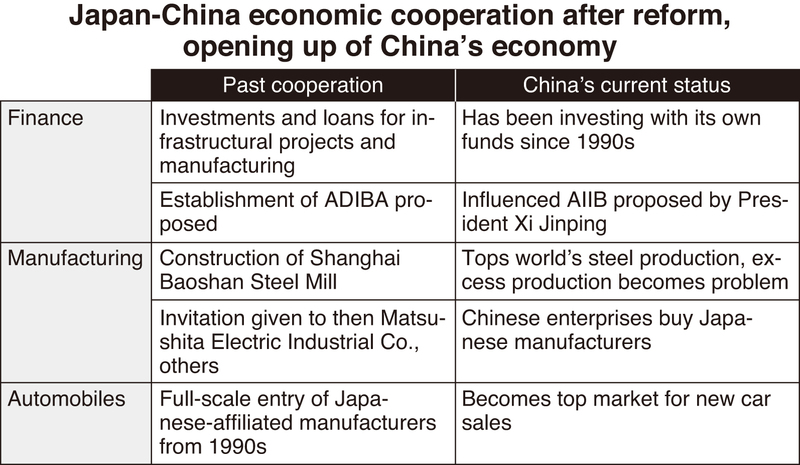
Shinichiro Kanno, who has held several posts such as IBJ's Shanghai branch manager, said, "ADIBA's philosophies are extensively used by the Chinese side."
A Chinese employee who was in charge of operations in China back then also stated with certainty: "A great number of former CDB employees joined AIIB when it was founded. There is no doubt they are still benefiting from the experience and knowledge gained from ADIBA."
Financial cooperation between Japan and China goes back to the era of Mao Zedong before the reform and opening up of the Chinese economy. It was Japanese people who taught the finance-challenged Chinese authorities very basic financial knowledge such as interest rates and depreciation.
This Chinese-Japanese honeymoon period, which Isao Okubo, former director at the Bank of Tokyo Ltd. (now MUFG Bank Ltd.), recalls as "an extremely close-knit financial collaboration," contributed to educating China to the point that it can lead an international financial institution.
Studying U.S. trade friction
The administration of Chinese President Xi Jinping is now facing trade friction with the U.S. administration of Donald Trump and is again trying to learn from what Japan experienced.
Zhang Jifeng, deputy director of the Chinese Academy of Social Sciences' Institute of Japanese Studies, highly evaluates Japan's alleviation measures when trade friction occurred between Japan and the United States, such as by relocating the country's automobile factories to the United States and utilizing technological innovations to increase the added value of its products.
"[Japan] conveyed talks smoothly under unfavorable conditions and kept its losses to a minimum," Zhang said.
The Xi administration has kept stressing a non-conciliatory posture toward the United States, but still wants to avoid a direct confrontation that could damage its domestic economy. Chinese diplomatic sources have said they are "now seriously studying past Japan-U.S. trade friction."
Learning from each other
The Chinese economy has long used the Japanese economy as one of its models. Now, however, an increasing number of people in Japanese financial circles are eager to learn from China.
Japanese business missions flock to a symbol of China's economic reforms -- Shenzhen, Guangdong Province -- and visit famed companies such as Tencent Holdings Ltd., developer of messaging app WeChat, the so-called Chinese version of Line. Some companies were so overwhelmed by the volume of requests for company visits that they began collecting fees for visits.
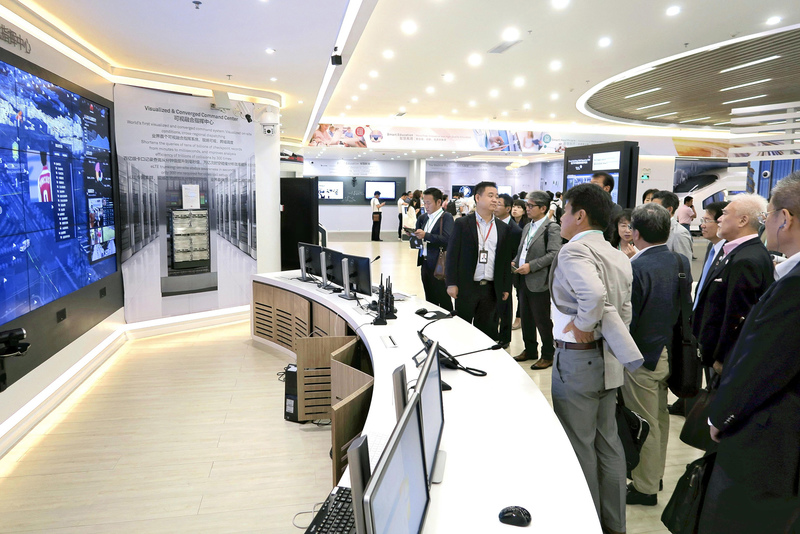
In July, a delegation from the Osaka Chamber of Commerce and Industry visited the headquarters of China's largest smartphone firm, Huawei Technologies Co., and was impressed with technologies such as their crime prevention system combining surveillance cameras with facial recognition technology.
One of delegation's members said with a sigh, "We need to change our stereotype that Japan is ahead of China in technological innovation."
China has voraciously absorbed Japan's experience and technology and made them its own. Some private companies in China in such fields as information technology have vitality that can surpass Japan's. The day may soon come when Japan adopts technology developed by China.
-- Asian Infrastructure Investment Bank (AIIB)
An international financial institution formed upon Chinese President Xi Jinping's proposal to raise the investment fund for infrastructure in areas surrounding China. AIIB has loaned or invested over 5 billion dollars so far. It also aims to support the Belt and Road Initiative spearheaded by the Chinese government to create a huge economic zone. AIIB currently has 87 member states and regions, but among the Group of Seven advanced nations, Japan and the United States are not participating.
Read more from The Japan News at https://japannews.yomiuri.co.jp/