This is the fourth installment of a series.
A group of Chinese men dressed in jeans and T-shirts is sitting at a bar in a busy downtown area of Shanghai. Flanked by hostesses and drinking wine, the men chat for a while before a man in a suit brings out a thick file that preoccupies them.
"I'll buy this one."
"Not interested in that one."
After some time spent flipping through the pages, the men pick up their wine glasses again as if nothing much had happened.
Someone linked to a Japanese company observed the scene of well-to-do Chinese on the equivalent of a bakugai (see below) shopping spree. The file was filled with information on small- and medium-sized Japanese manufacturers for sale. "The price for one such company is over a billion yen. That seems to be pretty cheap shopping for them. And it seems that they go on to make a profit by reselling these companies," the observer explained.
The Chinese government is also keeping an eye on Japanese companies, which have a high level of technical expertise and a diligent labor force. According to the Chinese chief executive officer of a company in Beijing that does Japan-related business, China's sovereign wealth funds "seek to purchase 51 percent or more of shares for companies whose market share ranks within the top five" and they are putting a great deal of effort into searching for Japanese companies suitable for purchase.
In recent years, Toshiba Corp. has sold its television business and household appliances business to Chinese companies.
In Hokkaido, which is popular among Chinese tourists, the Chinese investment company Fosun Group bought Hoshino Resorts Tomamu in 2015, and since then, resort development based on Chinese capital has grown throughout the prefecture.
Chinese capital has been buying up companies in its pursuit of Japanese brand power and quality and is now concentrating efforts on entering sectors such as Japanese mobile phones and automobiles, which have not yet been tapped due to reasons such as fierce competition.
China's Huawei Technologies Co. and Oppo Electronics Corp., which rank among the top five companies in the global smartphone market, have a combined Japanese market share of less than 10 percent, but they are strengthening their offensive.
By the end of last year, the Shenzhen automobile manufacturer BYD Co., which sees Japan as an "important market," had sold a total of 17 electric buses in Kyoto and Naha, building a foothold for its future business development.
The influx of Chinese people into Japan is also increasing.
The population of Chinese people living in Japan numbered 730,000 as of the end of 2017 -- the largest demographic of foreign residents in Japan. The number of people becoming naturalized Japanese citizens is also changing, with around 3,000 people per year in recent years.
Beijing-born Hiromasa Yuminaga is an executive of a Japanese company in Changzhou, Jiangsu Province. Yuminaga, his wife and his daughter hold Japanese citizenship. They were naturalized in 2002 while living in Osaka Prefecture. One of the major reasons is the appeal of the ease of living in Japan.
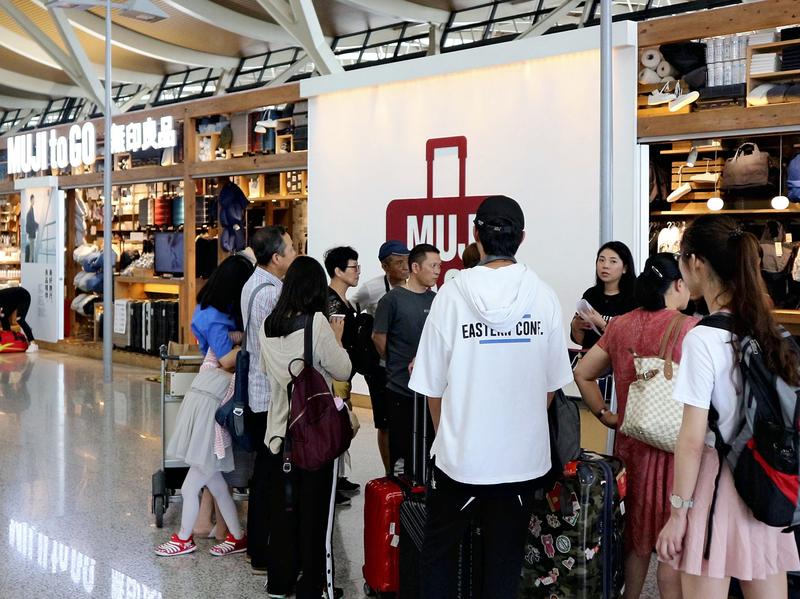
The Japan travel boom is also continuing. Last year, Chinese visitors to Japan hit a record high of approximately 7.36 million people. Yuminaga, who is currently living in Shanghai for work, said, "My sense is that, from the perspective of Chinese people, the "walls" that stand between China and Japan are dropping in height each year."
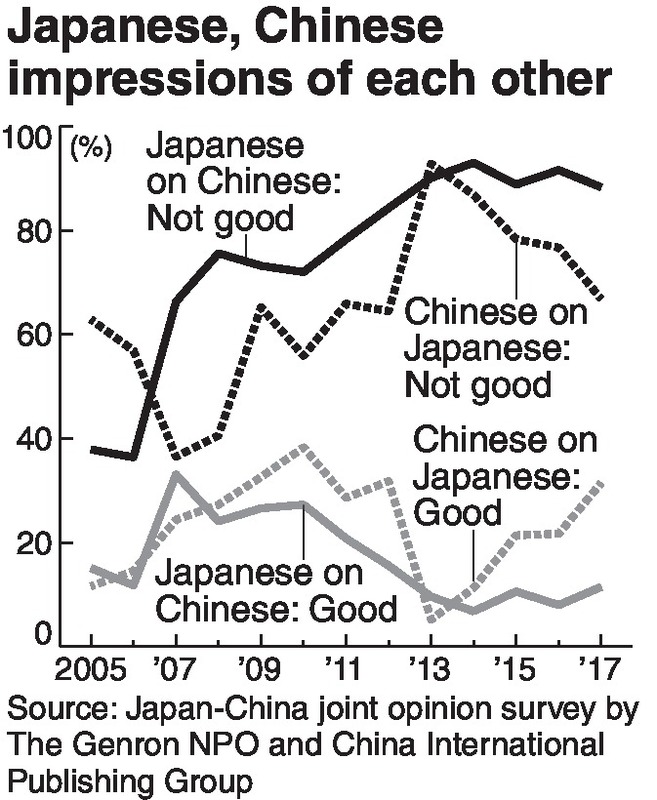
A Japan-China joint opinion survey released at the end of last year revealed that 31.5 percent of Chinese people held a positive image of Japan, representing a 9.8 percentage-point increase over the previous year.
Meanwhile, the same survey revealed that only 11.5 percent of Japanese had a positive image of China, and the number of people with negative impressions of China is still high at 88.3 percent.
With various factors such as a dislike for China's hegemonic behavior in the international community, the "walls" between Japan and China are still high from the perspective of Japanese people.
At the intergovernmental level, Japan-China relations are improving. The next step is how to lessen the sense of emotional distance. The true value of rapprochement is at stake.
-- Bakugai
Bakugai, or shopping frenzy, is an expression used to describe the bulk purchasing of electronics and cosmetics by Chinese tourists in Japan that was selected as the 2015 Word of the Year. According to the Japan National Tourism Organization, the per capita spending of Chinese tourists in Japan was 284,000 yen in 2015, significantly higher than the average tourist spending of 176,000 yen per person. However, Chinese travelers have been visiting Japan for more diverse reasons and the amount of money spent by Chinese tourists subsequently saw a drop in 2017, with 230,000 yen spent per capita.
Read more from The Japan News at https://japannews.yomiuri.co.jp/