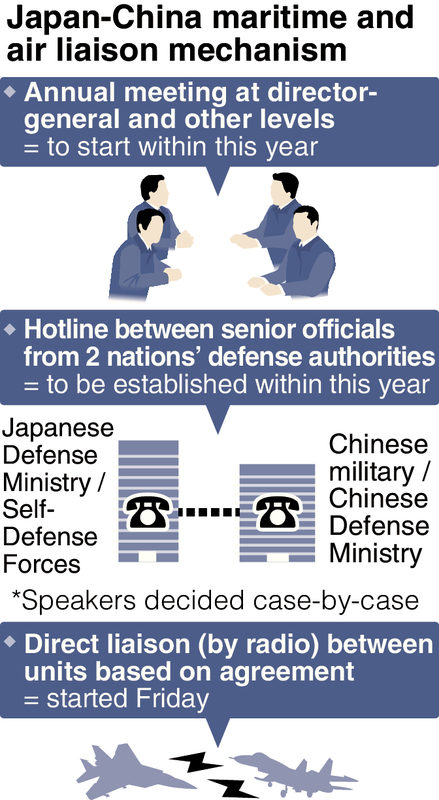
The Japanese and Chinese governments on Friday officially started operating a bilateral maritime and aerial communication mechanism designed to avert unintended clashes between the Self-Defense Forces and the Chinese military.
The mechanism includes enabling military ships and aircraft to directly communicate by radio at sea and in the air, establishing a hotline connecting senior defense officials by the end of this year and holding regular meetings between defense officials.
"This is extremely significant in that it will help prevent unexpected clashes," Katsutoshi Kawano, chief of the Joint Staff and the highest-ranking SDF officer, said regarding the communication mechanism at a press conference Thursday.
The Maritime Self-Defense Force and the People's Liberation Army Navy currently directly communicate based on the Code for Unplanned Encounters at Sea, an international standard stipulating procedures for avoiding accidental clashes.
Although the Air Self-Defense Force and the People's Liberation Army Air Force have no official agreement on communications between them, they do communicate at their discretion.
However, there have been confirmed cases of Chinese military aircraft not responding to SDF radio messages during encounters in the sky above territorial waters around Japan.
The communication mechanism will not involve any changes to how this communication is conducted. But given that it has become part of an agreement between the leaders of Japan and China, "The Chinese military will probably take it more seriously and abide by it," a senior Japanese Defense Ministry official said.
This enhanced communication with the SDF looks set to make it much easier to confirm the intentions of flights and navigation routes taken by the Chinese military.
The hotline, which will be the first established between Japanese and Chinese defense authorities, is a centerpiece of the communication mechanism. Which senior officials speak on the hotline will not be decided in advance. Rather, this will be determined following a discussion on the situation.
Both sides also agreed Japan and China will alternate the hosting of yearly meetings between director-general or deputy director-general level officials, as well as meetings for section-chief level officials. The first meetings will be held this year.
Establishing the communication mechanism was first agreed upon at a 2007 Japan-China summit meeting. However, negotiations did not proceed smoothly due to friction over the Senkaku Islands in Okinawa Prefecture and disagreement over whether waters and airspace around the islands would be subject to the mechanism. Ultimately, both sides compromised and the mechanism does not include any specific geographic references.
In May, Prime Minister Shinzo Abe and Chinese Premier Li Keqiang agreed during their talks to start operating the mechanism.
Read more from The Japan News at https://japannews.yomiuri.co.jp/