LONDON -- Japan and Britain agreed in substance on most areas of their new trade agreement on Friday, aiming to reach a broad agreement by the end of August to resolve all issues.
The new bilateral trade agreement accompanies the United Kingdom's departure from the European Union, and is expected to be in line with the contents of the economic partnership agreement (EPA) between Japan and the EU.
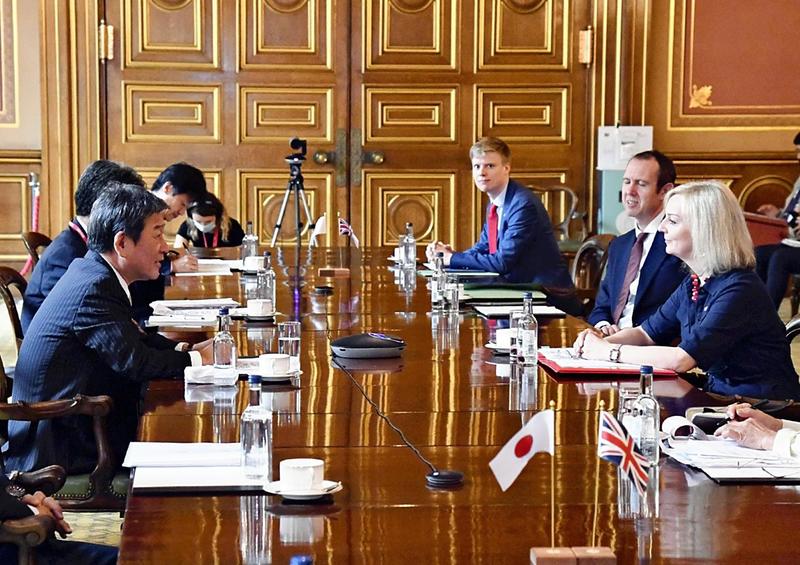
Foreign Minister Toshimitsu Motegi and his British counterpart Elizabeth Truss held their second day of meetings Friday. They are believed to have mainly discussed Japan's demand for the early elimination of tariffs on automotive products and Britain's demand for preferential tariffs on agricultural products.
At an online press conference after the meeting Friday, Motegi said, the new agreement "will lead to further expansion of trade and investment." Truss, the British secretary of state for international trade, said in a statement that the negotiations were positive and productive and that the two sides reached consensus on the major elements of the deal.
The Japan-EU EPA, which came into effect in February 2019, is currently being applied to trade between Japan and Britain as it is the transition period following Britain's withdrawal from the EU. Under the agreement, tariffs on passenger cars exported from Japan will be reduced to zero in 2026, the eighth year after the agreement came into force. The current situation is likely to be maintained.
Tariffs on automobiles and other industrial products exported from Japan to the Britain are expected to be abolished in the future, as in the case of the Japan-EU EPA. The impact on Japanese automakers such as Toyota Motor Corp. and Nissan Motor Co. is expected to be small.
Meanwhile, preferential tariffs for agricultural exports from Britain to Japan are expected to be limited. Britain has asked Japan to set new quotas for imports of some dairy products and malt at low or zero tariffs.
The rules in the digital sector, including electronic commerce, are expected to protect consumers while maintaining a high degree of freedom for companies.
The Japanese and British governments hope to reach a broad agreement at the end of August and sign the agreement as early as this autumn, after the text of the agreement is finalized. Tokyo aims to put the deal into effect in January after gaining Diet approval. If the transition period after Britain's withdrawal from the EU is extended amid tough negotiation over their trade agreement, the effectuation of the trade agreement between Japan and Britain will be delayed.
Read more from The Japan News at https://japannews.yomiuri.co.jp/