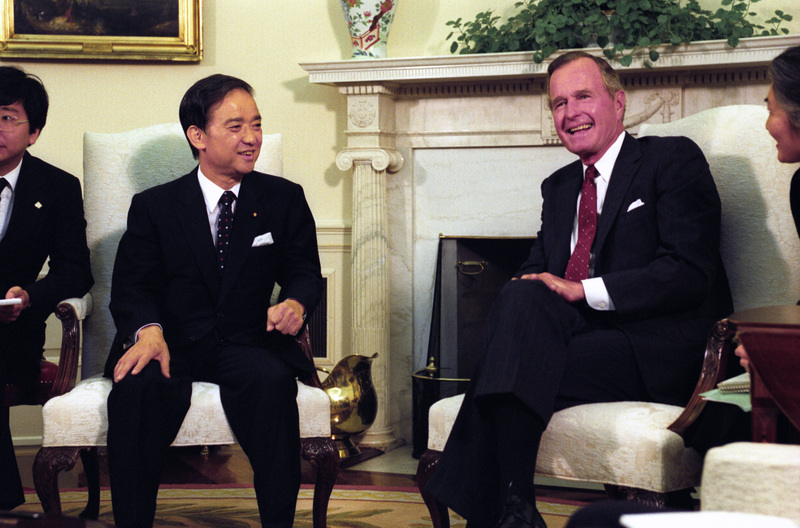
In preparation for the first summit between Prime Minister Toshiki Kaifu and U.S. President George H.W. Bush on Sept. 1, 1989, the Japanese government requested the U.S. government not to mention its NCND policy, under which it neither confirmed nor denied the existence of nuclear weapons even to its allies, according to a diplomatic document released on Wednesday.
This policy was established by the United States in the 1950s to enhance its nuclear deterrent.
In May 1989, a U.S. magazine reported that a U.S. Navy carrier-based aircraft carrying a hydrogen bomb had fallen into the sea and sunk in waters near Okinawa in 1965.
The Japanese government made the request apparently because opposition parties had raised suspicion that nuclear weapons might have been brought to Japan when the aircraft carrier made a port call.
According to the document, at a meeting of the two countries' officials on Aug. 30, an advisor to the U.S. president proposed that the president would state the NCND policy is essential to ensure nuclear deterrence.
The Japanese government expressed disapproval, saying the draft of the comment by the president was undesirable in many ways. In response, the U.S. government insisted that at least the defense secretary should mention it.
In Japan, the ruling Liberal Democratic Party suffered a crushing defeat in House of Councillors election in July 1989 due to a bribery scandal involving the Recruit company and other negative factors, resulting in a situation in which the opposition parties held a majority in the upper house. Just after the LDP's defeat, Prime Minister Sosuke Uno resigned and Toshiki Kaifu became his successor in August.
The United States is believed to have understood Japan's difficult political situation and eventually accepted Japan's request. No specific reference was made to the NCND policy, not just during the Japan-U.S. summit meeting on Sept. 1, but also at the meeting between Kaifu and Defense Secretary Dick Cheney.
"After the accidental [plane] sinking, there was growing suspicion in Japan that the United States had brought nuclear weapons to Japan. The United States might have wanted to say, 'We can't tell you [about the existence of nuclear weapons] because we have the NCND policy,'" said Prof. Takashi Shinobu of Nihon University, who specializes in Japan-U.S. diplomatic history.
Read more from The Japan News at https://japannews.yomiuri.co.jp/