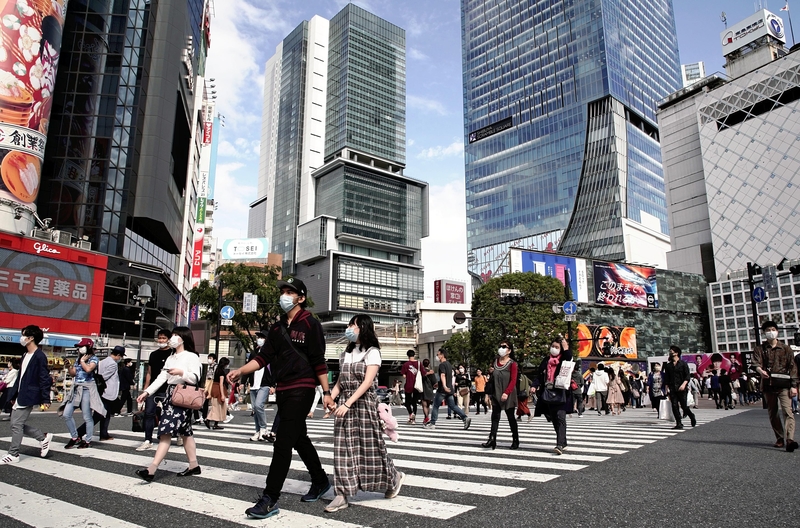
The government is making final arrangements to lift the state of emergency to prevent the spread of the new coronavirus on Monday in Tokyo and other areas, as long as there are no major changes in the situation.
With the number of infections and other factors improving, the state of emergency is expected to be fully lifted in Tokyo, Kanagawa, Chiba, Saitama and Hokkaido before the initially scheduled end date of May 31.
The criteria for doing so are based on a comprehensive assessment of factors including the status of infections, the health care system and the surveillance system, including PCR testing.
Regarding the status of infections, the standard for new cases is about 0.5 per 100,000 people or less in the previous week. Tokyo had only two new infections Saturday. In the most recent week of May 17-23, there were 0.29 infections per 100,000 people, which meets the standard.
As of Friday, Tokyo's health care system had 42 severe cases in 400 beds available for these patients, an occupancy rate of 10.5%. Its capacity for PCR testing is 3,100 per day, which is seen as sufficient, as the most ever conducted in a day was about 1,800.
Tokyo Gov. Yuriko Koike said at a press conference Friday that if the state of emergency is lifted Monday, she would likely start relaxing business closure requests from midnight Tuesday.
"We want to get back to normal as quickly as possible, while balancing infection control with socioeconomic activity," she said.
Infection figures in Chiba and Saitama prefectures meet the standard at 0.10 and 0.20 per 100,000 people, respectively. Both prefectures have enough beds for severe cases and have made progress in establishing testing systems.
The number of infections per 100,000 people in the four metropolitan prefectures is 0.34.
Kanagawa Prefecture is the only one to be above the standard at 0.70 infections per 100,000 people. However, as of Thursday its hospital bed occupancy rate for severe patients was 31.4% and it could perform 600 to 700 PCR tests per day, indicating the situation is not critical.
The number of infections is also above the standard in Hokkaido at 0.63 per 100,000 people, but the bed occupancy rate for severe cases is only 15 percent and it can perform about 1,000 PCR tests per day.
"As long as they are close to the standards, we can rescind the order for [the metropolitan area and Hokkaido] all at once," a senior government official said.
At a press conference Saturday, Economic Revitalization Minister Yasutoshi Nishimura, who is in charge of the new coronavirus taskforce, said that new infection data and other factors "are trending positively" in the five prefectures.
On Monday, the government is expected to present policies for lifting the order to the Advisory Committee on the Basic Action Policy. If these are deemed appropriate, Prime Minister Shinzo Abe will submit a report to the Diet, hold a press conference to explain the policies to the public, and then make a final decision at a meeting of the government's coronavirus response headquarters.
Concerned about the coronavirus? Look for information and contact numbers here if you suspect you have contracted the virus and are exhibiting symptoms.
PLEASE NOTEThe Japan News is providing this story for free to help all readers keep informed about the coronavirus.
Read more from The Japan News at https://japannews.yomiuri.co.jp/