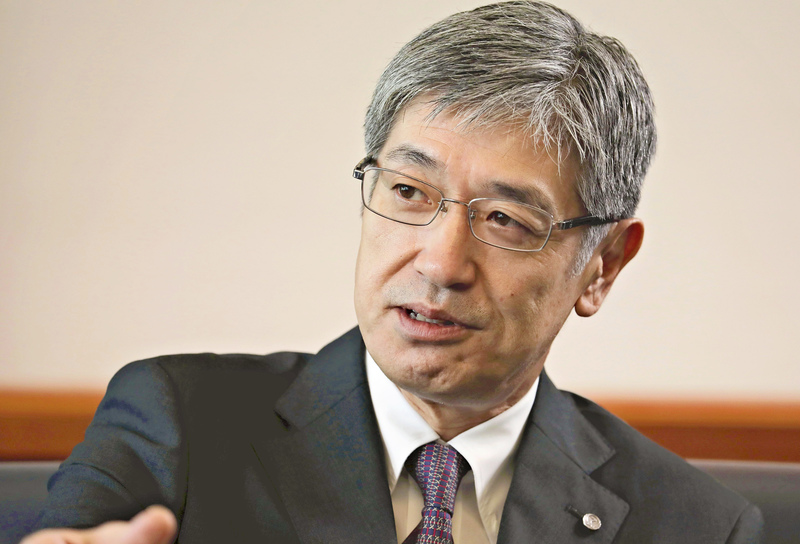
A tailwind has been blowing for a new business takeoff by Japan Airlines Co., Ltd., which has completed its business reconstruction, amid a growing number of foreign visitors to Japan. For this installment of Leaders, a column featuring corporate management and senior executives, The Yomiuri Shimbun asked Representative Director and Executive President Yuji Akasaka how JAL will respond to passengers' demands so as to achieve future business growth.
The speed of the increase in foreign visitors to Japan over the last several years has exceeded our expectations. Nearly all visitors come to Japan, which is an island country, by air. JAL has a highly significant role to play in maintaining that trend [of growth] and not letting it just be a passing phenomenon.
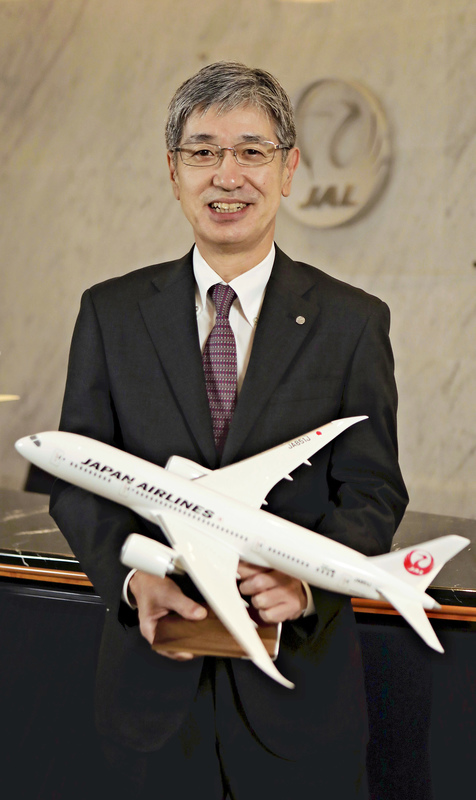
We've been working on strengthening our partnerships with foreign airlines, with the aim of expanding our capacity to carry more foreign visitors.
[JAL announced in August a new partnership with Shanghai-based China Eastern Airlines. While the two carriers have already started codeshare flights -- each partner airline attaches its own flight numbers to the flight and shares passenger seats -- the two companies will further deepen their relationship, starting a joint enterprise to coordinate flight schedules and fares, based on the approval of the application.]
While we should expand our own flight routes, there's a limit to what a company can do alone. Drastically expanding the business would put stress on our staffers. Any move that may heighten safety concerns should not be allowed. For this reason, it's effective to form partnerships.
At present, the two airlines operate about 460 flights per week between Shanghai and Japan. With this new partnership, it will be more convenient for travelers from Japan to visit around 90 cities in China via Shanghai. Visitors from China will be connected to a network of about 50 cities in Japan. Accessibility will definitely improve.
Under the joint venture, it will be more feasible for us to adjust flight schedules because we'll share the revenue and manage our codeshare flights, as if operated by one company. This will make our operations more efficient.
In practice, as the same quality of service should be provided to our customers, we'll share our knowledge in this regard. Frequent flyers of American Airlines -- JAL's joint business partner -- have given us feedback such as "services have improved." This is because we've explained to the carrier what kind of services Japanese customers expect. On the other hand, we've received suggestions from American customers that the volume of in-flight meals is insufficient.
The increase in foreign visitors to Japan has prompted me to realize that Japan has not been as well-known as I thought. The 2020 Tokyo Olympics and Paralympics will be a major opportunity to convey Japan's particular characteristics.
I want to revitalize regional areas by inviting visitors to these areas from Tokyo. I'm considering giving free domestic air tickets to travelers, for a limited time, who plan to visit regional areas during the Games. I also intend to examine other efforts, such as collaborating with railway companies.
Demand for long-distance LCCs
JAL's next move is starting a new low-cost carrier (LCC) business featuring international routes with medium- and long-haul flights. The LCC business has grown considerably worldwide. We cannot neglect the LCC business, as it has been creating new demand without competing with existing routes.
[In May, JAL announced the decision to establish a new LCC company and its aim to operate international flights connecting Narita to cities in Europe, the United States and elsewhere by a target date of 2020. The company will use a separate brand name from JAL and operate midsized Boeing 787-8s.]
At present, LCCs mainly provide short-distance flights with small aircraft at frequent intervals. Many LCCs are aggressively competing with one another in the short-haul business domain. In contrast, few LCCs exist that operate on medium- to long-distance routes like those connecting Japan to Europe and the United States. JAL has decided to cultivate business opportunities in that domain.
There must be many customers in the world who want to use a long-distance LCC. However, the operations involved in long-distance flights are not simple. Small aircraft with a short flight range cannot do it. Long-haul flights require a completely different knowledge in maintenance and other areas.
Flying over the sea or managing time differences costs more and involves a wider operational workload. It's not an easy job, but we have the knowledge. We're capable of launching the new flight operations without compromising safety.
Operation costs can be reduced by various measures, including charging for in-flight meals and jointly procuring aircraft with JAL -- taking advantage of JAL's business scale. We should be able to create new demand.
1985 crash changed my life
Ever since I joined the company, I've climbed Mt. Osutaka [in Gunma Prefecture], the site of the Japan Airlines jumbo jet crash [in 1985], two or three times a year. This has not changed since I took up my current position as executive president. Because I spent lots of time in my career in maintenance-related divisions, the mountain has been a special place for me.
I've been an aircraft enthusiast since I was little, and I majored in aeronautical engineering at university. When the plane crash happened, I was a graduate student. It changed my life. My older brother was a newspaper reporter then and he went to the site two days after the crash. Even now, I can't forget listening to him talk about it afterward. The expression on his face was horrifying.
I was studying aircraft design, but I came to think: "Simply manufacturing aircraft is not enough. It's more important to consider operational technology to upgrade flight safety as much as possible." This thinking led me to join JAL.
Another unforgettable experience occurred in 2005, when I was handling a series of problems while in charge of quality assurance at the maintenance division.
[As operational troubles -- neglecting maintenance errors and making a wrong approach to a runway -- occurred one after another, JAL received a business improvement order from the Land, Infrastructure, Transportation and Tourism Ministry under the Civil Aeronautics Law in March 2005.]
Even after receiving the improvement order, troubles including maintenance errors and equipment malfunctions happened in succession and the chain of these troubles seemed never-ending. I couldn't take a day off and I was completely exhausted.
How can we prevent human error? I found clues in a report compiled by experts including a nonfiction writer, Kunio Yanagida. It called for us to establish a "Safety Promotion Center" exhibiting the wreckage from the 1985 plane crash and others, in order for employees to remember the accident. The report also recommended many other practical pieces of advice such as, "Make sure to listen to what the families of the deceased say."
The uneasiness and distrust I felt toward JAL was reflected in the report. I said to myself, "This is it."
What I learned from the report is that we should not merely consider safety an issue for the related divisions and sections. Management must take responsibility for safety. I continue to visit JAL's worksites as often as possible.
Filing petitions for corporate reorganization in 2010 was a painful experience as well. However, JAL has drastically changed itself since then.
Kyocera's Kazuo Inamori became the chairperson of JAL and carried out two innovations: "amoeba management," which emphasizes the profitability of each division; and the thorough enforcement of the ideas called "JAL Philosophy." It changed the employees' mind-set, making them all realize the importance of respecting customers' viewpoints. In the past, much of our thinking was oriented toward the company [rather than customers], but employees have changed to think seriously about whether it is good for our customers and society.
As our efforts to reorganize our management have achieved results, we're entering a phase of seeking commercial growth again. Concerns are lingering over the impact of recent natural disasters caused by the typhoons and the earthquake that hit Hokkaido, and I hope we will overcome these difficult situations to increase the number of foreign visitors to Japan.
To accomplish this, my goal is to establish a strong JAL brand that will represent Japan and be admired by people around the world.
-- Key Numbers
500 cities
In the "Medium term management plan -- rolling plan 2018," issued in February, JAL set a goal of "flying to 500 major cities in the world." JAL's global network with airline partners has so far expanded to 343 cities. By achieving management reorganization, JAL has shifted its course for business growth. JAL was founded in 1951. According to the consolidated financial results for the year ended March this year, its operating revenues were 1.3832 trillion yen (12.3 billion dollars), up 7.3 percent from the previous year. The consolidated number of employees was 33,038 as of March 2018.
-- Yuji Akasaka / Representative Director, Executive President of Japan Airlines Co., Ltd.
Born in Hokkaido in 1962, Akasaka received a master's degree from the School of Engineering at the University of Tokyo in 1987 and joined Japan Airlines. He was appointed as an executive officer in 2014 and managing executive officer in 2016, before assuming his current post in April 2018. Akasaka was mainly involved with the maintenance division, which is in charge of aviation safety. After working at Haneda and Narita airports, Akasaka moved to the head office for the first time in his career when he became executive president.
Read more from The Japan News at https://japannews.yomiuri.co.jp/