The government and highway operators are promoting wider use of the electronic toll collection (ETC) system not only on expressways but also at drive-through windows and ferry ports.
ETC allows drivers to pay tolls at tollbooths while passing by in their vehicles, making the system a convenient, contactless payment method amid the coronavirus pandemic.
The government also plans to replace all tollbooths on expressways with ETC-only tollgates to promote further use of the system.
-- No cash required
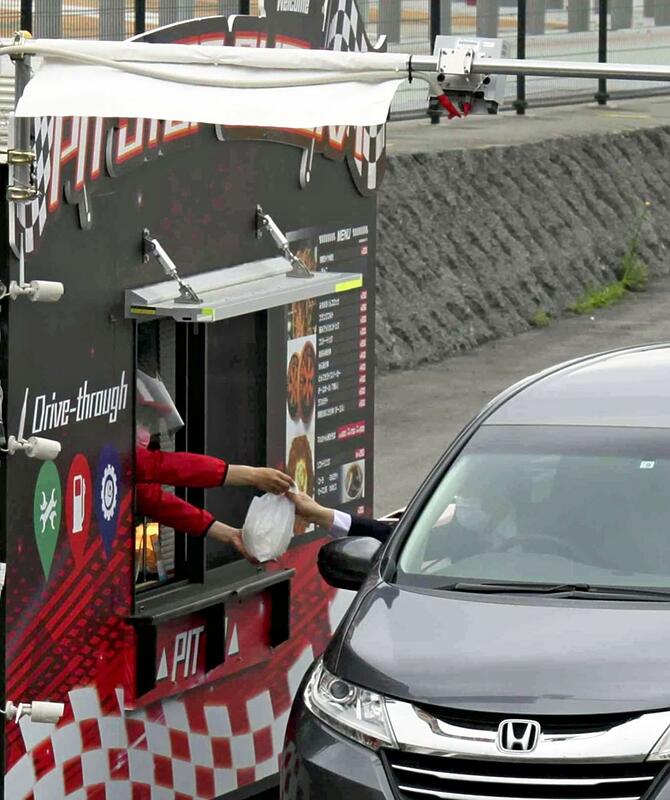
At the Suzuka Parking Area on the Shin-Meishin Expressway in Mie Prefecture, a car had stopped in front of a store with a drive-through window. The driver ordered food and told the store's staff member, "I'll pay by ETC."
The staff member operated a device connected to an antenna installed near the shop's roof, which instantly read the ETC card installed on the vehicle. Payment was completed, and the customer took their food and drove off.
Central Nippon Expressway Co. set up the store in April to test payments using the ETC system. The facility is open on Saturdays, Sundays and national holidays until the end of May to test the system's feasibility.
"Many customers have said they found the system convenient because they don't have to get out of the car or handle money," said Norio Niwa, who works at the store. "Also, less contact is appreciated as the coronavirus continues to spread."
-- Swift transactions
The ETC system was fully introduced in 2001 and has been designated as a means for paying tolls under an ordinance by the Land, Infrastructure, Transport and Tourism Ministry.
In 2017, each highway operator announced that they would start using the system for multiple purposes on a trial basis to promote information technology. The government concurrently compiled an outline of relevant rules.
East Nippon Expressway Co. conducted trials at a parking lot located below Hibiya Park in Chiyoda Ward, Tokyo, from January to February in 2018. Central Nippon Expressway conducted an experiment from August to November last year at the drive-through of a KFC in Sagamihara. Most of the about 430 people registered as trial participants had positive responses, and one said, "Contactless payment is very convenient," while another found the whole procedure "speedy."
The system has been used in March 2019 at Hachinohe Port's ferry terminal in Hachinohe, Aomori Prefecture. Drivers no longer have to fill in the boarding application because vehicle information is read by the ETC system.
Central Japan Expressway said it plans to expand the use of ETC.
-- Exclusive lanes
The plan to make all tollgates ETC-only is behind the push to promote wider use of the system.
The transport ministry announced in December a plan to replace about 1,500 manned tollbooths and other facilities across the country with ETC-only tollgates by around fiscal 2030.
The move is aimed at easing traffic congestion and cutting costs. In the three major metropolitan areas -- around Tokyo and in the Kinki and Chukyo regions -- the plan calls for all tollbooths to be replaced with ETC-only tollgates by fiscal 2025.
The average ETC usage rate on the highways run by six companies was 93.3% as of February, a rate high enough to implement the plan, but further use is needed to reduce the number of people who are still not familiar with the system.
For vehicles not equipped with ETC, the ministry is considering using cameras at ETC-only tollgates to check driver's licenses and license plate numbers and bill people later.
"Using the ETC system for various purposes promotes cashless transactions and can help prevent virus infections, so we hope to expand it further," a ministry official said.
Read more from The Japan News at https://japannews.yomiuri.co.jp/