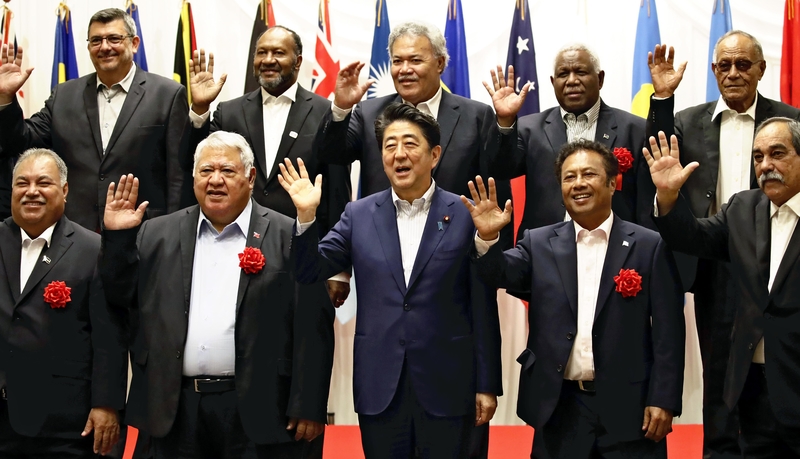
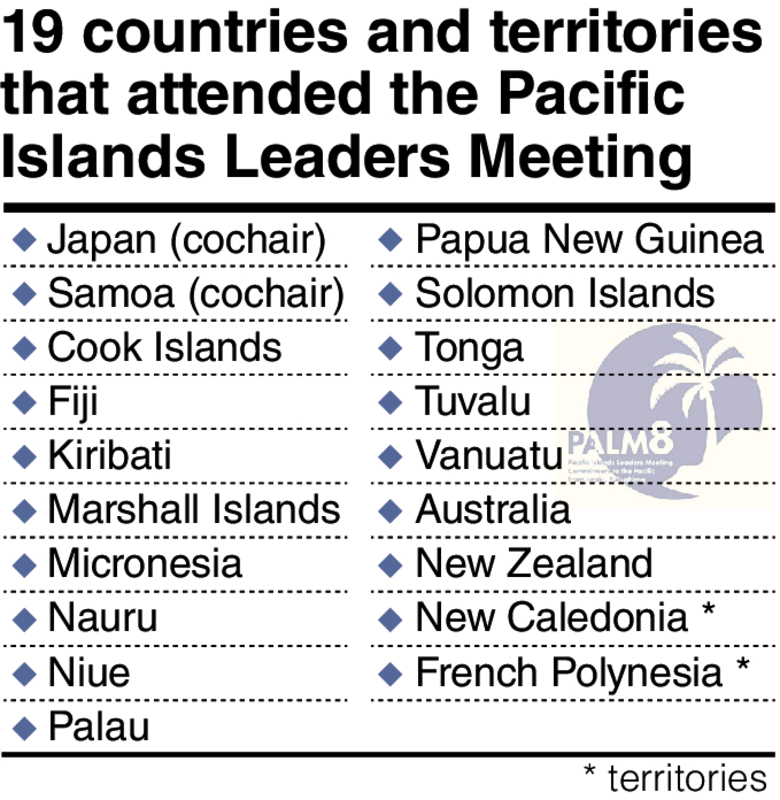
Leaders from Japan and Pacific island nations and territories discussed two major themes at the recent Pacific Islands Leaders Meeting -- how to deal with North Korea and how to promote mutual cooperation, particularly regarding Chinese maritime advancement.
The Japanese government recognizes significant achievements on both fronts. However, the summit-level meeting, which wrapped up Saturday, also revealed the rising influence of China on some of the island nations.
"If the normalization of diplomatic ties with North Korea is realized, providing economic cooperation is also a possibility," Prime Minister Shinzo Abe said at a joint press conference on Saturday. "Neighboring the growing Asia-Pacific economies, and with its industrious labor force and natural resources, North Korea will have a bright future if it walks the correct path."
Abe also stressed, "Quickly resolving the issue of the abductions [by North Korea of Japanese nationals] is also essential to that."
For Tokyo, the meeting's biggest aim was to gain cooperation in addressing North Korean issues. The declaration adopted by the leaders explicitly referred to the "immediate resolution of the abductions issue" for the first time, in addition to the acceleration of measures against North Korea's "ship-to-ship transfers" and continued pressure on Pyongyang.
Japan has received "a near-perfect score," a senior Foreign Ministry official said.
The other task was to promote Abe's "free and open Indo-Pacific strategy." As China assertively proceeds with its maritime advancement in the South China Sea, the prime minister aimed to ensure freedom of navigation and the rule of law in the Pacific region and curb China's advances.
Some nations expressed concern about explicitly referring to the Indo-Pacific strategy in the leaders' declaration, a source with ties to the Foreign Ministry said. The expression was eventually included, but a source close to Abe said, "The distance between some island nations and China has shrunk."
China is offering island nations a substantial amount of aid to build ports and other infrastructure, and is actively making investments in these countries. This is also meant as a warning to Taiwan, because the island nations account for six of the 19 nations that have diplomatic relations with Taiwan.
Tokyo wants to maintain its influence on the island nations and territories by promoting human resource development and exchanges. The Japanese government "attaches priority to the quality" of its human ties with the island countries and territories, Deputy Chief Cabinet Secretary Yasutoshi Nishimura said.
Summary of the leaders' declaration
-- Expressed commitment to exerting continued pressure on North Korea. Expressed hope that the U.S.-North Korea summit would deliver concrete actions by North Korea.
-- Expressed deep concern over North Korea's tactics to evade sanctions, including "ship-to-ship transfers." Emphasized the need to accelerate efforts, including by deregistering North Korean vessels.
-- Welcomed Japan's contribution through the "free and open Indo-Pacific strategy."
-- Pledged to support capacity-building for the island countries in the area of maritime security. Japan promised to implement human resource development and exchanges of more than 5,000 people over the next three years.
Read more from The Japan News at https://japannews.yomiuri.co.jp/