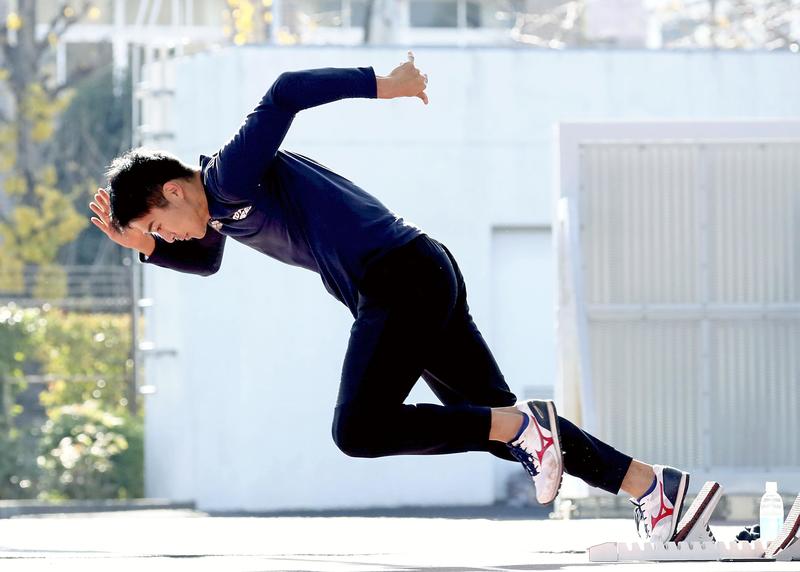
Japanese sprinter Shota Iizuka stepped onto the track for the first time in ages and was filled with a sense of nostalgia.
Following his workout, he slipped off his running shoes and used his bare feet to get a actual feel for the track.
"Outside of an injury, I've never been away from the track this long before. It feels like coming home," Iizuka said.
The Ajinomoto National Training Center, the Tokyo training base for many top athletes, was closed for use for nearly two months because of the new coronavirus. During the state of emergency, the most work Iizuka was able to do were nighttime jogs.
When the suspension was lifted at the training facility in late May, Iizuka was the first to begin to work out. He had to hold back the enthusiasm, but still did five 100-meter sprints.
The feeling of zipping through the wind exhilarated him. The 200-meter star from Shizuoka Prefecture at 19 won the 2010 World Junior Championships for the men's first gold medal in history for Japan in the 200.
He then competed at the 2012 London Games and at the 2016 Rio de Janeiro Olympics. He set a personal record of 20.11 seconds in 2016, making it a real possibility for him to become the first Japanese to break the 20-second barrier.
At 186 centimeters and 80 kilograms, he compares well physiclaly to foreign competitors. His vertical jump is easily was more than 80 centimeters. And there's still plenty of room for him to develop his speed.
His potential is evident in the fact that his standing vertical with no arm swing is not that different from the height he measures when he swings his arms to generate momentum.
He said that the latter usually yields better results by 10% or more.
"I'm not very good at using my upper body. By improving that aspect, I can get up to top speed at the start," Iizuka said.
The 28-year-old spent the winter exercising his the mucles around his shoulder blades and repeatedly practicing to get his arm swing straight in preparation for a year of competition. However, the Tokyo Olympics were pushed back to next year because of the pandemic.
He had to experienced a bit of a letdown as well, but what bubbled up inside him was more of a sense of responsiblity.
"A lot of sprinters in my age group have already quit the sport. I can't be depressed if I have the opportunity to run races," Iizuka said.
He called on his fellow athletes, including a teammate with whom he earned the silver medal in the 400x100 relay at the 2016 Rio Games, and has put out workout and other videos on the internet. He said he hopes "we'll all fight together."
The Japan National Championships are scheduled for October, about three months later than usual and that could affect his offseason work. Skipping the championships is an option because they won't be an Olympic qualifier.
However, said Iizuka: "The No. 1 thing is my desire to run the race. I'm looking to be at my best for the national championships."
At this time, he is just unable to contain his hunger to run races.
Read more from The Japan News at https://japannews.yomiuri.co.jp/