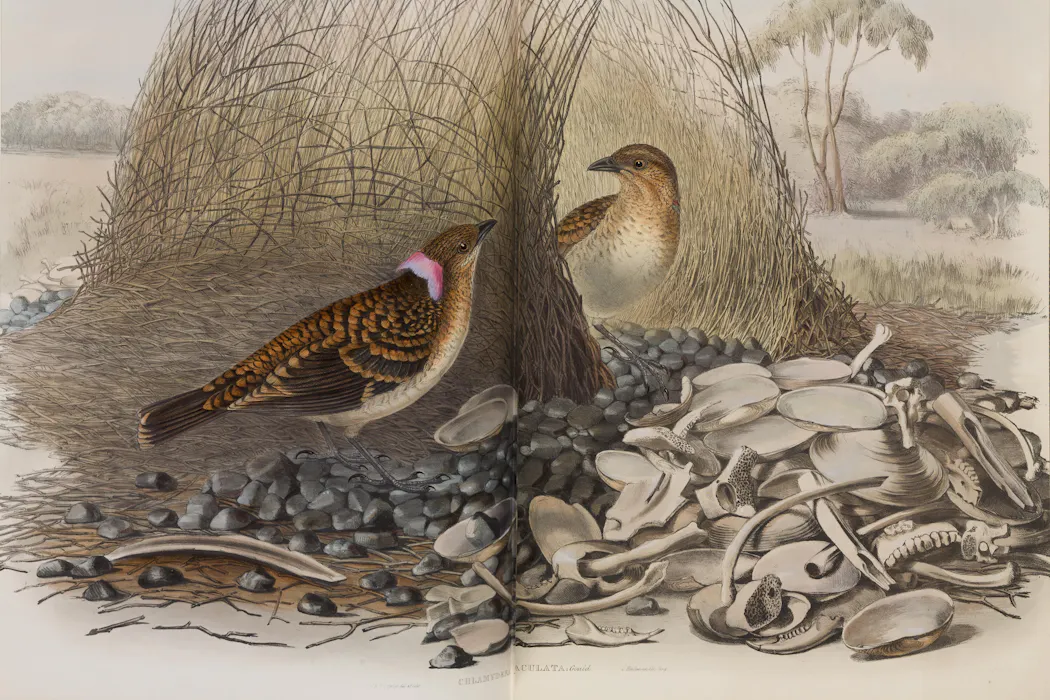
In the 19th century, natural history was a field dominated by men: collectors, curators and naturalists. Names such as John Gould and John James Audubon are well known for their contributions to ornithology.
Far less familiar is Jane Catherine Tost (nee Ward, 1816–1889), a skilled taxidermist and naturalist who worked alongside leading figures of her era, and became the first woman employed in a professional role at an Australian museum.
Recent archival research has brought new attention to Tost’s life and career, revealing the extent of her contribution to 19th century natural history. While, to our knowledge, no images of her have survived, many of her works are still in museum collections.
Tost’s story is the subject of my new book, For Her Love of Birds, published by Museums Victoria.
Early life in London
Jane Catherine Ward was born in 1816 into a family closely connected to the London bird trade. Her father was a bird breeder, and her older brothers, like Jane, were taxidermists.
In 1825, her eldest brother, James Frederick Ward, entered a partnership with the young naturalist John Gould. Operating from Golden Square, London, the pair advertised themselves as “bird stuffers to the King”, preparing specimens for elite clients.
Evidence uncovered for this book confirms James Frederick Ward was Gould’s first business partner, a detail not recognised in previous histories. The partnership ended in 1828 after Gould was appointed to a curatorial role at the Zoological Society of London.
But the Ward family remained active in scientific circles. They developed an association with the naturalist John James Audubon, and Jane’s brothers travelled to the United States to assist him in collecting bird specimens. Her brother Edwin Henry Ward accompanied Audubon on his first trip into the Florida Territories in 1831.
Jane remained in London, where she developed her own expertise as a taxidermist. By 1838, at the age of 21, she was working for Gould, preparing bird specimens for his projects – including those from his travels across Australia.

Her position was unusual, considering how few women worked in paid scientific fields back then. Indeed, in 1838, of the 18 taxidermists listed in the trade directories, none were women.
But in the 1841 census, Jane listed herself as a taxidermist (or bird stuffer, as they were known then).
Hardship and emigration
Jane married Charles Tost, a Prussian-born pianoforte maker, in 1839. Yet she continued working while raising a family.
During the 1840s they experienced financial hardship. And, like many others living in London during this period, they faced the threat of disease, instability, and personal tragedy.
Moving from London to Nottingham 1850, Jane opened her own business, advertising herself as a leading naturalist and using her maiden name “Ward” alongside her married name. Her work as an independent, professional naturalist gathered considerable attention in the local papers.

In 1855, the family emigrated to Australia. Although it has been previously reported they travelled to Australia on the Indian Queen, research for this new book uncovered documentation they sailed on the fast-clipper Schomberg, bound for Melbourne.
The voyage was fraught with problems, which came to a head on a stormy night two days after Christmas when the ship wrecked on the Victorian coast. Although all passengers were rescued, the ship was lost.
The Tost family eventually continued on to Tasmania, all their belongings at the bottom of the sea.

A new career in Australia
In Hobart Town, Jane began working for the Royal Society of Tasmania, preparing specimens for their new museum, which would later become the Tasmanian Museum and Art Gallery. Her work was well regarded, and she contributed to displays that would be shown internationally, including in an 1862 exhibition held at the Crystal Palace.
Seeking broader professional opportunities, Jane moved her family to Sydney. There she established a taxidermy business and undertook work for private clients and public exhibitions. Her work, including a well-publicised display of alpacas that won medals at the International Exhibition in London in 1862, helped establish her reputation.
Her most significant appointment came when Australian Museum director and curator Gerard Krefft employed her as a taxidermist in 1863. She was paid £10 per week, the same wage as the men. In this role, she repaired and prepared specimens for display when the museum’s collections required extensive restoration.
Her employment marked a milestone: she was the first woman appointed to a professional position at the Australian Museum, and likely one of the first at a museum globally.

Her legacy
Despite her achievements, Jane’s career was not free from difficulty. Heated disputes within the museum led to the dismissal of her husband, who had also been employed there, and she subsequently lost her position. The family again faced financial strain.

Following further tragedies, Jane and her daughter Ada established a taxidermy business opposite the museum. Over time, it became one of the leading taxidermy establishments in Australia, supplying specimens to museums and private collectors globally.
Jane continued working until her death in 1889, exhibiting at international exhibitions in London, Paris, Calcutta and Chicago.
Although her name faded from mainstream accounts of scientific history, Jane Ward Tost played a significant role in the development of natural history collections in both Britain and Australia.
The full extent of her life – spanning professional achievement, migration, personal loss and resilience – is finally being fully documented.
Her story offers a new perspective on the people who underpinned 19th century museums and natural history, and on the women whose expertise helped build museum collections that still exist today.


Jane Melville does not work for, consult, own shares in or receive funding from any company or organisation that would benefit from this article, and has disclosed no relevant affiliations beyond their academic appointment.
This article was originally published on The Conversation. Read the original article.