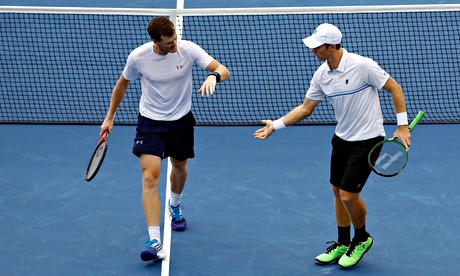
Australia’s best doubles player by a distance, John Peers, admits on the eve of partnering Jamie Murray in the final of the US Open that he will not be supporting his country when they play Great Britain in the Davis Cup semi-finals in Glasgow next weekend.
“I’ll be back home and I’ll probably watch a couple of the results,” he said after their three-set semi-final win over the Americans Steven Johnson and Sam Querrey on Thursday, “but I won’t actually watch it live because of the time difference back in Australia. I will just wish them all the best. I won’t be there to either support or give encouragement either way for either team.
“I spoke to Wally [Masur, the team captain] and Josh [Eagle, the coach] the other day and they just said I was close ... All I can do is keep trying to get another win and prove the point that I should be there, and hopefully they can select me somewhere down the track.”
As diplomatic as he was striving to sound, Peers is known to be seething over his omission.
His declaration of neutrality is a devastating critique on the shambles that has enveloped the Australian team, after the omission of Nick Kyrgios and the restoration of Bernard Tomic. A source close to the team said: “Those two are bad news for each other. It’s toxic. But to leave Peers out is just plain madness. He is far and away the best doubles player we’ve got.”
Meanwhile, Peers and Murray turn their attention to the final against the French pairing of Nicolas Mahut and Pierre-Hugues Herbert, who beat the British-Swedish alliance of Dominic Inglot and Robert Lindstedt, 7-5, 6-2, in the other semi-final.
It is Peers and Murray’s second slam final in two months, after falling just short of the prize at Wimbledon.
“Today it was weird, 200 people watching in a big stadium,” Murray said of their 6-4, 6-7, 7-6 win over the Americans on Louis Armstrong, the court where his brother, Andy, went out to Kevin Anderson in the fourth round.
“It didn’t feel like we were playing a grand slam, say compared to Wimbledon where we played on Centre Court, in a packed stadium. It was maybe good for us, because we’re both pretty relaxed. The whole atmosphere was kind of flat.”
Murray and Peers have been one of the unsung success stories in the game, quietly working their way up the rankings to the point where they are virtually guaranteed a place in the ATP World Tour Finals in London in November.
“It’s our third year together,” Murray said. “It’s pretty long-term, considering a lot of other teams out there are chopping and changing. We’ve both improved aspects of our game that needed to get better. I’m definitely serving better than I ever have, in terms of speed and also hitting my spots better.
“There was a stat the other week that [said] we were two or three in the year for service holds, at 92-93%. We both have improved on return, getting a lot more balls in court. Once the ball’s in play, I think we’re better than a lot of teams, because we’ve got that understanding; we’ve played so many matches together. We both know what each other is going to do on the court and that pays off.”
He said friendship is a key element of their partnership.
“It is important, because you spend that much time with each other, you go through a lot of good and bad experiences, tough moments. If you’re at each other’s throats all the time, it’s not good. Better to make it easy.”
And will they last as a team? “I guess so – if we keep winning, keep putting money in each other’s bank.”