Tate Britain’s big summer attraction is the first major exhibition in thirty years on Britain’s first modern artist. Except that artist happens to have been a loud-mouthed American who championed “art for art’s sake” in the face of Victorian moralising, kicking off the first great “it’s not art” row well over a century before the YBAs. Oh, and his nocturnal views of the Thames are some of the most hauntingly beautiful paintings ever created.
Yet James McNeill Whistler never quite gets his due as one Britain’s strongest contenders – probably the strongest – in the great 19th century shake-up of art, when Paris seemed always decades ahead of London in the race to modernity. Prior to this exhibition he was represented in Tate Britain by only two modestly sized works. Born into an eminent New England family in Lowell, Massachusetts in 1834, raised in Russia and trained in Paris, Whistler moved to London in 1859. Remaining here till his death in 1903, he turned the staid British art scene on its head over four tumultuous decades. His flair for self-mythology paved the way for generations of performative artists from Paul Gauguin to Tracey Emin. Whistler claimed to have been born in St Petersburg, because "I shall be born when and where I want, and I do not choose to be born in Lowell," while playing up his fleeting contacts with the Parisian greats to the hilt.
Appropriately for someone who consciously performed the role of “artist” in a way that’s become the norm in the art world today, Tate’s exhibition follows Whistler’s progress through a series of self-created living and working environments, stage-sets almost, rather than simply tracing his progress from work to work in the usual way of exhibitions. In the opening painting The Artist in his Studio (1865-6), Whistler watches himself at work as his partner Joanna Heffernan and fellow model Emily Jones chat in then voguish Japanese robes. If the loose handling of the paint feels broadly Impressionistic, any connection to the works of Monet and Co is dispelled by the comically quizzical glance that Whistler flashes to the viewer.
Chinese pottery, pieces of contemporary furniture and a screen decorated by Whistler evoke the Chelsea studio-house where he held breakfasts for “the press and fashionable society”, serving up then exotic fare such as pancakes with maple syrup. Whistler certainly appears well ahead of his time in his flair for playing the media – if not always in his art.
The screen in fact is a modern reconstruction. Indeed, the show includes more reproductions than any other exhibition I can think of, though they’re treated as props in the telling of Whistler’s story, rather than simply replacements for unobtainable works. Reconstructions of pivotal arguments with patrons – Whistler had many – and speeches by the artist boom through the galleries to sometimes distracting effect. Early portraits of French peasants are in the dark and gritty vein of the great French realist Gustave Courbet, a feel that’s still present in the brilliant Wapping (1860–4), in which a group of friends sit on the balcony of a “disreputable” Thames-side pub, before a panorama of densely packed shipping. The modernity of the hyper-clear focus stretching back through the painting seems to fight with the dark colour palette, as though Whistler is momentarily stuck between the old world and the new.
It’s with two smaller paintings that we see him developing a really unique painterly touch. In Green and Grey, Channel (1865), with its yacht sail listing beneath ominously swirling clouds, the range of tones is so narrow that the slightest variation in the muted greys, greenish in the sea, purplish in the sky, stands out with luminous clarity. Chelsea in Ice (1864) captures the frozen Thames in masterfully manipulated white and steely grey, radiating light in a stripped back Impressionist style that feels way more daring than anything the Impressionists themselves were attempting at the time. The exhibition’s most famous work, meanwhile, commonly known as “Whistler’s Mother”, one of the most widely reproduced and parodied paintings of all time, feels relatively conventional in comparison.
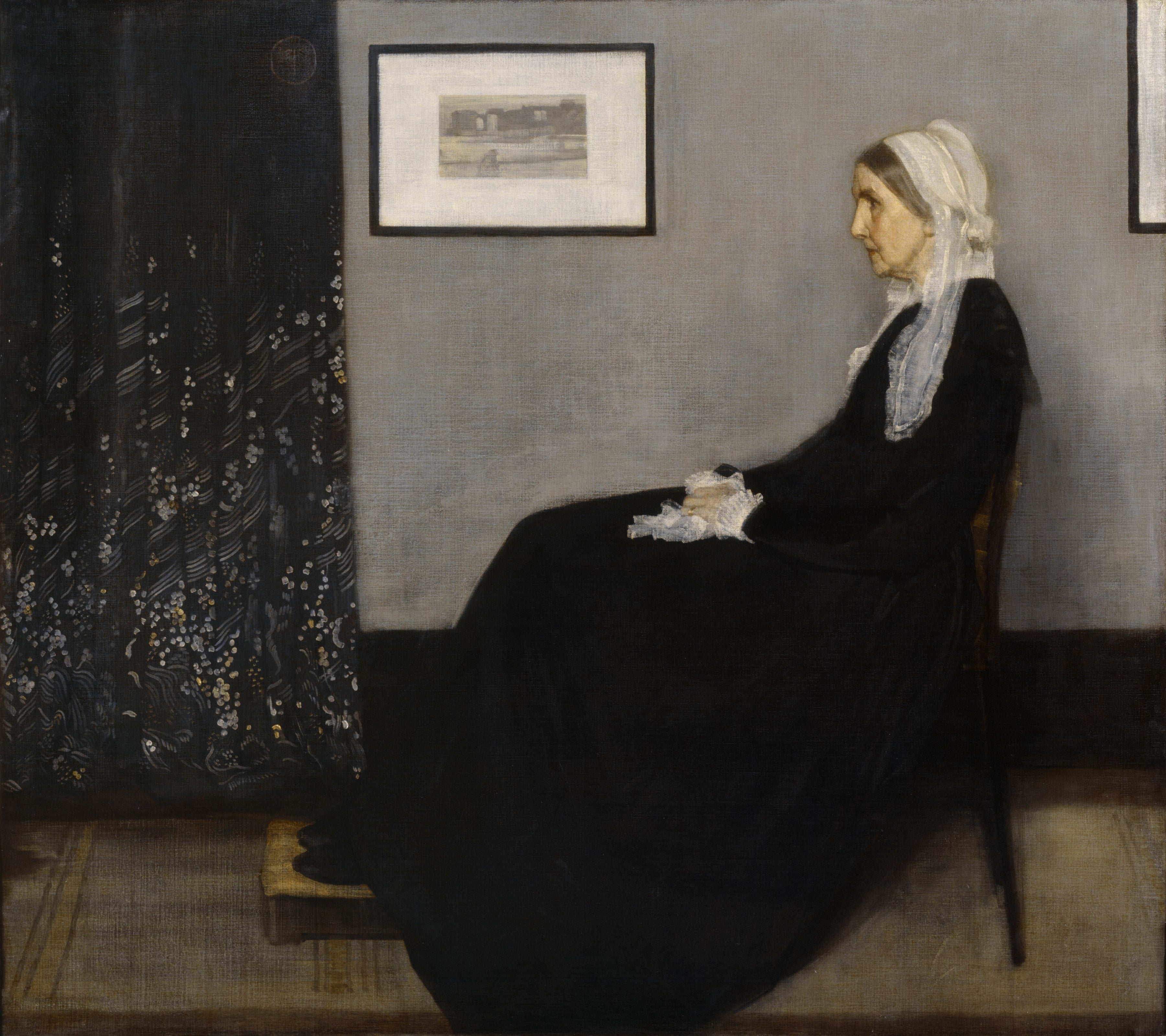
Whistler’s conception of art’s most famous mother as an “arrangement” of colours and tones (the official title is Arrangement in Grey and Black: Portrait of the Painter’s Mother) exemplifies his desire to create quasi-musical “harmonies”, even “symphonies”, in paint that he considered fundamentally abstract. The positioning of the old woman’s stark profile against the flat grey background and right-angled picture frames and black curtain does indeed create a decisive abstract impact. But the focus is still on the minutely, and brilliantly detailed rendering of his mother’s face, her remote expression and black widow’s weeds bringing a touch of New England puritanism, which seems to refer back to the Old Masters rather than forward to pure abstraction.
Equally, the delightful Symphony in White, Number 3 (1865-7) and The Little White Girl (1864) showing long-haired young women fetchingly posed in white dresses have a kind of Alice-in-Wonderland prettiness that feels very much of its time. The less well known Three Figures: Pink and Grey (1868 to 78), hanging alongside, feels bracingly modern in comparison, with its stylised colour and mysterious mood that perfectly suits its intended setting, the notorious Peacock Room (1876-7) which is evoked in the next gallery.
Now regarded as one of the crowning achievements of the Aesthetic Movement, the “cult of beauty” in which Whistler was a pivotal figure, this wildly decorative, Japanese-themed dining room brought Whistler damaging controversy when his patron, the ship owner Frederick Leyland, took against his dramatic blue and gold murals and refused to pay for it. The arrangements of blue and white porcelain and gilded fittings are brought before us in wall-filling photographs so detailed there’s a split-second delay before we realise that only Whistler’s briskly drawn Cartoon of Rich and Poor Peacocks is the real thing. But this is a mere antechamber to the show’s most spellbinding room, devoted to the largest group of Whistler’s Nocturnes ever assembled.
The relatively realistic Crepuscule in Pink and Green: Valparaiso (1867) sets the tone with its heavy-sailed ships captured at dusk against a sea of the most muted turquoise with bars of greyish violet cloud overhead. Whistler carried this basic colour scheme back to his Thames waterfront, borrowing the term “nocturne” from Chopin’s piano studies to describe the mood of sombre serenity in paintings that became ever more minimal. Nocturne: Blue and Silver – Cremorne Lights (1872) is little more than smears of pale blue and purplish grey, with the lights of the Cremorne pleasure gardens sparkling on the far shore. It’s hard to tell if we’re viewing the scene by moonlight, residual daylight or the reflected glow of millions of urban lights. Nocturne in Blue and Silver (1875-8) turns the light down to almost zero, with a barge reduced to a dark slither against a ghostly, barely glowing stretch of water.
It’s hard to imagine that one of these sublimely meditative works could have led to one of the bitterest and most widely publicised legal disputes in the history of art. But when the influential critic John Ruskin described Whistler’s Nocturne in Black and Gold: the Falling Rocket (1874), showing a riverside firework display, as “flinging a pot of paint in the face of the public”, Whistler sued for libel. While he won the case, he was awarded a derisory farthing in costs and bankrupted.
Whistler’s final society portraits which close the show – doubtless done to repair his fortunes – are gratingly theatrical. But it’s a late self-portrait that’s most revealing, with Whistler still wearing that cocky grin that opened the exhibition. It’s hard not to conclude that Whistler was his own worst enemy, and that his image as a provocateur-showman has hindered his reputation right up to date. But it’s by those magisterial nocturnes that he needs to be judged. Far from being a provincial sideshow to mainstream Impressionism as they’ve tended to be seen, they are some of the most extraordinary and genuinely revolutionary paintings in one of art’s most momentous periods.
‘James McNeill Whistler’ is at Tate Britain from May 21 until Sept 27
Lubaina Himid’s British Pavilion confronts us at a chaotic Venice Biennale
Hurvin Anderson is one of Britain’s most significant painters
David Hockney’s Serpentine show offers a message of hope in a desperate world
Catherine Opie’s first major UK show is full of emotional generosity
Tracey Emin, A Second Life review: Britain’s greatest living female artist
Lucian Freud’s drawings show the artist at his most spontaneous and personal