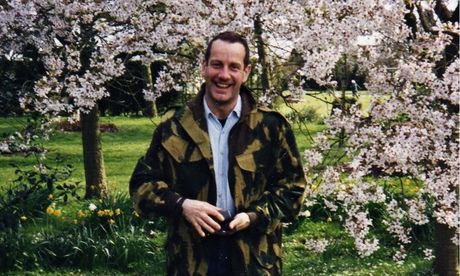
James Malpas, who has died of a cerebral haemorrhage aged 56, was an art historian with a broad knowledge of western art, literature, history, music, eastern arts and spirituality. He was a virtuoso lecturer and educator at galleries including the Tate, Victoria & Albert and Hayward, for the National Association of Decorative & Fine Arts Societies and the National Art Collections Fund, and on BBC Radio 3 and 4. He lectured without notes and with seamless unpredictability. The structure was in his head: a mesh of narrative connections. On air, he spoke without hesitation, almost as if competing on Just a Minute. No repetition, plenty of surprising, long-jump deviation.
He was keen that people should monitor their responses to art, not become stuck in a single way of looking. Talking about Caspar David Friedrich in 2012, he even appeared to be doing himself out of a job, suggesting the “interiority” of Friedrich’s painting was best appreciated in solitude, without commentary.
In Realism (1997) – his study of Walter Sickert, the social realists, the German expressionists and the pop artists Richard Hamilton and Andy Warhol – he wrote: “The Anglo-Saxon world … is fascinated by things, not ideas. A painting is a gadget, just as a story is.” Malpas enjoyed such provocations, yet was on the artist’s side – alive to the challenges they faced, an ally. He wrote with wit and had an ear for puns (one Tate lecture was entitled Life in the Roar: Edward Burra).
He wanted art to be accessible, and it seems appropriate that he was author of the 1994 Radio 4 documentary Of Muck and Magic, an exploration of the role of clay in the history of art and ideas, in which the white clay of Cornwall, Christian theological references and Greeks smashing plates in restaurants all turned on his potter’s wheel.
Son of James, an oncologist, and Joyce (nee Cathcart), Malpas was born in London and educated at St Dunstan’s school, Catford. On the back of a degree in English literature and art history from Cambridge (1981) and an MPhil in Renaissance studies from the Warburg Institute in London (1984), from 1986 Malpas earned his living teaching BA and MA students at Sotheby’s Institute in London, before moving in 2012 to Christie’s as their short course director.
Being a teacher of art history was more than a day job – a keen motorcyclist, he encouraged biker friends to drop in on art galleries. He also put his bike to use as a volunteer blood runner, delivering to hospitals at all hours of the night to help in emergency cases, no matter what the next day’s schedule might be.
He lectured on topics as various as 19th-century German romanticism, Hogarth, late 19th-century Scandinavian artists, Japanese art, camouflage, alchemy and William Blake. Above all, he resisted typecasting. The BBC producer Abigail Appleton remembers not only his art historical broadcasts but riding on the back of his bike to a small airfield where Malpas did a parachute jump and described how it felt (the monologue was broadcast as a concert interval on Radio 3). A set of samurai armour, a dashing exhibit at his home, must have sharpened his contribution to Understanding Art Objects: Thinking Through the Eye (2009). His chapter was Realism and Authenticity in Ceremonial Samurai Armour 1450-1800.
He reviewed for the Observer, the Art Newspaper, Poetry Review and the London Review of Books. He was an occasional poet and frequent letter-writer, and kept diaries on a Pepsyian scale. He had an etching press in his garage and latterly took up ceramics. He had a flair for garden design, creating an eastern-inflected garden at his home in south London with ponds in which to keep amphibians – another enthusiasm. An affinity with Scandinavia (he was working on a PhD on the painter Akseli Gallen-Kallela) prompted him to add birch trees to the plot.
Malpas was a member of the territorial army, serving during the Iraq war as a weapons instructor for the Parachute Regiment, and became owner of the only Ferret armoured car in Southwark Bridge Road. Occasionally, action man and art historian collided. During a weekend with the TA on Salisbury Plain, Malpas was summoned to the CO’s tent. The radio was on – a R4 broadcast in which he was attempting to make sense of Edward Munch’s The Scream.
“Is that you?”
“Yes, sir.”
“Crikey. Well done, Malpas! At ease.”
He is survived by his parents, and his brother, Tim.
• James Julian Malpas, art historian, born 27 May 1958; died 16 May 2015