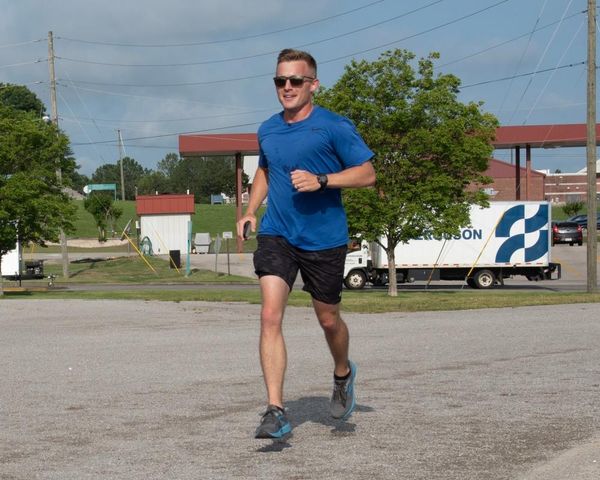
Jamel Herring’s dark story could be overwhelming but the world champion boxer speaks with such a light touch that all the death and depression, the memories of the Iraq war and his PTSD, are lit up as markers of a past that has shaped him. Herring is explaining how revisiting the bleakest moments actually help him and others who hear everything he overcame on his way to winning the WBO super‑featherweight title a year ago last week.
The 34-year-old American, a retired Marine, is expected to headline US boxing’s first post‑quarantine world championship bill in Las Vegas on 2 July. If the Nevada State Athletic Commission clears the fight, it will take place behind closed doors as Herring defends his title against Jonathan Oquendo.
“I’m a regular human being,” Herring says. “I’ve been through ups and downs but here I am today. I’m happy. I’m humble. I just try to uplift anyone who’s listening. That’s what I love about being a world champion – having a bigger platform to share my experience. I never really cared for the attention but I have a responsibility to be open.”
Herring and I talk on Zoom 10 days before George Floyd is killed so coldly by a policeman in Minneapolis. But when I made contact with Herring again he decides not to make any comment on the way America is now burning with rage against police brutality, injustice and Donald Trump. I can respect Herring’s wish to keep his thoughts private because he has endured a testing and fraught life.
Boxers rarely shy away from discussing their doubts and troubles. In the ring they are tough and brutal but, in quiet times, they reveal vulnerability. They have often suffered terrible hardship and the bravest always examine their past. Herring adheres to this tradition while making the point that there is also a new breed of fighter – from Tyson Fury to Isaac Chamberlain – who is even bolder in stripping away once secret trauma.
Training in Nebraska with the great world welterweight champion Terence Crawford, Herring has been encouraged to open up by Fury. “We’ve all learned from Tyson how good it is to talk about our personal battles. When Tyson first spoke out about his problems he was on the top of the world. He had beaten Wladimir Klitschko to become undisputed champion. But no one of his household knew what he was going through. When I heard the stories, I was shocked but I felt such respect for his honesty.
“It reminded me of my PTSD and depression. So I look at it as the responsibility of a true champion to share my story. Potentially I can help save someone’s life and put them on the right path.
“My own PTSD still comes back every now and then. But since I got the proper help, and spoke about it, it’s better than shutting myself off from the world and going into my mood swings. My wife says I have been doing great the past year. It never fully goes away, but I handle it much better than three years ago.”
Last month his eldest daughter Ariyanah would have turned 11 – had she not died in July 2009. She was a victim of SIDS [Sudden Infant Death Syndrome] and it took Herring years to recover. “I still get flashbacks of her tragic death. They also come from my time at war in Iraq and when I lost my best friend, Stephen. All those negative things hit me one after the other and brought me down. My dreams turned to nightmares. When I woke up I’d be in a terrible mood, and depressed. At one point it was unbearable.”
Herring grew up in Long Island, near New York, and he was saved from falling into a wayward life by Stephen Brown. “I met him when I was six and he lived right across the street. He was a year older and a great inspiration. It was rocky as a kid and he kept me out of trouble. He went into the Marine Corps the year before I did and I followed his path. But then, when I was 19, he got lung cancer and passed away on 12 December 2004. It was devastating.”
Less than a year later Herring was sent to Fallujah in Iraq. Surviving day after day under fire from mortar rounds or the deadly threat of snipers, Herring still sounds stunned. “Fallujah. Nineteenth zone. I just saw stone buildings ready to fall apart. I had never experienced a sandstorm before – or heat up to 130 degrees. It just made me sad seeing little kids in those conditions. If anybody says that stuff didn’t affect them they’re crazy.”
Herring’s second tour of duty in Iraq was harder. His first wife was expecting their first child and he was haunted by the death of a bomb disposal technician who was blown up soon after he spoke to Herring. The images have never left him, but Herring found solace in meeting his own son who had been born while he was in Iraq. The baby was named Stephen.
“My son knows his name comes from a great person. I keep his memory alive and I also think of my daughter all the time. Every time I feel I’m starting down the wrong path, I think of her. What would she think if I was to do this? It keeps me on the right track and I have more joy today than I did 10 years back when the tragedy happened.”
On 25 May 2019, 10 years to the day of Ariyanah’s birth, he won the WBO title by beating Masayuki Ito. Herring was elated but, a year on, he remembers how hard it was for his son. “He definitely had a scare watching that fight. My ex-wife was with him and she recorded it on her phone. He was pacing back and forth in the room during the fight because he was so worried. But in the end he was definitely proud of me.”
Herring nods when I say it must be hard for all his family whenever he steps into the ring. “My wife, Jennifer, feels it. It was so hard for her to watch all I went through against Denis Shafikov [when Herring suffered his first loss in 2016]. I had a hole in my mouth from one of those accidental head‑butts. After the fight I had trouble walking for a bit. That was a wake‑up call so I took time off after that.”
His last bout, a world title defence against Lamont Roach last November, was even more bruising. “I suffered swelling on the back of my head due to rabbit punches,” Herring says. “So I look at this whole Covid-19 situation as a positive way for me to rest until this swelling eventually went down. We know a lot of head injuries come from massive swelling. I was really in bad shape but luckily I got out of that fight intact.”

Herring was due to fight Carl Frampton in Belfast this month but the current crisis forced a postponement. “After Carl’s last fight in Vegas [in November] I jumped into the ring because we both want to meet in Belfast. But I didn’t want to be in Vegas. Even when I shook Carl’s hand I was suffering pain behind my head. It was a few weeks after my fight and the swelling went on for at least two months. That’s the longest I’ve felt the effects of one fight.
“Even when I got cleared by the doctor I was going to a chiropractor to get my mobility back. I’m still following my doctor’s advice on how to properly rest. It’s definitely a big factor in healing. I’m feeling my old self again but it was a reminder of the dangers.”
Last year, Herring was shaken by the death of five boxers in the space of four months. He knew and liked Maxim Dadashev and Patrick Day who both died after gruelling fights last summer. “I always think of Max and Pat, and my friend Prichard Colón. Prichard’s story hit me so hard. He got rabbit punched so badly [in his last fight in 2015], they had to put him in a coma.”
Colón was in a coma for 221 days. Fear he would remain in a persistent vegetative state finally eased and now “he’s going through continuing rehab”, says Herring, adding: “So he’s getting better. They are speaking to him and he understands what’s going on. But it’s so sad to see this kid who had a bright future end up like this. There’s not a day where I don’t think of Prichard.
“I was also rabbit-punched but thank God I wasn’t put in a coma. So we need to focus on taking better precautions in the ring and that’s why the referee’s job is crucial. If you watch the fight with Roach, I keep reaching for the back of my head and talking to the ref. I’m not saying it was intentional but I was hit over and over in that area. My doctor said in the 11th round, from all the rabbit punching, I had a pre-concussion. I played it smart in the last round but it was worrying.”
How does he feel about returning to the ring next month? “I watched the first UFC promotion behind closed doors and it didn’t seem normal. But it was enjoyable and they took the right precautions. Fighters also need to provide for their families. So this is definitely a good start to getting back to where we need to be.
“I really like Frampton as he’s a good family man – but we won’t see that fight until we can get crowds back in Belfast or New York. But for now we can take baby steps.”
Herring has two daughters with autism and the Covid crisis is just another test in a life framed by adversity. “It’s been hard but this time has made people think about what’s important in life,” he says.
“I know it has for me. I’ve had plenty of tough times but I’m now even more appreciative of life. I believe this crisis will eventually blow over. But I hope at the same time people will never forget what they had to go through this year. It’s during such hard times that you learn the most about yourself – and come out stronger.”