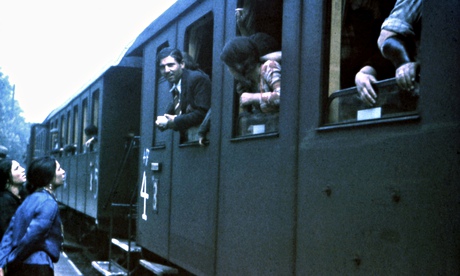
Over the last 70 years, the Holocaust has been established in the western world’s collective conscious as the ultimate expression of human evil. Its victims are remembered with horror and pity; no fate, we’re agreed, could be worse than to be among their number. Except, perhaps – as Lindsay Hawdon obliquely suggests in her debut novel – to be among the Holocaust’s forgotten victims; those such as the Romany people who, when they’re mentioned at all, are tacked on at the end of the roll call, restricted to a dependent clause.
The Roma refer to the act of genocide perpetrated against them by the Nazi regime as the Porajmos – the Devouring. The Nazis themselves certainly didn’t see it as an afterthought: as Hawdon explains in a brief, bleak coda, the regime viewed gypsies as “hereditarily sick” and called for their “elimination without hesitation”; by 1945 it had claimed more than 1.5 million Romany lives. Nevertheless, in a shabby and dishonourable second act of silencing, their murders were not prosecuted at Nuremberg, and it wasn’t until 1994 that the US Holocaust Memorial Museum held a commemoration for them. Even today, their stories remain largely untold.
It’s this silence that Hawdon seeks to break in Jakob’s Colours. The novel tells the story of Jakob, a half-Roma boy fleeing from soldiers whose duty it is to exterminate him: hiding out in forests, sleeping under pine needles, slipshod, starving, “lice-infested and full of sores”. Eventually, he’s taken in by a kindly stranger who stashes him, Anne Frank-like, in an under-stairs cupboard. It’s a deeply involving tale, hazardous and harrowing, but its constituent parts (including the atrocity that set Jakob on the run, hinted at throughout the novel but only described in detail in the final pages, when we’re committed to the characters) are grimly familiar. The challenge for Hawdon, then, is firstly, to differentiate Jakob’s story from those of the Jewish Holocaust victims in, say, Schindler’s Ark or If This Is a Man – and secondly, to justify the inclusion of these all-too-recognisable scenes of torture and mass murder. Tales of terrorised children will always move us, but does the novel earn our investment?
To her credit, Hawdon achieves both of these things. By intercutting Jakob’s story with flashbacks from the early lives of Lor and Yavy, his mother and father, she establishes both the family’s essential difference and the reasons why we ought to care about its members. Jakob’s parents’ lives, it turns out, could furnish a novel in themselves. Lor is the daughter of a well-to-do but dysfunctional English family, raised amid the trappings of respectability before being dispatched to a mental institution in Austria after a personal tragedy leads her to self-harm. Yavy, the son of Swiss gypsies, was taken from his parents at an early age in a state-sponsored bid to “educate” him out of his heritage. After a string of brutal experiences, he fetches up at the asylum in which Lor is incarcerated, where he works in the grounds, taking refuge in his joy in colour, which he surrounds himself with in the form of “dried petals, dried leaves, pieces of fabric, stones of ochre and malachite … tinted glass and broken china shards”. The pair escape together and make a new home for themselves in a bustling Austrian town, their freshness and optimism made unbearably pathetic by our knowledge of where their lives are heading.
But while the singularity of their history and the bleakness of Yavy’s backstory (between 1926 and 1973, the children of Swiss gypsies were forcibly separated from their parents and installed in orphanages in order to “combat vagrancy”) more than bear the weight of the horrors that come after, what stops the novel from succeeding fully is the storylines’ lack of balance. For all the horrors of the Holocaust, it’s Lor’s tale, not Jakob’s, that grips: Hawdon’s feel for the subject matter is instinctive, and her depiction of the crumbling of a brittle, middle-class marriage correspondingly convincing. Yavy’s story seems attenuated, despite its drama; he’s by far the weakest character in the novel, not least because his speech grates, rendered in hackneyed anglicised “foreign” (“I love you. It don’t be feeling like a choice”). Dialogue is a problem throughout, in fact; while Hawdon has a fine eye for detail in description, she has something of a tin ear for speech, only really pulling it off in the clipped, English sections of Lor’s childhood. In the end, this lack of affinity for the spoken word undermines what is otherwise a well realised and unquestionably admirable enterprise. If Hawdon can nail this, she’ll go far.
• To order Jakob’s Colours for £11.99 (RRP £14.99), go to bookshop.theguardian.com or call 0330 333 6846. Free UK p&p over £10, online orders only. Phone orders min p&p of £1.99.