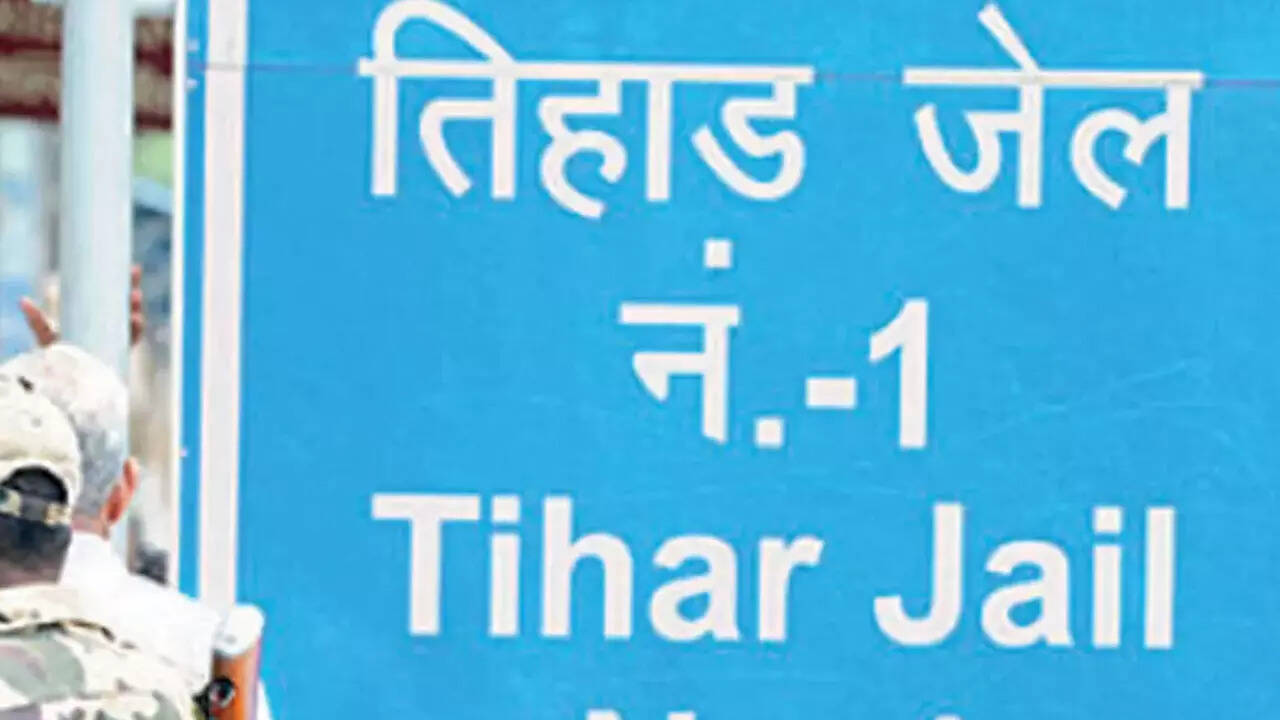
NEW DELHI: After the Supreme Court’s scathing remarks on the Tihar administration, a recent post by retired IPS officer Kiran Bedi, who has headed the jail in the past, has put the spotlight on the current state of affairs at Asia’s largest maximum-security prison that has of late been in the news for all the wrong reasons.
Bedi had tweeted: “Something drastically wrong has happened with #Tihar #prisons. Such large-scale mismanagement cannot happen overnight. A judicial inquiry is needed to know when did this decay begin. How and why? It cannot persist. We have to recover and stop this decline (sic).”
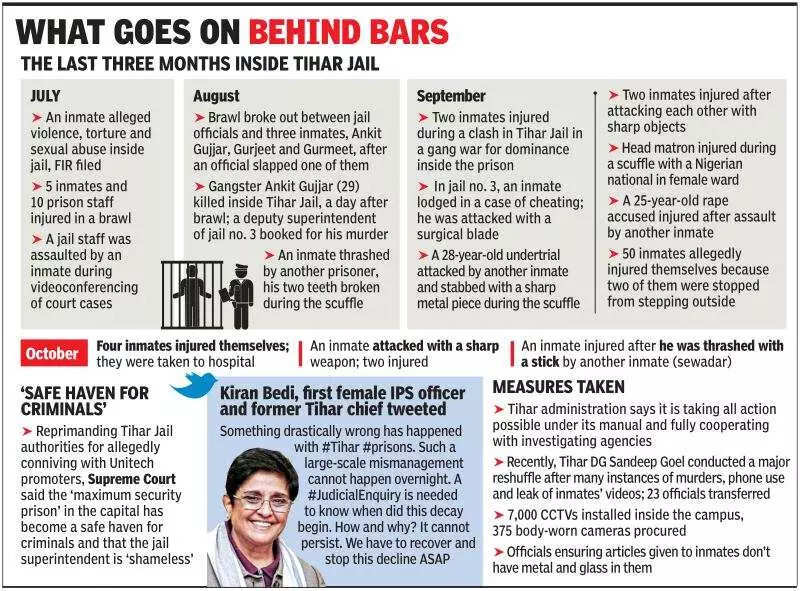
In the last six months, Tihar has been in the dock for jailed gangsters ordering hits outside, brawls, officials assaulting or killing an inmate and providing undue favours to convicts, like in the Unitech case, for pecuniary gains. From brazen murders to massive mobile phone usage by inmates, Delhi’s jails have been courting multiple controversies.
On multiple occasions, Delhi Police has stumbled upon evidence suggesting an organised extortion racket being run from inside the prison. The menace has become huge as all top gangsters are lodged there. Several inmates in leaked videos have alleged that jail officials seek hefty amounts to let them keep a mobile phone or use the internet.
Recently, the Delhi high court questioned the prison authorities for not carrying out a proper probe into the alleged murder of an undertrial prisoner. It asked CBI to take over the probe. In this case, the deceased, Shrikant Rama Swami, was supposed to be released on the day he was murdered. The matter had barely gone cold when gangster Ankit Gujjar’s murder rocked Tihar. This time, there were specific allegations and evidence to suggest senior jail officials, including the superintendent, were involved.
The latest controversy was the sensational Rs 200 crore extortion case carried out by high-profile conman Sukesh Chandrasekhar, which was first reported by TOI on August 9.
Currently, there are around 18,000 inmates lodged in 16 sub-jails. The Tihar complex alone houses more than 12,000 inmates. Most inmates are lodged in the four bigger jails — 1, 3, 4 and 8/9. The rest are scattered across Rohini and Mandoli jails, making management a difficult job.
When TOI spoke to several former and serving IPS officers to know what may have gone wrong, a common point was that changes were needed at the grassroots level and knee-jerk reactions would not work in an environment like Tihar Jail. “One has to go inside to see. Can’t say. One can only suspect. Which is why a detailed inquiry is needed by a team that goes inside to see,” said Bedi.
Bedi had started with small changes, like Vipassana, which helped inmates remain calm. Her initiatives brought a visible turnaround in the state of affairs. She believed in making the place a reformatory with measures like community building and collective contribution by the administration and inmates.
A retired senior police officer on anonymity said things were going downhill as director-generals were being posted at the fag end of their career for a short period. He pointed out how in the last decade the postings had a pattern, except for a couple of aberrations.
“In the last decade, the post of the Tihar chief was largely seen as a cooling posting for a Delhi Police commissioner. What Tihar needs is younger and dynamic officers who wish to undertake reforms and not be sent there while looking forward to retirement or the post of the top cop,” added the officer.
The officers pointed out that the recent events proved that a sense of accountability was needed to be instilled in the superintendents who needed to be answerable for their actions. “As they manage most affairs, a sense of being indispensable creeps in after certain years. That feeling needs to be checked and frequent reshuffles can tackle that,” an officer suggested.
“News reports show a sense of revolt developing among inmates, which is a dangerous thing. The next step could be a jailbreak, so urgent intervention is required,” said another officer.
Sandeep Goel, director-general (Tihar), said various measures had been taken to curb clashes inside prisons. “We have identified inmates involved in nefarious activities. We keep rotating them and lodge them in special or high-security wards,” he added. There are hundreds of such inmates, 40-50 in each prison.
An officer said sharpened metal strips and blades of fans were being used by inmates to create weapons. “Sometimes, inmates use iron clips used in the mesh. They have also used tubelight stands, cutlery, utensils and other miscellaneous metallic items to attack others,” said an officer.
Goel said they were providing inmates items free from metal or glass. “We are giving them plastic plates and spoons,” he added.