If you’ve never seen visually impaired ski racing, it’s a little like the pre-credits sequence of The Spy Who Loved Me, just without the ski-pole rifles and disco soundtrack. A guide carves a path through the course, while the athlete follows at speeds of 60mph a few metres behind. Instructions are exchanged through Bluetooth headsets. Britain had never achieved anything in the discipline until day one of the 2014 Paralympic Winter Games in Sochi, when Jade Etherington bombed down the mountain with her sighted guide Caroline Powell to win a silver medal.
More was to come. Etherington raced three more times with Powell and collected three more medals (two silvers and a bronze). In one week, they became the first British women to win a Paralympic skiing medal and then the most successful female Winter Paralympians ever. This surprised no one more than Etherington, who was born with glaucoma and has a hereditary condition called Axenfeld syndrome, which means she has just 5% vision. “I never thought I was good enough,” she admits. “But then I started to believe, ‘Oh, I can actually ski a little bit’.”
If the results were a shock, there was drama still to come. Last month, Etherington, 23, announced she was quitting the sport. The reasons for her retirement were a stinging indictment of the British Disabled Ski Team (BDST). Etherington did not receive funding until the last six months before the Winter Paralympics, having to find the money for hotels and flights, plus pay for her guide and an annual £9,000 team membership fee. “I had to pay nine grand just to be on the team,” she says. “Didn’t get a uniform for that. Anything.”
Following the success of the team in Russia – Kelly Gallagher also won a gold medal in the visually impaired Super-G with her guide Charlotte Evans – UK Sport has awarded the BDST funding of £2.7m towards the 2018 Winter Paralympics. This would undoubtedly have been a boost for Etherington, but she decided instead to concentrate on becoming a geography teacher. She is set to qualify in the new year and hopes to start in a secondary school full-time after that.
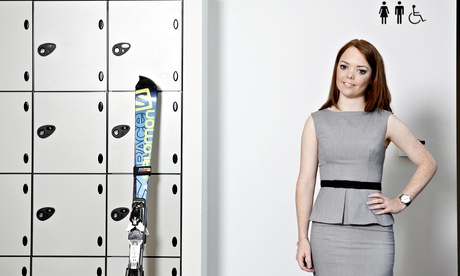
“It’s not just the money,” says Etherington when we meet at Bishop Grosseteste University in Lincoln. “It’s the set-up of the team: it needs to become more professional. Since I’ve said this, nearly every athlete on the team has said how thankful they are to me for saying that.” She continues: “On the other side, I love my teaching. Teaching is a lot harder than skiing. The easy thing would be to carry on skiing, 100%. But in 20 years’ time, I would definitely value my teaching more than the medals.”
Etherington admits life has been odd since she came home from the Games. She recently turned on the Christmas lights in Bourne, her home town, and Lincoln; the other day she was almost knocked over by a bus that had her face on the side of it. She has a new boyfriend, her first since becoming semi-famous: “He already knew I couldn’t see very well. It wasn’t a shock to him.” Mostly, however, she has been disoriented by being able to do whatever she wants and eat whatever she likes. “Before, anything I did, it was always, ‘Is that going to help me get a medal?’ Now you’re thinking, ‘I haven’t achieved anything today!’ And that’s really scary.”
At Christmas, Etherington is going skiing with her parents and three sisters, her first time on the slopes since the Games. For the first time in years, she won’t have to wake up at 4.30am and she can stop whenever she likes for a hot chocolate. But as she talks about the holiday, it’s obvious she has mixed emotions. “I do miss skiing – it’s such an exhilarating feeling. When I’m skiing with my family I know I’ll be like, ‘I wish Caroline was here so I could go fast!’”