“As painful as this is, we feel it a necessary decision to maintain the integrity of the Little League program.”
If the above statement looks familiar, it should. It’s yet another example of person who runs a highly profitable sports league – in this case, the president of Little League International, Stephen Keener – framing a business decision as a moral imperative.
On Wednesday, Keeler announced that Jackie Robinson West “knowingly violated Little League International rules and regulations by placing players on their team who did not qualify to play because they lived outside the team’s boundaries.”
In brief, the team cherry-picked a few talented children to create a powerhouse, and apparently not for the first time. In October, an opposing administrator, Chris Janes, started making formal complaints. A cursory investigation began, with Jackie Robinson West officials clumsily trying to backdate a form or two to make it seem like all this was on the up and up. Little League International initially tried to bury this mess, saying that the documents “met their standards and they were satisfied.” Janes wouldn’t relent, though; getting the information to a reporter, and it wasn’t long before the mounting evidence was too overwhelming for the powers that be to ignore.
The thing that rankles here is that the ruling seems excessively punitive; that it wasn’t necessary to bring the hammer down on the kids themselves. Keeler certainly could have booted all of the so-called adults in charge (as he did), and let the title stand, instead of literally erasing the players from the history books. After all, it seems as if they weren’t active participants in this deception.
Why, then? Well, let’s return to Keeler’s official statement. “For more than 75 years, Little League has been an organization where fair play is valued over the importance of wins and losses.”
That’s what they’re selling; a sport that doesn’t feel like rapacious multibillion-dollar entertainment colossus. Forget the fact that the US title game brought more than 5m pairs of eyeballs to ESPN, that the network is going to shill out $76m over the next eight years to broadcast the Little League World Series, and that Little League International, like their NFL brethren, a non-profit organization, is sitting on, as Jeff Passan of Yahoo! Sports reported, “more than $80m in assets and nearly $25m in revenue.”
If you watched these kids play, or marveled at Mo’ne Davis’ ability to fire 70mph fastballs past hitters like an in-his-prime Randy Johnson, you could plausibly engage in the fantasy that all of this really about building character, learning how to be a leader, and all of the quote unquote “life lessons” that we’re told sports exists to impart. It felt fun, innocent, pure, and in no way, shape or form about the money. To quote Norville Barnes, “You know, for kids!”
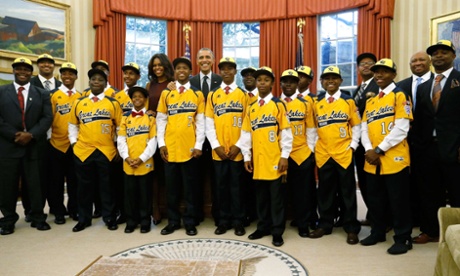
And the best part of all of this is that a lot of it was true. It was great, unadulterated fun. The kids of Jackie Robinson West were having a blast, and watching their improbable trip to the finals against South Korea made for fabulous theater – a straight shot to the heart of the reasons why people chose to invest emotional currency in sports. It’s no wonder that Chicago politicians of every stripe shamelessly tried to bathe in their attendant glory, including President Obama.
But now it all feels so tawdry, and none of this is the kids’ fault. What makes both the revelations and the stripping of Jackie Robinson West’s title feel so unseemly and awful is not only the basic unfairness of it all. More to the point, it’s yet another instance in which the high-profile news emanating from the sports world has been about the ways in which the organizing powers enforce their particular set of rules, rather than the games themselves. Once again, the punishments seem to both betray a fundamental hypocrisy and reinforce the authority of the powerful.
It’s Roger Goodell, desperately clinging to the notion that his job description is to “protect the shield”, consolidating his power even in the face of his massive bungling of the Ray Rice affair, or bringing the full weight of the league’s investigative powers to bear to plumb the depths of the enduring silliness that is Deflategate, stating that (there’s that word again) he “takes anything that attacks the integrity of the game very seriously.”
It’s Donald Sterling, finally expunged from the NBA even though they’d turned a blind eye to decades of casual and criminal acts of bigotry, because he’d turned into a PR nightmare and their various corporate partners were getting skittish.
It’s the NCAA dumbly humping its patently ludicrous definition of amateurism to suborn indentured servitude and deeming it “uniquely American.”
All of this should serve as a stark reminder that whenever a CEO screws on his or her most serious, concerned expression, someone’s about to get screwed, and it’s probably going not going to be the individual gripping the podium.
So the kids get slapped with a Belichickian Scarlet C for cheater, because Keeler doesn’t want you to notice the six-month gap between the initial complaints and the actual ruling, when they thought they could ride out this particular storm, let alone the numerous cases where parents have tap danced around Little League International’s laissez-faire oversight to lined their pockets.
He’d also prefer you don’t talk about the fact that, as the Atlantic reported, “in the ‘70s and ‘80s, foreign teams were often accused of using over-age players, practicing out of season, or building illegal “all-star” teams using the best players in their nation” without suffering the safe fate as Jackie Robinson West.
They feel bad about all this, you see. It’s “heartbreaking” and “painful.” It’s not actual emotion, mind you, but branded sentiment. And it pales in comparison to the mom who heard about the decision on the radio, watching her son, Brandon Green, the team catcher, and seeing “tears well up in his eyes,” yet still be able to put on a brave face and say, “No Mommy, I’ll be OK.”