Afternoon summary
-
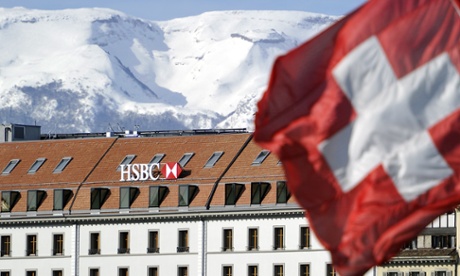
A new offence of aiding and abetting tax evasion and aggressive tax avoidance is expected to be included in the budget next month, George Osborne has said in his first comprehensive parliamentary response to the HSBC scandal. As Nicholas Watt reports, the chancellor, who declined to say whether he asked the former HSBC group chief executive Lord Green Hurstpierpoint about his tax affairs before his appointment as trade minister in 2011, also indicated that Britain is close to reaching an agreement with the French authorities to widen the use of the leaked HSBC files. The deal will mean that law enforcement agencies, including the Serious Fraud Office, will be able to make use of the files in addition to HMRC. The chancellor made his announcement during an urgent question in the commons tabled by the shadow chancellor Ed Balls. On the planned new offence of aiding and abetting tax evasion, the chancellor said:
Ahead of the budget I set the treasury to work on providing further ways to pursue not just the tax evaders but those providing them with advice. Anyone involved in tax evasion, whatever your role, this government is coming after you. Unlike the last government, who simply turned a blind eye, this government is taking action now and will do so again at the budget.
- The Labour party has challenged David Cameron to state whether he will take part in the TV leaders’ debates in the runup to May’s general election after the running order of the three debates was revealed on Monday following the drawing of lots between the broadcasters involved. A head-to-head debate between Cameron and Ed Miliband is last on the schedule, on 30 April, days before the vote. It is to be presented by Jeremy Paxman and Kay Burley.
- Ukip’s plans to make immigrants have health insurance for their first five years in Britain would not lead to ill people being denied treatment, Nigel Farage has said. As Rowena Mason reports, unveiling his party’s health policy on Monday, the Ukip leader confirmed that tourists, students and all those moving permanently except refugees would need medical cover before entering the country. However, the party has not yet set out precise details about how this would work, including whether more visitors would need visas to enter, the method of policing it and how those who were already in the country without cover would be dealt with.
- David Cameron has said that airlines and internet companies need to do more to prevent radicalised British teenagers travelling to the Middle East to join radical group Islamic State. In a statement to MPs on last week’s EU summit, he said he was “horrified” over by the case of three London girls believed to have travelled to Syria to join IS after being indoctrinated by extremists online. As the Press Association reports, he announced that home secretary Theresa May and transport secretary Patrick McLoughlin will be talking with airlines on new “proportionate” arrangements to ensure that children who are at risk are properly identified and questioned, and said border police should be alerted of any concerns so they can stop individuals from travelling.
- Cameron has dismissed calls for a change in the law to specifically ban abortions on grounds of gender, insisting existing legislation is sufficiently strong. MPs are due to debate the proposal later today.
- Nick Clegg has said that thousands of offenders are being jailed unnecessarily. As the Press Association reports, in a speech he promised to press for more early interventions to stop vulnerable people going to prison if the Liberal Democrats are in government after the general election. He also dismissed the claim that “prison works” as nothing more than a “slogan” when the reality for many offenders is that it makes their problems worse.
- The archbishop of Canterbury has admitted the revelations jobs in the Church of England are paying below the Living Wage - despite its calls to the contrary - are “embarrassing”. However, as the Press Association reports, Justin Welby said the church had been clear the “move towards” having the Living Wage paid across all parishes, cathedrals and diocese was a gradual process which would take time. The archbishop dealt head-on with a story on the frontpage of the Sun newspaper that Canterbury and Lichfield Cathedrals were offering posts under the living wage, which is 7.85 an hour outside London.
Monday's Sun front page: Wages of sin #tomorrowspaperstoday #bbcpapers pic.twitter.com/RPtQ6YKl5p
— Nick Sutton (@suttonnick) February 22, 2015
That’s all from me for today.
Thanks for the comments.
Updated
Osborne's statement on HSBC - Summary
This is what George Osborne said in response to the five questions about the government’s conduct over HSBC and tax avoidance raised by Ed Balls.
I’ve taken the text of the questions from Balls’ letter, and posted the key points from Osborne’s reply in the chamber this afternoon.
1 - Why has there only been one prosecution out of 1,100 names? Was the “selective prosecution policy” a decision made by ministers?
The answer is, yes it was a decision made by ministers. The Inland Revenue’s overall approach to prosecuting cases of suspected serious tax fraud was set out in column 704 on 7 November 2002 by [Gordon Brown]. It was set out again when HMRC was created in 2005, again by [Brown].
2 - When were you first made aware of these files, what action did you take and did you discuss it with the prime minister?
Well, I first became aware of the existence of these files in 2009, when a story appeared in the Financial Times. I was the shadow chancellor at the time so I could take no action. But I couldn’t discuss it with the then prime minister because I was not on speaking terms with him.
3 - Why did you and David Cameron appoint Lord Green as a Conservative peer and Minister months after the government received these files?
Because we thought he would do a good job as trade minister. And so did the Labour party. They welcomed the appointment. But the trade job was not Stephen Green’s first public appointment. That was when he was appointed by the last government to be not just a member of the prime minister’s business council, but the chair of the prime minister’s business council, a post he continued to hold after the existence of the HSBC files became public and after HMRC under the last government negotiated to recover them.
4 - Did you and David Cameron discuss tax evasion at HSBC with Lord Green, or did you turn a blind eye? Did you discuss allegations of money laundering at HSBC during Lord Green’s time at HSBC which led to the bank being fined $1.9bn?
I can confirm that the cabinet secretary and the director general for ethics at the Cabinet Office carried out the background checks for ministerial appointments that were put in place by the last government.
5 - Why did you sign a deal with the Swiss authorities in 2012 which prevents the UK from actively obtaining similar information in the future?
Well, you don’t need my explanation. Listen to the shadow chief secretary at the time. He said this: “We support the agreement signed by the UK and the Swiss government.”
During the exchanges, Osborne also dropped a strong hint that he would announce new measures to tackle tax avoidance in the budget.
Osborne v Balls on HSBC - Verdict
Osborne v Balls - Verdict: Generally, the HSBC story has probably been a positive one for Labour, because it has allowed the party to remind voters of the unpalatable links between the Tories and mega-rich City donors and because, in the showdown between Ed Miliband and Lord Fink, Fink backed down. It was not so much Lord Fink as Lord Blink. But Labour’s hasn’t done such a good job trying to establish that the Tories are to blame for anything that happened at HSBC, and for HMRC’s rather lacklustre response to it, and, when Ed Balls had another go today, he failed. George Osborne saw him off with ease.
Osborne was helped by an anti-Balls heckling operation that was excessive even by Commons standards. But mainly he won because he engaged with Balls’ points, and answered them with partisan ruthlessness. He took the five questions Balls posed in a public letter to him and went through them, essentially arguing that it all went wrong under Gordon Brown. I will post a summary shortly.
As I’ve already said, the FT’s George Parker came to much the same conclusion. (See 3.57pm.) Here are verdicts from two other journalists on Twitter.
George Osborne is truly Son-Of-Brown when it comes to totally dominating the Commons. Whose fault is HSBC? Balls, Brown and, er, the French
— ann treneman (@anntreneman) February 23, 2015
Labour MPs could do better job of pretending to look enthused if they want us to conclude they think Balls is doing a good job with this qu
— Isabel Hardman (@IsabelHardman) February 23, 2015
John Bercow, the Speaker, says he is going to have to stop the statement now, even though some MPs are still trying to ask questions, because there is a statement from the prime minister coming next, and than an important debate.
I’ll sum up the main points from the exchange soon.
Ed Balls is using Twitter to take a fresh swipe at Osborne.
George Osborne fails to answer any questions concerning his conversations with Lord Green on tax evasion at HSBC or the Swiss deal
— Ed Balls (@edballsmp) February 23, 2015
George Osborne has now three times refused to say whether he discussed HSBC tax evasion with Lord Green after he became a minister
— Ed Balls (@edballsmp) February 23, 2015
Osborne says tax evasion is illegal. And aggressive tax avoidance is something the government goes to great lengths to stop, he says.
Jacob Rees-Mogg, a Conservative, says even the most respectable families use legitimate methods to minimise death duties.
Osborne says this is a reference to Ed Miliband.
Labour’s Emily Thornberry asks Osborne to back corporate liability, making banks corporately liable for wrong-doing by their employees. Labour is proposing this, she says.
Osborne says Labour had 13 years to deal with this. He says the government will address this in the budget.
Labour’s Helen Goodman asks Osborne if he ever discussed tax avoidance at HSBC with Lord Green.
Osborne says the proper procedures were followed for the appointment of a minister. He is not privy to the tax affairs of any citizen. It would be an abuse if he were, he says.
He says the information about HSBC came to light in 2009, when Green was chair of the prime minister’s business council.
George Parker, the FT’s political editor, thinks George Osborne had the better of the exchange with Ed Balls.
Osborne announces new measures on tax evasion in Budget. Balls not landing many hits on HSBC scandal
— George Parker (@GeorgeWParker) February 23, 2015
Osborne says Danny Alexander yesterday raised an idea - a new penalty for those who facilitate tax evasion - that is being considered by the Treasury. An announcement will come in the budget, he suggests.
My colleague James Balls has two stats to back up Ed Balls’ case.
Days UK government had #HSBCfiles under previous gov: 11 Days UK government had #HSBCfiles under current gov: 1,749
— James Ball (@jamesrbuk) February 23, 2015
Labour’s Frank Dobson asks Osborne if obtaining financial advantage by deception is a crime. And why does HSBC have 566 operations in tax havens?
Osborne says these are serious allegations.
The information was received from the French authorities subject to terms governing its use. The government is now in active discussion about whether it can pass this to the Serious Fraud Office. Osborne says he thinks this will come to a fruitful conclusion.
Osborne is responding to Balls.
He says that performance won’t save Balls’ career.
He has answered all the questions, he says.
Balls says the information was given to the government in May 2010. But it was in April 2010, when Labour was in power, Osborne says.
The information was given under a restrictive agreement. This government is now trying to change that, he says.
Under Labour, rich people were paying less tax than their cleaners, and rich people regularly avoided capital gains tax.
Osborne says Balls’ economic policy is in tatters. He cannot name a single business supporter. His war on tax avoidance has turned into a war with his window cleaner. And, having lost the support of the public a long time ago, Balls has now lost the support of his leader, he says.
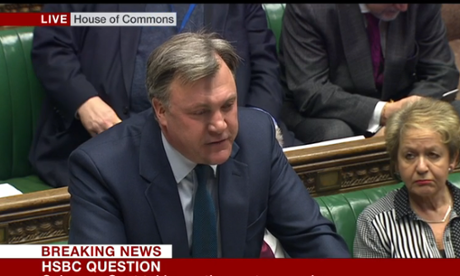
Ed Balls says Osborne has finally been dragged to the Commons to answer questions about this.
We need action, not a chancellor sweeping these issues under the carpet, he says.
The government was given detailed information in May 2010 about 1,000 HSBC clients.
(The shouting is very loud. John Bercow interrupts, and tells MPs to “cut it out or get out”).
Balls says when the Tories shout, they have something to hide.
He says he wants to ask Osborne what he knew and when.
Downing Street said ministers did not know about these allegations until two weeks ago. But now he says he knew in 2009. If he knew in 2009, why did he not act when he became prime minister?
Why has there been only one prosecution out of 1,100 names?
Did Osborne says he wanted a selective prosecution policy?
Why did Osborne sign a deal with the Swiss authorities in 2012 that would stop HMRC getting this kind of information in the future? They signed a deal which said Britain would not “actively seek” information stolen from banks.
Why was Green appointed as a Conservative peer and minister after the government received these files?
What due diligence was carried out?
Did Green have any involvement in the Swiss tax deal? Did Osborne ever discuss what happened at HSBC with Green? David Cameron could not answer this question. Osborne needs to answer.
Balls says it is not good enough for Osborne to “bluster” and to sweep this under the carpet.
Isn’t it clear either that Osborne and Cameron were negligent, failing to act on the evidence? Or did they, as with Andy Coulson, deliberately turn a blind eye?
Updated
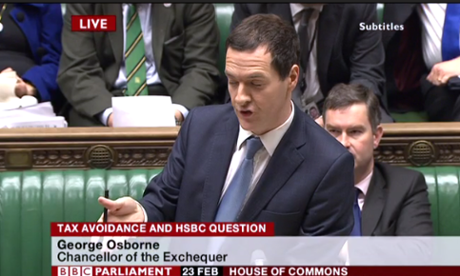
George Osborne says the chief executive of HMRC and the director of public prosecutions have the necessary resources to investigate these cases.
But the cases related to the period before 2006, when Ed Balls was the Labour government’s chief economic adviser. And the files came to light when Balls was in the Labour cabinet.
Osborne runs through five questions posed by Balls.
1) Was the prosecution policy set by ministers? Yes, says Osborne. By Gordon Brown when he was chancellor. Did Balls draft that policy.
2) When was Osborne first aware of this? And when did he discuss it with the prime minister. Osborne says he learnt about it when he read about it in the FT in 2009. He could not discuss it with the PM at the time because he was not on speaking terms with him. But Balls was in cabinet at the time, and could have raised it.
3) Why did the government appoint Stephen Green as a minister? Osborne says Green’s first public appointment came under Labour. He was on the prime minister’s board of economic advisers, and chaired it.
4) Why was Green given a peerage? Osborne says this happened under procedures set out by Labour.
5) What is the government doing about tax evasion? Osborne says the government’s moves were welcomed by Labour.
He concludes saying he is happy to answer for his record. Now Balls has to answer for his.
Updated
Ed Balls asks for a statement on the HSBC tax evasion scandal.
John Bercow, the Speaker, says he does not want to be pedantic, but the agreed wording of the urgent question related to the “tax avoidance” scandal.
George Osborne responds to urgent question on tax avoidance and HSBC
George Osborne is about to answer an urgent question from Ed Balls on HSBC and tax avoidance.
Here’s Iain Anderson, chairman of the Association of Professional Political Consultants, on the cash for access allegations.
How many times does this kind of story need to happen and how many times do we need to make the point there are NO professional lobbyists to be seen in these sting operations? What is also clear is that the statutory lobbying register would not have stopped any of this.
Straw criticises three main party leaders for not backing Ipsa over MPs' pay
Jack Straw told Newsnight earlier today that, if a cap is imposed on MPs’ outside earnings, as Ed Miliband proposes, their pay should go up. (See 11.56am.)
In an interview for a Radio 4 programme being presented on Saturday, Julia Dear Boy ... Welcome to Westminster, presented by Julia Langdon, Straw criticised the party leaders for not backing Ipsa, the independent parliamentary standards authority, when it said MPs’ pay should rise. The interview was recorded before today. Asked whether higher salaries would attract a “different category of person” to become MPs, Straw said:
Yes and I think there is [a] really serious issue these days of making politics sufficiently attractive for the brightest and best in our society and quite a number of us on both sides are privately concerned about this.
I am very critical of all three party leaders for the fact that we set up Ipsa, we gave it independent power to determine MPs’ pay and in fairness to them they bit the bullet and said yes, it needs to go up to the level of the head of a smallish school. Now the party leaders - three of them - are seeking to renege on that which is very unimpressive because each of them are paid six figure salaries.
Updated
And here’s a Guardian video showing Jack Straw responding to the cash for access allegations.
'Cash for access' - Who's winning?
Unless members of the intelligence and security committee get together later and hand Sir Malcolm Rifkind the black spot, we’ve probably had most of the drama we’re going to get today from the “cash for access” controversy.
So, who’s winning (apart from Channel 4 and the Telegraph, obviously)?
Certainly not parliament. What’s most striking about the controversy is the yawning gap it has exposed between what MPs are allowed to do and what people actually think that they should do. MPs are allowed to take second jobs as consultants, provided they do not engage in “paid advocacy”, and the relevant rules are largely about ensuring that relevant interests are declared. My colleague Matthew Weaver has had a look at the rules that Jack Straw and Rifkind could conceivably have broken, but he hasn’t found it easy, and if the best that anyone can do is to find Straw guilty of having a business meeting in his office (see 1.17pm), then the parliamentary commissioner for standards is unlikely to get excited. (The claim that Straw got his parliamentary researcher to do business work for him looks more serious, but Straw answered this this morning when he said that only two thirds of the researcher’s salary was paid by parliament, and that the rest was paid by Straw himself.)
But even if Rifkind and Straw were acting within the rules, there are two aspects of this that people find disturbing; first, MPs who are paid to represent their constituents having second jobs; and, second, former ministers using their political influence for commercial gain. When stories like this crop up, there is always a vocal “they’re all crooks” lobby who will queue up to denounce the MPs involved. But today’s reaction (see 10.40am) goes beyond kneejerk MP-hate.
So far I’ve labelled Straw and Rifkind together, but their cases are quite different. Straw was speaking to the undercover reporters about a paid role for after he left the Commons. And he has sounded notably more contrite than Rifkind, who was interested in picking up a new consultancy to combine alongside his important and demanding parliamentary duties.
That’s one reason why, although both main parties are implicated, the Tories are more damaged.
But there’s another, much more important reason. It is hard to see what you can do to stop former ministers trying to monetise (as we call it in digital journalism) their experience and contacts, but it is easy to see what you can do to stop MPs having a second job. Ed Miliband has clear ideas, and he hasn’t even had to improvise today because this is an issue he has highlighted before. (See 10.16am.) There are strong arguments against the cap on outside earnings he is proposing - David Cameron, see 12.51pm, and Paul Goodman, see 1.23pm, have been making them - but Miliband has one huge advantage. The public agree with him. According to a YouGov poll from 2013, 56% of people are in favour of a ban on MPs having second jobs and only 25% are opposed.
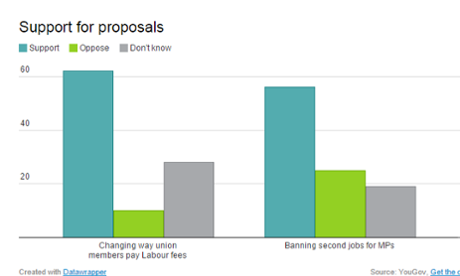
So, who’s winning? Today, it’s Miliband.
Updated
In a post for ConservativeHome, Paul Goodman (who quit his job at an MP in 2010 to return to journalism) says people want the impossible in relation to MPs’ pay and outside interests.
Here’s an extract.
We have moved much closer to a Commons of professional politicians, with their salaries and expenses paid by the taxpayer. These are no more popular than the generation that preceded them.
There is a choice. The first option is the citizen legislator model of MP, under which they earn privately and aren’t supported by the taxpayer. That would mean more scandals like today’s. The second is the professional politician who is paid to do a full-time job as a legislator and is supported by the taxpayer to that end. He will have to be better remunerated if the quality of MPs is not to collapse.
Collectively, we don’t want to make that choice. We want MPs who don’t earn outside the Commons and aren’t paid more by the taxpayer and are people of real ability. But it’s impossible to have all three at once.
Nick Sutton, editor of the BBC’s World at One, has found one Commons rule that Jack Straw may have breached.
Did Jack Straw breach Members' Handbook by meeting undercover reporters in Commons? http://t.co/Ucgvxbe4k1 #wato pic.twitter.com/3svYqY0skE
— Nick Sutton (@suttonnick) February 23, 2015
Sutton also says that one former minister approached by the undercover reporters told the programme that their offer felt “dodgy”.
One former minister we spoke to this morning approached by Ch4/Telegraph told us that "it appeared dodgy from the outset." #wato
— Nick Sutton (@suttonnick) February 23, 2015
Rifkind suggests he expects internal Tory inquiry to clear him quickly
Sir Malcolm Rifkind told the BBC’s Daily Politics that he accepted the party’s decision to suspend him temporarily. But he implied that he expected to be reinstated quickly.
It is meant to be a temporary matter for a period of time before there is an internal investigation inside the Conservative party. If it is that for a short period of time then we must let that take its course ...
All political parties are in a difficult position when allegations of this kind are made. They don’t want to jump to conclusions in either direction and if there is to be an internal Conservative examination, if I am given the opportunity, which I understand is likely, that I will be able to present these matters to such a body and they will be able to come to a view within a very short period of time – one way or the other - then that is a reasonable way forward.
I’ve taken the quote from PoliticsHome.
At an event in south London Nick Clegg said that the “cash for access” affair felt like “Groundhog Day” because “this keeps coming round”.
After the election the rules on MPs having second jobs should be reviewed, he said.
Whether there is individual wrongdoing or not, the cumulative effect is to deepen public scepticism about how politics operates and that’s a great shame for anyone who believes in the quality of our democracy.
My own view is all political parties would be well advised to immediately after the next general election get together and have a look on a cross-party basis whether the rules need to be changed.
Huffington Post’s Asa Bennett says Sir Malcolm Rifkind earns about as much from his outside interests as he does from his parliamentary work.
Malcolm Rifkind manages to basically double his £81,936 (MP and #ISC chair) salary with all his second jobs... pic.twitter.com/3eM4I61TGk
— Asa Bennett (@asabenn) February 23, 2015
SNP says Straw/Rifkind claims show Westminster 'incapable of cleaning itself up'
Angus Robertson, the SNP’s leader in Westminster, says the Straw/Rifkind affair shows that Westminster is incapable of cleaning up its act.
These revelations once again raise serious questions about the way the Westminster Labour and Tory establishment behave and conduct themselves. It is not good enough to brush these revelations aside as a ‘trap’ or as ‘silly things to say‘- as those involved have.
What is even more galling is that the Dispatches investigation is a rerun of an almost identical exercise carried out just before the last election five years ago. At the time, MPs – including Jack Straw – queued up to condemn the MPs’ behaviour and promise reform.
Fast forward five years, nothing has changed and we can see that Westminster is completely incapable of cleaning itself up.
It isn’t surprising that Westminster is held in such low esteem by so many people when we see antics like this. People are sick and tired of this kind of behaviour. Time really is up for this tired Westminster Labour/Tory cosy establishment, which is so out of touch with the way people lead their lives.
Ed Miliband's statement on the Straw/Rifkind allegations
Here is the statement Ed Miliband has put out this morning about the Straw/Rifkind allegations.
These are disturbing allegations. That is why it’s right that Jack Straw has referred himself to the Parliamentary Commissioner for Standards, and he has been suspended from the Parliamentary Labour Party.
We need a proper investigation of this, but I believe we need to go further.
Labour candidates standing at the next election will be banned from taking paid directorships or consultancies.
Today I’m writing to David Cameron saying he should do the same for his Members of Parliament. We’ve got to settle this issue of second jobs once and for all so we remove any suspicion that MPs are working not for their constituents’ interests but someone else’s interests.
Cameron on the Straw/Rifkind affair
Here are the key quotes from David Cameron’s Q&A on the Straw/Rifkind affair.
-
Cameron said these were “very serious” allegations and that it was right that both Sir Malcolm Rifkind and Jack Straw were being suspended from their parties pending an investigation.
These are very serious matters and we have, rightly, very clear rules in this country which is: MPs being paid to lobby, that is not acceptable, that is not allowed under the rules. I think it’s right that both Jack Straw and Malcolm Rifkind have referred themselves to the Parliamentary Commissioner to have themselves investigated. And I think it’s also right that in both cases, while that happens, that the party whip should be suspended and that is what will happen with Sir Malcolm Rifkind, as well as with Jack Straw.
-
Cameron suggested an internal Tory inquiry would adjudicate on Rifkind quickly so that he could, if cleared, stand as a candidate at the general election. (Straw is standing down at the election, but Rifkind has - at least until today - been intent on getting re-elected.)
Obviously in Sir Malcolm’s case, he is still a candidate at the next election so there will be an immediate disciplinary inquiry by the Conservative party to look at this case.
-
Cameron said it was up to the intelligence and security committee, not him, to decide whether Rifkind stayed on as its chair.
Under the new rules, that is a committee of the House of Commons. The chairman is not appointed by me; the chairman is appointed by the members and I cannot interfere with that and it’s a matter for the committee, it’s a matter for the House of Commons.
-
Cameron rejected Ed Miliband’s call for a very tight limit on the amount MPs can earn from second jobs. It was more important to ensure the current rules were enforced, he said.
I don’t favour a complete ban on all outside jobs or interests. What I see from the Labour proposal is actually not outlawing outside business or interests, but putting a new set of rules which would, for instance, allow someone to work as a trade union official, but wouldn’t allow someone to run a family shop or a family publishing business or such like and I think that wouldn’t make sense. I think: enforce the rules, total transparency, and demonstrate to people: people in Parliament are there to work for them, serve their communities, serve their country.
I’ve taken the quotes from PoliticsHome.
At the Ukip health event, Nigel Farage, the Ukip leader, also suggested that Sir Malcolm Rifkind should stand down as chair of the ISC.
Farage says he thinks it's 'very questionable' that sir Malcolm Rifkind should retain any senior role he has in parliament
— Robin Brant (@robindbrant) February 23, 2015
The Ukip MP Douglas Carswell is even blunter about this.
How can Malcolm Rifkind possible chair the Intelligence Committee? What sort of country have we become?
— Douglas Carswell MP (@DouglasCarswell) February 23, 2015
Updated
It was the Justice and Security Act 2013 that made the ISC a committee reporting to parliament, not to the prime minister.
As Donald Campbell points out on Twitter, the legislation does allow the chair to resign, or MPs to remove a member of the committee by passing a resolution in the Commons.
Tom Watson accuses Cameron of 'ducking the question' over Rifkind's future as ISC chair
Tom Watson, the Labour MP, has just told BBC News that Sir Malcolm Rifkind should resign as chair of the intelligence and security committee. He accused David Cameron of “ducking the question” over this.
The idea that we can have a chair of an intelligence committee who is negotiating payment from a Chinese company would really concern people in the intelligence community. I heard the prime minister’s answer at the press conference. For him to not take responsibility whether it is the right thing to do or not is ducking the question ...
If the chair of the intelligence committee no longer has the confidence of the prime minister, then he shouldn’t be in that position. I think the prime minister needs to form a view whether he wants the intelligence committee chair to be working as a lobbyist for Chinese companies. Just put it the other way round. Do you think the Chinese government would let the equivalent chair of the intelligence committee in China work for a British company?
Updated
Q: Are you going to suspend Sir Malcolm Rifkind from the party? And will he have to stand aside as ISC chair? And will you match Ed Miliband’s plan for a curb on how much MPs can earn from second jobs?
Cameron says these are very serious matters.
MPs are not allowed to be paid to lobby.
It is right that Jack Straw and Sir Malcolm Rifkind have referred themselves to the parliamentary commissioner for standards. And it is right that they have both had the party whip suspended.
Rifkind is a candidate at the next election. And that is why the Conservative party will be looking into this quickly, he says.
He says the government has legislated to change the rules on lobbying.
Cameron says the ISC, under new rules, is a committee of parliament. Its chair is elected by its members. And so this is not a matter for him, he says.
(Sorry. My earlier post - see 10.40am - was wrong. I had not realised that the status of the ISC had changed.)
He says that MPs draw useful experience from having second jobs.
Labour’s plans would allow an MP to work as a union official, but not to run a shop. That does not make sense, he says. It would be better to enforce the current rules.
- Cameron confirms that Sir Malcolm Rifkind has been suspended from the Conservative party - but suggests the party will decide his fate quickly so that, if cleared, he can stand again at the election.
- Cameron says it is up to the ISC to decide whether Rifkind remains as its chair.
Rifkind reacts LIVE: "I think it's meant to be a temporary matter before there is an internal investigation within the party"
— Guido Fawkes (@GuidoFawkes) February 23, 2015
Cameron's Q&A
David Cameron is taking questions now.
He says he will save up questions from the press until he has taken questions from people in the audience.
Tory source are confirming that the party whip has been removed from Sir Malcolm Rifkind, pending an investigation into the “cash for access” allegations.
Guido Fawkes is claiming that the Tories have suspended Sir Malcolm Rifkind.
Tories suspend Rifkind.
— Guido Fawkes (@GuidoFawkes) February 23, 2015
No 10 rejects Miliband’s call for tight limits on MPs’ earnings from outside jobs
David Cameron is delivering his speech on pensioner benefits now.
I will cover the substance later, when I’ve read the text, but I will be covering the Q&A as it happens. As I said earlier, we may get some clarification about Sir Malcolm Rifkind’s future.
But, from what we were told at the Number 10 lobby briefing, we know that he is going to reject Ed Miliband’s call for a drastic curb on how much MPs can earn from second jobs.
No 10 say Cameron not budging on MPs having second jobs. PM believes it's good for MPs to have broad range of experience
— David Singleton (@singersz) February 23, 2015
Cameron's spokesman has said no @Ed_Miliband says PM doesn't want a chamber full of professional politicians
— Jim Pickard (@PickardJE) February 23, 2015
Sir Malcolm Rifkind has had his meeting with Michael Gove, the BBC’s Norman Smith reports.
A tight lipped Sir Malcolm Rifkind refuses to discuss outcome of his meeting with chief whip
— norman smith (@BBCNormanS) February 23, 2015
Straw says MPs' pay would have to go up if cap on outside earnings were introduced
Jack Straw has told Newsnight that, if a cap is imposed on MPs’ outside earnings, as Labour proposes (see 10.16am and 10.24am), MPs pay would have to go up.
Jack Straw tells Newsnight he doesn't think Labour can cap MPs' outside earnings at 10/15% w/o following IPSA advice to up MPs' salaries 1/
— Allegra Stratton (@BBCAllegra) February 23, 2015
2/ Straw: "There's a really significant issue which needs to be debated in a rational way about how you attract good people in to politics..
— Allegra Stratton (@BBCAllegra) February 23, 2015
3/ "... And ensure not that they are brilliantly rewarded but that they are reasonably rewarded", Jack Straw just told us.
— Allegra Stratton (@BBCAllegra) February 23, 2015
Ipsa the independent parliamentary standards authority, says MPs should get a 9% pay rise after the election. But all the main party leaders have opposed this proposal.
Updated
David Cameron is about to give his speech on pensioner benefits.
David Cameron about to make speech pledging to protect pensioner benefits: Politics Live - http://t.co/swIqB1YUcE pic.twitter.com/H24J6x8mZ1
— BBC Politics (@BBCPolitics) February 23, 2015
Presumably he will address the Straw/Rifkind affair in the Q&A.
No 10 refuses to express confidence in Rifkind as ISC chair
The Number 10 lobby briefing is over. And it sounds as if David Cameron could be getting ready to ditch Sir Malcolm Rifkind as chair of the intelligence and security committee (ISC).
No 10: Michael Gove, chief whip, meeting Sir Malcolm Rifkind this morn. MG to brief PM on MR future as ISC chair after 'concerns' raised
— Nicholas Watt (@nicholaswatt) February 23, 2015
Cameron withdraws support for Rifkind - PM's official spokesman refuses to express confidence in his ISC chairmanship or holding Tory whip.
— Tom Newton Dunn (@tnewtondunn) February 23, 2015
PM's spokesman refuses to say the David Cameron has confidence in Malcolm Rifkind as chair of Intelligence and Security Committee
— Joey Jones (@joeyjonessky) February 23, 2015
If the ISC were a normal committee, Cameron could not remove the chair, because those chairs are elected by MPs.
But the ISC is a special committee that reports to the prime minister. If Cameron were to say that he no longer had confidence in Rifkind, Rifkind’s position would be untenable.
Michael Gove, the chief whip, is meeting Rifkind this morning and will brief Number 10 afterwards. We should get a decision on Rifkind’s future before the end of the day.
UPDATE AT 12.18PM: The ISC does not report to the prime minister anymore. Sorry, I was wrong about that. David Cameron clarified this in his Q&A. See 12.18pm.
Updated
Here are two interesting blogs about the Straw/Rifkind affair.
[Rifkind] wasn’t paid a salary, he was self-employed so he could do what he wanted. Oops. He had to admit getting that one wrong. The taxpayer very definitely does pay him a salary – of £67,000, two and a half times the average wage – but what he meant was that it was too small to really count.
“That’s not a professional salary,” he said to the presenter in the certain knowledge that the BBC man will earn probably three times an MP’s income plus a fortune in outside speaking engagements. It means that the presenter is even part of the problem. He knows he can’t bark at Rifkind: “Are you saying £67,000 isn’t enough to live on?” and he also knows he is earning £10,000 a speech on the after dinner circuit so his own position is compromised.
Here you have the British elite dancing around each other with feign and parry in the ceremonial tableau of failed accountability. Why is Rifkind in Parliament?
But the harder ways in which our democracy is being auctioned off are only a small part of the problem. Because what really matters are the softer mechanisms – the ways in which those with lots of money find guides to navigate the complexities of the British state, the web of gentle influence which quietly ensures that British public policy never crosses certain lines, that the voices heard first, the people whose language MPs become accustomed to speaking, are at a certain end of the income spectrum.
Perhaps the most remarkable thing when each of these stories breaks is that those who have done wrong seem not to understand where or that they have erred. Like toddlers being told off for putting their fingers in the chocolate spread, they simply don’t see what the issue is. This is because the story about Rifkind and Straw isn’t so much a one off scandal as a system. The walls of Westminster are papered with corporate logos.
The Spectator’s James Forsyth thinks the order of the proposed TV debates (see 11.06am) will discourage Nick Clegg from participating.
Having the Cameron / Miliband head to head as the last debate is going to make the Lib Dems even more opposed to the current TV debate plans
— James Forsyth (@JGForsyth) February 23, 2015
Here’s a Guardian video showing Sir Malcolm Rifkind defending his conduct.
The Labour MP John Mann says paragraph 46 of the committee on standards and privileges report into the undercover sting involving Geoff Hoon and others before the 2010 general election should be worrying for Jack Straw and Sir Malcolm Rifkind.
Para 46 of standards report into Hoon is bad news for Straw and Rifkind
— John Mann MP (@JohnMannMP) February 23, 2015
Here’s the report (pdf). And here is paragraph 46.
In oral evidence, Mr Hoon accepted that most of what was said at the meeting with the undercover reporter had related to his experience of public life.68 That public life was of course as a Member of Parliament and a Minister. For us, this is the key point. Mr Hoon was still a public figure—still an MP—when he attended the meeting, during which he referred constantly to his experience of public life as qualifying him for the appointment he thought he was discussing. Because he was an MP, talking about his experience as an MP, we conclude that his behaviour and statements at the meeting were covered by the Code of Conduct. In our view, the question of whether the appointment he thought he was discussing was or was not a “public appointment” is of less significance.
Broadcasters announce order of proposed TV debates
Turning away from the Straw/Rifkind allegations for a moment, the broadcasters have just announced in what order they intend to hold the proposed televised leaders debates.
2 April: ITV - Debate between the party leaders of the Conservatives, Labour, Liberal Democrats, UKIP, the SNP, the Green Party and Plaid Cymru.
16 April: BBC - Debate between the party leaders of the Conservatives, Labour, Liberal Democrats, UKIP, the SNP, the Green Party and Plaid Cymru.
30 April: Sky and Channel 4 - Head to head debate between the Leader of the Conservative Party and the Leader of the Labour Party.
Whether the debates ever take place, though, is still anyone’s guess.
Here’s the start of a Sunday Times story (paywall) about this yesterday.
Televised leaders’ debates during the general election campaign will not take place, two senior government figures have declared, after the broadcasters refused to change the plans to invite seven parties to participate.
The BBC, ITV, Sky and Channel 4 have written to the parties to confirm they want to hold three debates in April, one featuring David Cameron and Ed Miliband.
The other two would also include Nick Clegg, the Liberal Democrat leader, Nigel Farage of Ukip and the leaders of the Green party, Plaid Cymru and Nicola Sturgeon, the Scottish National party leader.
But senior sources on both sides of the coalition said the broadcasters had “totally screwed up” and made “a massive strategic error” by refusing to tweak their 7-7-2 plans.
And here is what Andrew Neil said about this on Twitter after that story appeared.
Month ago I gave a lecture venturing TV election debates would not happen. No reason, yet, to change my mind. But still time.
— Andrew Neil (@afneil) February 22, 2015
And here is some political reaction to the Straw/Rifkind allegations.
From the Labour MP Paul Flynn
In 1994 I said 'Some MPs have their trouts so deeply in the trough all that's visible of them is the soles of their Gucci shoes' Plus ca ...
— Paul Flynn (@PaulFlynnMP) February 22, 2015
Whatever the outcome of the Rifkind/Straw allegations the reputation of UK politics is further damaged and anti-politics is boosted.
— Paul Flynn (@PaulFlynnMP) February 23, 2015
None of his interviewers asked Malcolm Rifkind why anyone would pay him to provide information 'that is already in the public domain.'
— Paul Flynn (@PaulFlynnMP) February 23, 2015
From the Conservative MEP Daniel Hannan
This is going to be deeply unpopular, but I found both Jack Straw and Malcolm Rifkind completely convincing on @BBCr4today this morning.
— Daniel Hannan (@DanHannanMEP) February 23, 2015
From the Labour MP John Mann
Will Malcolm Rifkind stand down as chair of parliamentary security and intelligence committee? He should.
— John Mann MP (@JohnMannMP) February 22, 2015
Rifkind and Straw refer themselves to the commissioner who reports to the standards committee , comprising of, err, oh yes, other MPs
— John Mann MP (@JohnMannMP) February 22, 2015
Jack Straw says it is easier to do paid lobbying in the House of Lords. This is true. Which is why it should be abolished.
— John Mann MP (@JohnMannMP) February 22, 2015
A national disgrace the Malcolm Rifkind has not resigned or had the Tory whip withdrawn
— John Mann MP (@JohnMannMP) February 23, 2015
No apology from Straw, but repeated use of word 'sting'. So if it was a real Chinese company then that's OK is it?
— John Mann MP (@JohnMannMP) February 23, 2015
From the Ukip MEP Patrick O’Flynn
I don't think Straw and Rifkind are bad people, but symptomatic of a bad system in which two parties have had too much power for too long.
— Patrick O'Flynn (@oflynnmep) February 23, 2015
From the Respect MP George Galloway
War criminal Jack Straw and Malcolm Bomber Rifkind are revealed tonight as a pair of old hookers renting themselves out in Parliament...
— George Galloway (@georgegalloway) February 22, 2015
From Dominic Cummings, the former special adviser to Michael Gove
Rifkind's feet shd not touch the floor as he's booted from intel role. Proved totally unfit & partic stupid given Chinese firm
— odysseanproject (@odysseanproject) February 23, 2015
Straw/Rifkind allegations - Verdict from the Twitter commentariat
Here is what some political journalists and commentators are saying about the Straw/Rifkind affair on Twitter.
Sympathy for the two former foreign secretaries is in short supply.
From the Newsnight editor Ian Katz
Most extraordinary bit of Rifkind/Straw story not what they sd but tht neither went to trouble of checking out "Chinese company" before meet
— Ian Katz (@iankatz1000) February 23, 2015
From Channel 4’s Michael Crick
Jack Straw and Malcolm Rifkind are fighting not just for their reputations but also their peerages
— Michael Crick (@MichaelLCrick) February 23, 2015
From the Guardian deputy editor Paul Johnson
During Snowden cab sec Jeremy Heywood came to Guardian and asked: how many of staff work for Chinese? Should have been asking in Parliament
— Paul johnson (@paul__johnson) February 23, 2015
From the Observer’s Nick Cohen
Malcolm Rifkind and Jack Straw have made a terrible mistake. If only they had advertised in the Telegraph, none of this would have happened.
— Nick Cohen (@NickCohen4) February 23, 2015
From the Guardian’s George Monbiot
When members of Parliament are allowed to take corporate money, their loyalties are divided. Moonlighting undermines democracy. #JackStraw
— GeorgeMonbiot (@GeorgeMonbiot) February 23, 2015
From the politics.co.uk editor Ian Dunt
I don't doubt that Straw and Rifkind stuck to the rules. That's the problem.
— Ian Dunt (@IanDunt) February 23, 2015
From the historian Andrew Roberts
Before the anti-establishment parties benefit from the Straw-Rifkind 'story', C4 & the Telegraph should say which pols turned them down flat
— Andrew Roberts (@aroberts_andrew) February 23, 2015
From the Telegraph’s Ben Riley-Smith
Startling contrast in tone between Sir Malcolm Rifkind and Jack Straw in reaction interviews this morning. Will public sympathies now split?
— Ben Riley-Smith (@benrileysmith) February 23, 2015
From LBC’s Julia Hartley-Brewer
Malcolm Rifkind told R4 Today that most "professional" earn far more than £67k a year. Really?!?!?!? Professional bankers maybe...
— Julia Hartley-Brewer (@JuliaHB1) February 23, 2015
4,150 candidates stood in 2010 gen elec for 650 seats: 6 for each seat. MPs, if you're unhappy with pay, plenty more where you came from
— Julia Hartley-Brewer (@JuliaHB1) February 23, 2015
From the academic Tim Bale
Whatever its merits, the Straw/Rifkind sting will play well for the Greens & UKIP - unless Miliband says 'No ifs, no buts, no 2nd jobs'.
— Tim Bale (@ProfTimBale) February 23, 2015
From Sky’s Faisal Islam
Banks, papers, politicians ... entire british establishment seems to be in some sort of cannibalistic feast.
— Faisal Islam (@faisalislam) February 22, 2015
From the Herald’s Iain Macwhirter
Astonishing that neither Straw or Rifkind appear to understand what the fuss is about. MPs for hire is just business as usual.
— Iain Macwhirter (@iainmacwhirter) February 23, 2015
From the Sun’s Steve Hawkes
Both Jack Straw and Malcolm Rifkind reminding voters that politicians - sometimes - don't get the fact they're held to higher standards
— steve hawkes (@steve_hawkes) February 23, 2015
From Isabel Oakeshott, the former Sunday Times political editor
Simply can't believe any politicians fall for this old chestnut. We've had decades of these exposes: all follow broadly the same format
— Isabel Oakeshott (@IsabelOakeshott) February 23, 2015
From the playwright Bonnie Greer
"Lobbying- next big scandal" Arguably Cam's only prediction to come to pass But he pledged to tighten the rules #JackStraw #MalcolmRifkind
— Bonnie Greer (@Bonn1eGreer) February 22, 2015
A useful reminder from the BBC’s James Landale.
Just remembered: Malcolm Rifkind was chairman of the Standards & Privileges Committee 2005-10.
— James Landale (@BBCJLandale) February 23, 2015
The cap that Labour is proposing for the amount MPs could earn from an outside job is 15% of salary, not 10% as Jack Straw suggested. (See 8.21am.)
Miliband in letter to Cameron calls for cap on outside earnings set at 15% of MPs salary and a ban on new directorships and consultancies.
— Patrick Wintour (@patrickwintour) February 23, 2015
Here’s a useful fact from the FT’s Jim Pickard.
Of 180 MPs with additional jobs, 112 are Tories. 43 are Labour. 15 are Lib Dems. #telegraph
— Jim Pickard (@PickardJE) February 23, 2015
Ed Miliband's letter to David Cameron about the Straw/Rifkind affair
Here’s the text of Ed Miliband’s letter to David Cameron reaffirming his call for MPs to be banned from having paid directorships or consultancies.
Dear Prime Minister,
I write this letter to you not just as leader of the Labour Party but as someone who believes that we all need to act to improve the reputation of our Parliament in the eyes of the British people.
I believe MPs are dedicated to the service of their constituents and the overwhelming majority follow the rules. But the British people need to know that when they vote they are electing someone who will represent them directly, and not be swayed by what they may owe to the interests of others.
Two years ago I said Labour MPs would not be able to hold paid directorships or consultancies after the next election.
My party is also consulting on legislation to make this a statutory ban, as well as imposing a strict cap on all outside earnings by MPs.
Today I can confirm that these measures will be included in my party’s General Election manifesto.
The low levels of trust in politics demands clarity and I urge you to follow my lead in banning paid directorships and consultancies.
There have been too many scandals about conflicts of interest in recent years.
It is time to draw a line under this and ensure these current allegations are the last.
I am sure you will agree this is a problem which affects all parties.
I believe these are circumstances which demand action and leadership.
I look forward to receiving your response.
Yours,
Ed Miliband
The Telegraph’s Ben Riley-Smith wasn’t impressed by Sir Malcolm Rifkind’s claim on the Today programme this morning that he was not “negotiating” terms with the undercover reporters. (See 7.19am.)
What's the difference b/w talking about future work + negotiating? Sir Malcolm Rifkind explains... pic.twitter.com/DuesQ1QRj1
— Ben Riley-Smith (@benrileysmith) February 23, 2015
Blair defends Straw and says he hopes he's cleared 'as soon as possible'
Here’s Tony Blair’s statement on Jack Straw.
I have known Jack for over 30 years. He is a byword for being a hard-working constituency MP and parliamentarian.
I can think of no-one who has more dedicated himself to public service.
I am really sorry he has been caught up in a sting operation about a job offer after he retires from Parliament.
It is typical of Jack that as soon as he was alerted of the sting against him he immediately contacted the parliamentary commissioner for standards and asked her to investigate the case. I hope that the commissioner will clear his name as soon as possible.
Tom Watson says ISC members should not have outside interests
Tom Watson, the Labour MP and a former defence minister, has written a short blog saying that members of the intelligence and security committee like Sir Malcolm Rifkind should not be allowed second jobs.
Here’s an excerpt.
The incident reminded me of a security briefing when a defence minister. “If a beautiful Russian or Chinese woman seeks your company in a bar Minister, it is unlikely to be because of your devilish good looks”. I’ve never forgotten it.
For the chair of the intelligence and security committee (ISC) to discuss working for a bogus Chinese company is very odd indeed. To be frank, I can’t believe ISC members are allowed outside interests. They see more sensitive information than most government ministers.
Tony Blair has defended Jack Straw.
Tony Blair offers support for Jack Straw in cash for access row - "He is a byword for being a hard-working constituency MP"
— norman smith (@BBCNormanS) February 23, 2015
I can think of no-one who has more dedicated himself to public service - Tony Blair on Jack Straw
— norman smith (@BBCNormanS) February 23, 2015
Updated
Sir Malcolm Rifkind is meeting Michael Gove, the Conservative chief whip, to discuss the “cash for access” allegations later today. Rifkind told Sky News that he asked for the meeting himself because he wanted to explain what happened. He was looking forward to “a very good discussion”, he said.
Ed Miliband is today calling for MPs to be banned from having paid directorships and consultancies.
Ed Miliband will write to the PM calling for MPs to be banned from having paid directorships or consultancies
— norman smith (@BBCNormanS) February 23, 2015
Jack Straw's Today interview - Summary
Here are the main points from Jack Straw’s Today interview.
- Straw said that he thought the rules on MPs having second jobs would be reviewed in the light of today’s allegations. He said he thought the current ones were satisfactory, but that Ed Miliband wanted much tighter restrictions on what MPs could earn from outside jobs.
I think the current rules are probably satisfactory, but I think inevitably they will be reviewed in the light of what has happened.
-
Straw said he was “mortified” that he had fallen for the Channel 4 sting.
I’m mortified by the fact that I fell into this trap set by very skillful journalists from Channel 4.
-
He said that he had always been “scrupulous” about following the rules on outside interests.
I’ve also been absolutely scrupulous in observing all the rules and those include all the rules that apply in respect of members’ outside interests since I left the front bench in 2010 ...
I have never, ever, ever misused information or contacts that I have made as a minister.
-
But he accepted that what he said in private to the undercover reporters sounded embarrassing.
Inevitably, if you have what you think is a private conversation where you trust the people you are talking to, you use language, not necessarily wrong, but [which could be] taken out of context.
- He stressed that he was talking with the undercover team about work he might do after leaving parliament, not while he was serving as an MP.
- He said that, when he talked about handling talks with EU officials “under the radar”, he meant that it was better to be polite than to be confrontational.
Let me just deal with this issue about ‘under the radar’, because it’s very important. I have worked for a very fine, long-established firm of British commodity suppliers called ED&F Mann. Issues have arisen about some unbelievably obscure aspects of the sugar regulations inside the EU and I’ve sought to help them negotiate changes in the EU sugar regulations
When I was talking to, as it turned out the undercover reporters about this, I said it was better to handle negotiations like this “under the radar” than shout in the street about them, in other words that you can get further with EU officials by being polite and quiet and forensic than shouting.
Updated
Q: Should the Chilcot report be published now?
No, says Straw. He says Sir John Chilcot himself has said the report is not ready to be published now.
But Straw says it would have been better if the report had been published earlier.
And that’s it. I will publish a summary shortly.
Q: Shouldn’t MPs be stopped from having second jobs?
Straw says he thinks transparency is most important.
Ed Miliband takes a different view, he says. Miliband wants to stop MPs earning more than 10% of their MP’s salary.
Straw says he thinks the current rules are satisfactory. But they will probably be reviewed in the light of this story, he says.
Updated
Humphrys plays a clip of what Straw said on a previous occasion when former Labour ministers (Geoff Hoon, I think) were caught on tape talking about making money in the private sector. Straw said those cases brought parliament into disrepute.
Straw says that, on that occasion, two of the MPs were found to have done something wrong.
He says he has always declared his outside interests.
If he had accepted a post with the supposed Chinese firms, he would have insisted on all sorts of security checks, he says.
Q: People will worry about ex-ministers using their contacts in this way. And they will be worried about you talking about acting “under the radar”.
Straw says everyone brings their contacts to a job. But he has never been accused of misusing his.
On the “under the radar” comment, he says he has worked for a commodity supplier. He has helped them change EU sugar regulations. He said he had done this “under the radar”. He meant that it was better to address these matters politely, rather than by running a public campaign.
He did exactly the same thing for a firm in his constituency, he says.
Updated
Jack Straw's Today interview
John Humphrys is interviewing Jack Straw on Today now.
Q: You say you have done nothing wrong. So why have you reported yourself to the parliamentary commissioner for standards and asked to be suspended from the Labour party.
Because of the way this appears, says Straw. It was a very skillful entrapment. But things that you say when you think you are having a private conversation can look embarrassing.
He says he has been MP for Blackburn for 36 years. It is what he always wanted to do, and he has always put the interests of constituents first.
He says he was talking about what he would do after he left the Commons.
Q: So why didn’t you wait until then to have the conversation?
Straw says he wishes he had done that.
He has had various talks about what he could do when he leaves the Commons. He wants a role that will engage his brain.
The previous conversations he has had have led to nothing.
Sir Malcolm Rifkind's Today interview - Summary
Here are the main points from Sir Malcolm Rifkind’s Today interview. I’ve beefed up the post from earlier, with some added quotes from PoliticsHome.
-
Rifkind said the claims that he had done anything wrong were “unfounded” and that that he would fight them vigorously.
These are unfounded and I am going to fight them with all my strength.
-
He said he was “hugely irritated and angry” about the allegations.
I’m going to be hugely irritated and angry because I’ve got nothing to be embarrassed about. Every single thing I said to these people, I would have been willing to say on television or to you if you’d put the same questions to me at the time.
- He said it was perfectly acceptable for MPs to have outside interests.
The basic allegation is there is something improper about a member of parliament being willing to take part in, in this case in an advisory board, in a company that is seeking to invest in the United Kingdom. But of course there are probably 200 MPs who have various business interests other than their MPs salary. Some people disapprove of that, and maybe the Labour party disapproves of that. But many of the public take a different view. Many say, actually, we don’t want full-time politicians. We want members of parliament to have some outside experience of the wider world.
-
He said senior business and professional figures would not enter parliament if MPs were banned from having second jobs.
If you’re trying to attract people of a business or a professional background to serve in the House of Commons and if they’re not ministers, it is quite unrealistic to think they will go through their parliamentary career being able to simply accept a salary of £60,000. That sounds a lot to a lot of people earning less than that, but the vast majority of people of a business or professional background earn far, far more than that.
-
He said the undercover team were just asking him to serve on an advisory board.
I received an email from them saying ‘we are setting up an advisory board for the company, we want to have on that board people of a senior business background and people with political experience’ – they never mentioned MPs. And they want the people on their advisory board to give us advice on the regulatory, financial and political position in many European countries, not just the United Kingdom ...
Many companies have advisory boards – many ex-ministers, former chancellors, home secretaries, prime ministers as well as other people have served on advisory boards.
- He said he would not stand down as chair of parliament’s intelligence and security committee, unless his colleagues on the committee insisted, because this had nothing to do with his role as ISC chair. He said he had a letter from Channel 4 accepting that he was not offering access to privileged information.
It’s well worth bearing in mind that Channel 4 themselves – I have a letter from them when they first contacted me saying ‘we accept that you, in these discussions you had, were not offering access to any privileged or secret information’. I’ve got that in writing from them and it’s a pity they didn’t emphasise that in their programme.
- He criticised Dispatches for not letting him appear on the programme to defend himself.
- He said telling the undercover reporters he did not get a salary as “a silly thing to say”. But he was talking in the context of his business activities, not his role as an MP, he said.
-
He explained why he talked about having access to ambassadors in his conversation with the undercover team.
They said: ‘One of the things we’d be interested in is actually finding out what the investment opportunities might be in various continental European countries – in France, in Germany, in Romania, Bulgaria and so forth – could you help us in that way?’ So I said: ‘Well, the only help I could give you, but I could give you it, is I could contact the Romanian or Bulgarian ambassador in London and ask them to speak to you and answer your questions’. That’s exactly what I said.
Sir Malcolm Rifkind's Today interview - Summary
I’ve posted a beefed-up version of this summary here.
Updated
Q: But a Chinese company approached you ...
Rifkind says he did not accept any post.
Q: You were negotiating with them ...
Rifkind says Channel 4 have made it look like this. But this was just a preliminary discussion.
Q: Will you stand down as chair of the intelligence and security committee while this is being investigated?
No, unless my colleagues demand it, he says.
This had nothing to do with the ISC. He says he has a letter from Channel 4 where they accept that he was not offering privileged access to secret information.
Q: But you will be embarrassed to watch this, won’t you.
Rifkind says he may not watch it.
But he is not embarrassed. He has done nothing wrong.
That’s it. I will post a summary shortly.
Q: But you also chair the intelligence and security committee.
Rifkind says he was invited to serve on an advisory board. He would be advising not just on UK matters, but European and global matters. The letter sent to him did not mention his role as an MP. Many MPs serve on boards like this.
Parliament has decided that jobs like this are acceptable.
This has been the case for years, he says.
He says he is grateful to Today for giving him the chance to respond. He offered to go on Dispatches to defend himself. They would not let him.
Sir Malcolm Rifkind's Today interview
John Humphrys is interviewing Sir Malcolm Rifkind.
Today starts the interview by playing a clip of the undercover interview with Rifkind. He said they would be surprised by how much free time he had. He also said he did not receive a salary.
Q: People will be surprised by hearing you saying you did not get a salary.
Rifkind says that was a silly thing to say. He was talking in the context of his business activities. He does not get a salary for those. But, of course, he gets a salary as an MP.
He says he will fight the claims very strongly.
Many MPs have outside jobs, he says. It is good that people without these skills are in parliament.
If MPs are not allowed outside jobs, people with business experience will not enter parliament, and parliament will lose their skills.
And this is what Jack Straw has said about the allegations.
According to the Press Association, he said in a statement that he made clear from the outset that any discussions he entered into related to what he might do once he left the Commons and not while he was a serving MP. He also said that despite his requests, Dispatches and the Telegraph had not supplied him with a transcript of his conversations with the undercover reporters so he could not identify the context of any of his remarks.
I now face the horrible situation in which what I said is being used to suggest wrongdoing when there was none. But I’ve spent long enough in politics to know how some of the remarks I made in what I had thought was a private conversation will now be used.
In view of this, and in order to clear my name, I have written to the Parliamentary Commissioner for Standards to make a self-referral to her. I have also written to Rosie Winterton, opposition chief whip, to say that pending consideration of my referral by the Commissioner, I shall voluntarily withdraw from the parliamentary Labour Party.
I am mortified that I fell into this trap, despite my best efforts to avoid this, and my previous public criticism of colleagues of all parties who have done so in the past. Of course I am kicking myself.
However, I am clear that there was nothing that I said in the meetings which was improper. I am proud of my record as member for Blackburn and a parliamentarian over 36 years.
This is what Sir Malcolm Rifkind told Dispatches about the allegations. I’ve taken the quote from the Press Association.
I have never undertaken nor would undertake any lobbying as an MP on behalf of any private organisation for which I was receiving remuneration. You suggest that I showed myself as ‘willing to act as an MP for hire’. That is untrue.
There was no suggestion that I was being approached as an MP ... Their approach to me was because of my previous experience as a minister ... Ambassadors tend to respond not because I am a current MP but because I was foreign secretary.
I said I would not be prepared to write to ministers on behalf of PMR or any other company ... The most I could do would be to inquire from them information which was already in the public domain.
Updated
Two more MPs have been caught in a “cash for access” sting, and they are two of the most senior figures to be ensnared by undercover reporters - Sir Malcolm Rifkind, the Conservative former foreign secretary, and Jack Straw, the Labour former foreign secretary. Both men have referred themselves to the parliamentary commissioner for standards and deny wrong-doing. It is not clear that they have broken any rules, but the evidence about how they were prepared to use their political influence for personal gain is clearly embarrassing.
The Daily Telegraph and Channel 4’s Dispatches broke the story. Here’s the Guardian’s version. And here’s how it starts.
Two former foreign secretaries are facing accusations of being involved in a new “cash for access” scandal by offering to use their political influence in return for payment.
The Telegraph and Dispatches said that Jack Straw and Sir Malcolm Rifkind offered to use their positions as politicians on behalf of a fictitious Chinese company set up by Channel 4’s Dispatches in return for payments of at least £5,000 per day.
Straw, one of Labour’s most senior figures, claimed that he operated “under the radar” to use his influence to change European Union rules on behalf of a commodity firm which paid him £60,000 a year. He also claimed to have used “charm and menace” to convince the Ukrainian prime minister to change laws on behalf of the same firm.
Straw has decided to refer himself to the parliamentary commissioner for standards and suspended himself from the parliamentary Labour party.Rifkind also referred himself to the parliamentary commissioner for standards. In a statement the Labour party described the allegations against Straw as “disturbing”.
I wil be following this story as it develops.
Here’s the agenda for the day.
7.10am: Sir Malcolm Rifkind talks about the ‘cash for access’ claims on the Today programme.
8.10am: Jack Straw talks about the ‘cash for access’ claims on the Today programme.
11.30am: Nigel Farage, the Ukip leader, and Louise Bours, Ukip’s health spokeswoman, unveil Ukip’s health policy. They will propose spending £130m per year on fighting dementia – £650m over the next parliament – double what the Conservatives have pledged.
Morning: David Cameron gives a speech on the elderly. He will say the Conservatives would keep benefits like winter fuel payments for all pensioners, unlike Labour and the Lib Dems, who would means-test some of them.
As well as bringing you the most interesting political comment and analysis from the web and from Twitter. I will post a summary at lunchtime and another in the afternoon.
If you want to follow me on Twitter, I’m on @AndrewSparrow
Monday's Telegraph front page: Straw and Rifkind in latest cash for access scandal #tomorrowspaperstoday #bbcpapers pic.twitter.com/arA6aNR7Zq
— Nick Sutton (@suttonnick) February 22, 2015
Updated