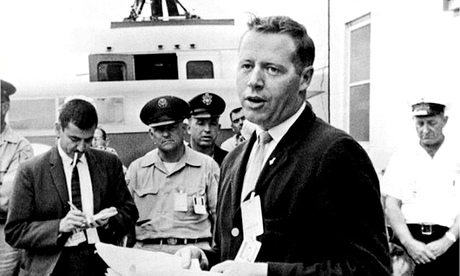
Just before 9.30am Florida time, on 16 July 1969, Jack King confirmed his place in media history by describing technology in action, and transfixing audiences around the planet. “Two minutes and 10 seconds and counting,” he said, in his flat, laconic, Bostonian tones. “The target for the Apollo 11 astronauts, the Moon … Third stage completely pressurised,” he went on. “Second stage tanks are now pressurised … all engines running.”
“We have a liftoff, 32 minutes past the hour. Liftoff on Apollo 11. Tower cleared.” Thus did a calm King, at the centre of a global media clamour, count down as the Saturn V rocket blasted Neil Armstrong, Buzz Aldrin and Michael Collins off into their lunar epic.
Apollo 11 was the climax of King’s time with the National Aeronautics and Space Administration. From 1960 until 1971, he was chief of public information at what became the Kennedy Space Center at Cape Canaveral in Florida, and subsequently, from 1971 until 1975, public affairs officer for Nasa. As such, King, who has died aged 84, provided the commentary on every manned spacecraft launch from Gemini IV in 1965 to the later Apollo moonshots in 1971. One exception was the ill-starred Apollo 13 mission.
Nasa was created in 1958, shouldering the civilian burden of the space race that had grown out of the cold war. It was a time when the American public, shocked by Soviet successes in space and sceptical after US rocket failures, needed reassurance. In 1961 President John F Kennedy raised the stakes, committing the US to a moon landing before the end of the decade.
The one-man Mercury project put Americans into orbit. The two-man orbital Gemini missions tested the systems for the 473,000-mile round trip. The Apollo operation, which began with the catastrophic launchpad incineration of Apollo 1’s astronauts in 1967 ended, in 1972, with the return of the last men to visit the moon, aboard Apollo 17. By then King had become, in the words of Reginald Turnill, the BBC’s then space correspondent, “the public relations man with the world-famous voice”.
Born in Boston, Massachusetts, King was the son of Bill, an Associated Press sports journalist, and Marcy, a schoolteacher. During his time at Dorchester high school, Jack spent vacations as an office boy at AP. In 1951 he was recruited by AP, before graduating with an English degree from Boston College in 1953. This was followed by two years’ national service, as a second lieutenant in the US army artillery corps posted to South Korea and Japan.
Back as an AP news reporter, in 1958, he was assigned as the agency’s first news chief at Cape Canaveral, on the “space coast” where Nasa’s rockets were heading out over the Atlantic. The Soviet Union solved PR problems with a news blackout. The US could not. In 1960 the promising young journalist moved into Nasa.
With the conclusion of the US moon programme in the early 1970s, King helped negotiate and assemble the news/PR package on the joint US-Soviet Soyuz-Apollo mission. Complete with orbital dockings, and cosmonaut-astronaut handshakes, it provided a moment of détente in the later cold war.
From 1975 until 1977 King directed public affairs for the US Energy Research and Development Administration. Subsequent corporate employment included time as an executive vice-president with the controversial oilman Armand Hammer’s Occidental Petroleum. Later, returning to his great love, he was a spokesperson for the private-sector United Space Alliance, backed by Boeing and Lockheed Martin.
Nasa – for whom he became a media volunteer – awarded King its exceptional service medal twice. In 2011, his words from Apollo 11 became part of a compendium of the sounds of American space flight.
King’s wife, Evelyn, whom he married in 1965, died in 2005, and their son William died in 2012. He is survived by his daughter, Beth, son, Harry, and five grandchildren.
• John William King, journalist, born 12 February 1931; died 11 June 2015