IWAKI, Fukushima -- Iwaki, Fukushima Prefecture-based Iwaki FC, who had been striving for entry into the J.League, was promoted to the Japan Football League this season. It was followed by the designation of all eight towns and villages in the Futaba district, located around disaster-crippled Tokyo Electric Power Company Holdings Inc.'s Fukushima No. 1 nuclear power plant, as the team's new hometowns.
Iwaki FC plans to have four official games at the J-Village soccer stadium in the Futaba district. And with more exchanges with children, the team hopes to revitalize the disaster-stricken areas.
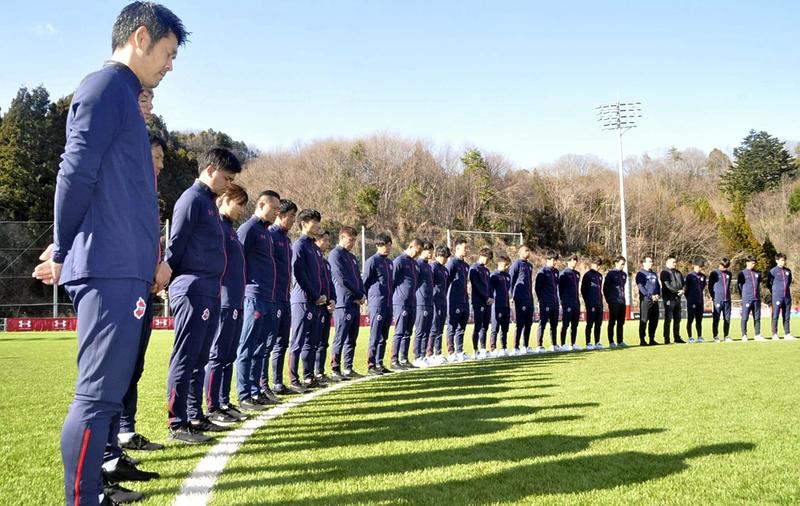
Nine years after the Great East Japan Earthquake, about 40 people, including Iwaki FC President Satoshi Okura, 50, and the Iwaki FC players, offered a silent prayer at a club facility in Iwaki at 2:46 p.m. on March 11. Okura, who has encouraged team members to become aware of their role as a player in the disaster-stricken areas through various efforts, including a tour of the inside of the nuclear power plant, renewed his resolve, saying that he wants to keep working closely with the locals.
Iwaki FC, which was established in 2012, was promoted from the second division in Fukushima Prefecture several times since a subsidiary of Tokyo-based Dome Corp. acquired the right to manage the club in December 2015. The team employed a scientifically-calculated muscle training program for its players. Dome operates the business of U.S. sports clothing and accessories company Under Armour Inc. in Japan.
While in the first division of the Tohoku region last season, the team won the national regional champions league for the first time and gained the opportunity to join the JFL, which is positioned beneath the three divisions of the J.League.
The start of the JFL official season has been postponed, but in February, Iwaki FC was recognized as one of the "100-year vision clubs" at a J.League board meeting, which is a precondition for the promotion to the J.League. The number of Iwaki FC's hometowns was also expanded to nine at the same time.
What's more, the club plans to organize a soccer school for children at the newly-added eight towns and villages.
"The team was created following the disaster. Our significance lies in contributing to the reconstruction of the stricken areas," Okura said.
With Okura's statement in mind, one can't help but think: What role can sports play in disaster-stricken areas around a nuclear plant that have been designated as difficult-to-return zones and where only a few residents live?
Undoubtedly, challenges related to everyday problems in the coastal areas are likely to continue as it marks the 10th year after the disaster.
Read more from The Japan News at https://japannews.yomiuri.co.jp/