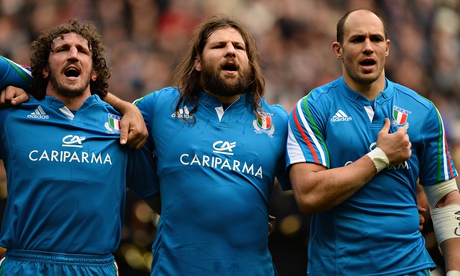
Excuse a clunking metaphor, but Italy have spent the week circling the wagons and sending for what cavalry they have in an attempt to lessen the damage England might do at Twickenham on Saturday. Not for the first time, we see an Italy coach hoping to get through a Six Nations without too much embarrassment.
This time it is Jacques Brunel, who long ago decided he was not going to extend his four-year contract, which ends after the World Cup. He is heading back to France, but he did at least get an offer to stay on, a luxury not afforded Nick Mallett, who was shown the door after four years, Pierre Berbizier, who had to make do with two, the former All Black, John Kirwan, now in charge of Auckland Blues, and Brad Johnston who had the reins when Italy were invited to join the Five Nations back in 2000. I wonder whether they would be invited today?
I ask not because I want to put the boot into Italy when they are down – which they really are – but because rugby is currently in the middle of an interesting cycle and those bean counters and others who questioned the sanity of that 2000 invitation, might just be reflecting on whether the deal could be unpicked. There are various reasons why they might.
First and probably most important, the Six Nations is talking openly about selling itself to the highest bidder when the current deal ends in 2018. It is understandable. Rugby in Scotland, Wales, Ireland and England depends upon a good deal with their broadcaster to ensure the financial health of the sport and when it looks around to see what else has been sold off, most recently golf’s Open Championship, it has to decide whether to stick with its terrestrial partner, the BBC, and an evangelical approach.
Of course, football’s £5bn-plus deal is clearly a pipe dream in the rugby world but £160m over four years, reportedly the current package, is just as clearly way out of kilter when you consider that Sky and BT Sport have decided that rugby is one of their chosen battlegrounds. And were they to enter negotiations, it would be easy to understand why they might want the cast list changed, especially as there continue to be many South Africans looking enviously this way.
Last week, when Cardiff and Paris were packed with emotion and energy, the game in Rome was distinctly second best and I would not expect Italy to be much more entertaining at Twickenham onSaturday. Backs are against the wall and, on the evidence of the performance against Ireland, an 11th wooden spoon beckons.
Sergio Parisse, probably Italy’s one world-class player since Diego Domínguez retired in 2003, said as much after losing 26-3 at home and Brunel confirmed it when he recalled 35-year-old Mauro Bergamasco for his 101st cap and 34-year-old Marco Bortolami for his 111th. Bergamasco is a legend and Marco a top man with whom I enjoyed working at Gloucester, but their selection has to be a backward step and I can’t see things getting better, which brings us to another uncomfortable issue for Italy.
This is the first season of the European Champions Cup and so far it has been a huge success – but at the expense of the second-tier competition, the Challenge Cup.
Until this season, interest in the Challenge Cup grew as the French clubs set aside early doubts because the prize was not just a trophy and a bit of prize money, but a place at Europe’s high table as well. The winner got into the Heineken Cup.
No more and if European rugby is to recover the esteem of its second-tier competition it is going to have to give it the kudos of old. Where does it find such a prize? Well, there is little arguable doubt about the weakest club in the competition this season – Benetton Treviso, representing the weakest country.
Again the currently evangelical line could be under pressure and again, things don’t look like getting any better.
Italy under at least the past three coaches have been despairingly consistent, with inspirational wins – over Wales in 2005, Scotland in Edinburgh and Wales in Rome in consecutive games in 2007 and France and Ireland in 2013 – followed by steady drift. Today the glories of 2013 seem a long way off. Last season was a washout and, with Scotland apparently gaining strength, this year seems destined to be the same.
Previously the Italian board has responded by attracting a “name” to coach their side without seeing that coaches can only work with the talent on hand and that the structure that produces the talent is increasingly unfit for purpose.
Exactly a year ago Treviso created a rush for the exit doors, saying they might save themselves the £2.5m bond demanded by the Pro12 and quit the league that gives them meaningful competition against the Welsh and Scots. Treviso recanted but not before too many players had left and today the club is one off the bottom of that league and above only Zebre, the other Italian club. No doubt, the pressure is on Italy – and on many levels.
Rugby is a pleasant world in which to live and a trip to the Eternal City every other year is most welcome, as could be seen by the amount of green in the 60,000-strong crowd at the Stadio Olimpico last Sunday. Let’s hope the bean counters allow it to stay that way for a while yet.