Closing market report
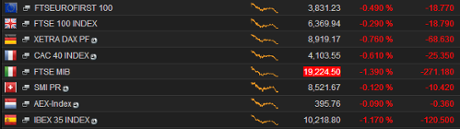
Europe’s stock markets have closed, and Italy’s Milan index has endured a bad day.
The Italian FTSE MIB tumbled 2.4%, as the failure of nine of its banks to pass the ECB’s banking examination drove shares down.
Chiusura #Borsa: FTSE MIB -2.40%, DAX30 -0.95%, CAC40 -0.78%, Cambio €/$ 1.271, DOW -0.14%
— FinecoBank (@FinecoLive) October 27, 2014
Jasper Lawler of CMC Markets explains:
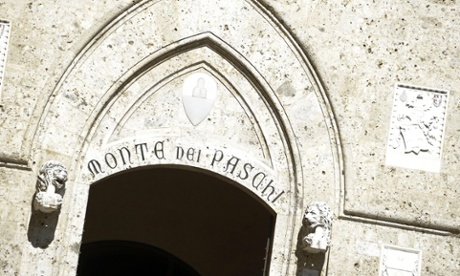
Italian stocks and particularly Italian banks were pasted after coming in bottom of the pile in the stress tests with Banca Monte dei Paschi di Siena needing to raise 2.1bn euros to pass. Banca Monte dei Paschi can hardly be described as an Italian stallion, in fact if it were a horse after this many bailouts it would have been shot by now.
In London the FTSE 100 index finished down around 0.4%
UK's FTSE 100 weighed down by financials after banking health check http://t.co/FnLrWbKTaX
— Tim (@IDXFox) October 27, 2014
David Madden of IG points to the concerns over Lloyds, which lost around 2% tonight:
The British banks may have passed the European stress test but for traders the margin by which Lloyds passed was too close for comfort. It hardly instils confidence in the UK financial sector when the big five banks are given the all clear but the sector still finishes lower. The timing of the stress test could not be worse, with Lloyds and Standard Chartered issuing interim management statements tomorrow.
Britain's FTSE 100 down 0.4 pct, Germany's DAX down 0.9 pct, France's CAC 40 down 0.8 pct #forex #fx
— A.Karim Yousfi (@karimy31) October 27, 2014
Updated
Afternoon summary: German gloom hits markets
Time for a catch-up....
Germany’s economic outlook has darkened after business confidence slipped to its lowest level in 22 months, according to the IFO institute.
IFO sees ‘few bright spots’ in the German economy now, as it suffers from geopolitical tensions and the weak European economy.
Andreas Scheuerle, an economist at Dekabank, says that morale is now “in a downward spiral” in Germany, as geopolitics and the eurozone slowdown hits demand and confidence.
The weak IFO report hit shares across Europe, with Germany’s DAX down almost 1% this afternoon:
Many of Europe’s bank shares have rallied today, after yesterday’s EU stress tests and asset quality reviews were published.
However, Italy’s Monte Dei Paschi has slumped by 20% after it failed the test, and must now find €2.1bn in new capital.
Analysts believe the world’s oldest bank could now be sold, or merged.
Rival Carige Bank is down 13% this afternoon, after also failing the stress test.
Stephen Lewis of ADM Investor Services fears that the euro stress tests will not suddenly revive the sector:
Bank lending to the euro zone private sector is still on a falling trend, registering a 1.8% year-on-year rate of contraction in September. Loan repayments continue to exceed gross borrowing. In some sectors, the deleveraging process is probably, for the most part, autonomous; borrowers wish to scale down their operations in high-risk sectors such as real estate. In other instances, banks may well be pressing customers with large exposure to high-risk sectors to reduce their commitments and repay loans. In either case, the impact on sentiment of the ECB’s stress test, even if favourable, is hardly likely to bring about a change in behaviour. The ECB’s hope is that banks’ new lending to more productive sectors of the economy, and especially to small and medium-sized businesses, will outweigh continued deleveraging elsewhere. But the chances of this happening are not helped by the sudden darkening in euro zone economic prospects. The ECB is likely to find that credit availability, though necessary for sustained economic expansion, is not a sufficient condition for triggering growth when other factors are unfavourable.
In the UK, Lloyds Banking Group’s shares are down 2%. Although it passed Europe’s tests, there is speculation that it could struggle with the UK’s own, tougher, examination due in December.
That could hamper Lloyds’ ability to start repaying dividends.
In other news....
Italy’s government has offered Brussels another €4.5bn of deficit cuts to address concerns over its 2015 budget, and warned that it can’t risk a longer recession.
Brazil’s stock market is also sliding, currently down 4.6% as investors react to president Dilma Rousseff’s re-election last night.
Dilma wins in #Brazil, as we expected. Since she thinks economy doing well, expect more of the same policies - which is, sadly, not good
— Robin Bew (@RobinBew) October 27, 2014
And America’s economy has lost some momentum this month, with service sector growth hitting its lowest rate in six months according to Markit.
The European Central Bank has announced that it bought €1.7bn worth of covered bonds last week, as it began its new stimulus programme.
Those purchases are meant to encourage bank lending and end the credit squeeze hampering the eurozone’s recovery.
Over in Cyprus, a former central bank governor was been jailed for five months for tax evasion today.
Christodoulos Christodoulou had pleaded guilty to not declaring a €1m payment from Greek ship-owner Michalis Zolotas to a company managed by his daughter. Full details here.
According to the Cyprus Mail, Christodoulou was transferred to Nicosia general hospital complaining of chest pain shortly after being sentenced by the Nicosia District Court.
US service sector growth hits six-month low
Another sign of slowdown. America’s service sector is growing at its slowest rate in six months, according to a survey just released by data firm Markit.
The US Services PMI dipped to 57.3 this month, from 58.9 in September.
That’s the weakest reading since April, but still shows expansion (any reading >50 = growth).
Markit says this signals “a further moderation in overall activity growth from the post-crisis peak seen in June”.
New order growth slows, while and the business confidence reading was the weakest since July and one of the lowest readings seen over the past two years.
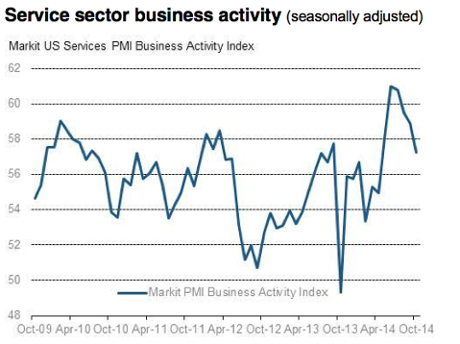
US service sector activity growth eases to six-month low in October. #PMI at 57.3, down from 58.9 in Sep http://t.co/F0peMx9Zm3
— Markit Economics (@MarkitEconomics) October 27, 2014
It probably shows that the US growth rate will slow in the last three months of 2014.
Chris Williamson, chief economist at Markit explains:
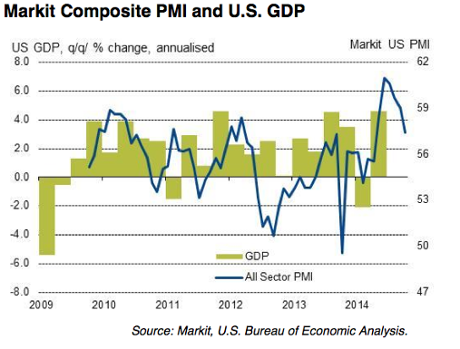
“The flash PMI survey data show the pace of economic growth easing for a fourth consecutive month in October. The weakened growth of new orders and downturn in business optimism suggest that growth and hiring could slow further in coming months.
“Having signalled an annualised rate of GDP growth of approximately 3.5% in the third quarter, the October readings indicate that the pace of economic growth looks set to moderate in the fourth quarter, down to perhaps 2.5% or less if the PMI falls further in coming months.
“There are clearly many concerns, ranging from worries about the impact of Ebola, the Ukraine crisis, the ongoing plight of the Eurozone , signs of further weakness in emerging markets and the Fed starting to tighten policy.
“We should not lose sight of the fact that the pace of growth nevertheless remains robust, having merely eased from very strong rates in prior months. The survey is also indicating another month of non-farm payroll growth in excess of 200,000 in October. This sustained strength should help alleviate recent worries about a sudden deterioration in the economy’s health. The pace of expansion appears to be easing only moderately.”
Memories of Big Bang, 28 years on

One for the history buffs -- today is the 28th anniversary of Big Bang.
That was the moment in 1986 when Mrs Thatcher deregulated the City of London, transforming it from a snoozy insiders’ circle to the thrusting, go-getting institution that made Britain what she is today.
Supporters would say that Big Bang helped London become Europe’s financial powerhouse, transforming the UK economy.
Critics say it paved the way for freewheeling financial capitalism, and the aggressive greed that helped to cause the 2008 financial crisis.
Either way, it transformed the City. There’s a nice piece in Moneyweek about the changes:
Before 1986, the City worked rather differently to the way it does today. Old Etonians would roll in from the shires mid-morning, depart shortly after for a civilised lunch and a bottle of very nice Bordeaux at a discreet restaurant somewhere, then hop in a cab to the club for a few snifters of single malt, before being whisked back first-class to London’s leafy fringes.
If you wanted to buy a stock, you approached your broker, who placed the order with a ‘jobber’ – cockney barrow-boy types who made the trade on behalf of the public schoolboys. It was all terribly, terribly cosy.
Unfortunately, it wasn’t very competitive....
And in the Telegraph, economist Roger Bootle argues that Big Bang helped to create a world where financial institutions are “not only too big to fail, but too big to manage”.
The task of the financial authorities, not only here but elsewhere in the world, and especially in the United States, is to preserve the energy, competition and efficiency of today’s financial system while clamping down on its conflicts of interest and its tendency to instability.
I feel sure that this will eventually have to involve the barring of certain sorts of financial institutions from particular forms of financial activity. The Volcker Rule in the US and the Vickers reforms over here represent merely the starting point.
Magnificent though it was, some of the Big Bang needs to be reversed.
OTDI 1986 the London Stock Exchange’s “Big Bang” transforms the way shares are traded http://t.co/iiQr4IHEZP pic.twitter.com/xid2H8IM3I
— David Jack (@DJack_Journo) October 27, 2014
Updated
Brazilian stock market tumbles 6%
As predicted earlier, shares are tumbling on the Brazilian stock market as traders respond to Dilma Rousseff’s re-election with a flurry of sell orders.
The Bovespa stock index has slumped by 6% at the start of trading, with oil explorer Petrobras leading the selloff:
#Brazil's benchmark index Bovespa plunges >6% in 1st trading day after Rousseff win. pic.twitter.com/aZvWaCQ89I
— Holger Zschaepitz (@Schuldensuehner) October 27, 2014
*PETROBRAS SHARES FALL 15% TO BRL13.41 IN SAO PAULO
— JP Spinetto (@JPSpinetto) October 27, 2014
And the Brazilian real continues to be thumped, as investors vent their angst that social democrat Aécio Neves - a more free-market friendly option to Rousseff -- had been narrowly defeated.
Brazi real suffering its own 7-1 thrashing after Dilma's victory. Worst performer in world. http://t.co/MzCiqCWC7c pic.twitter.com/WAR8gkjKFS
— Robin Wigglesworth (@RobinWigg) October 27, 2014
Italy outlines €4.5bn of new budget cuts
Italy’s government has made concessions to Brussels, after being challenged over its 2015 budget plans.
Pier Carlo Padoan, minister of economy and finance, wrote to the EC today to outline €4.5bn in extra deficit-reduction measues.
It includes €3.3bn that had been assigned to lower the tax burden on Italians.
In the letter (online here), Padoan also reminds the EU of the economic strife in Italy, and emphasised the need for growth:
At the same time, it is my duty to remind you that the Italian economy is going through one of the most severe and lengthy recessions in its history. GDP declined by more than 9% with respect to the level of 2008.
The economy is now in its third year of recession and at serious risk of deflation - or a prolonged period of very low inflation - and stagnation. A fourth year of recession is to be avoided by all means as it would be extremely problematic to pull the country out of such an economie environment. Furthermore, it would make debt sustainability much harder to be maintained.
That’s why Italy had been trying to deliver a “growth-friendly fiscal adjustment”, Padoan explains.
The 2015 budget includes more spending on various “growth-enhancing spending” such as R&D, innovation, education and essential infrastructure projects. he points out.
But still, it has agreed to these additional measures to hit Brussels’ deficit demands.
You can read Italy's (Padoan's) response to Katainen at the European Commission over its budget here. http://t.co/UdThPgBOjc
— Lizzy Davies (@lizzy_davies) October 27, 2014
Italy is going to do more - cuts of €4.5billion - to ensure it meets EU budget rules on the deficit. That leaves France in dispute.
— Gavin Hewitt (@BBCGavinHewitt) October 27, 2014
Renzi's move to -partly- address @EU_Commission's concerns and revise #Italy's 2015 draft budget puts Hollande in a tough spot.
— Yannis Koutsomitis (@YanniKouts) October 27, 2014
Updated
The ban on short-selling isn’t helping Monte Dei Paschi’s shares -- they’re now down 20%!
Bank that performed the worst in the ECB's stress test RT @Schuldensuehner: Monte Paschi Shares Resume Trade In Milan, Down 20%.
— Christopher Vecchio (@CVecchioFX) October 27, 2014
Updated
Brazil's currency slides after Rousseff's victory
Brazil’s Real has tumbled this morning, losing 3% against the US dollar following Dilma Rousseff’s re-election as the country’s president.
It’s going to be a rough day on the Brazilian stock market, where traders had hoped that her pro-business rival Aécio Neves would triumph. Shares in oil giant Petrobras have already tumbled 15%, in Frankfurt.
Along with drop in real, #Brazil's Ibovespa futures fall 8.2%
— Michael McKee (@mckonomy) October 27, 2014
TV reporter Stephanie Kennedy sums up the mood:
Wall Street Jornal laments 4 more yrs of "economic mediocrity".Financial world woke up today bitter that #Brazil remains on the Latinam left
— Stephanie Kennedy (@StephanietlSUR) October 27, 2014
This is why these elections have been as emotional as ever, an us vs them. Because it takes guts to stand up to the west. #Brazil @dilmabr
— Stephanie Kennedy (@StephanietlSUR) October 27, 2014
Relief as UK retail sales beat forecasts

Just in..... UK retailers have reported their fastest quarterly sales growth in three years, easing fears that the sector was struggling.
The CBI found that clothing sales rose sharply this month. That suggesting that people have finally updated their wardrobes with wintery outfits after the long summer.
Its October retail sales balance held steady at +31, beating forecasts of a fall to +25 (this measures how many shops reported that turnover had risen, or fallen)
This pushed the three-month average retail sales balance to rise to +33 from +30, its highest level in three and a half years.
UK CBI October retail sales balance at +31 in October (unchanged). Three months to October best since Feb 2011
— Markit Economics (@MarkitEconomics) October 27, 2014
The CBI reported that grocers and the clothing sector saw an acceleration in sales growth, but sales did fall at hardware & DIY and specialist food & drink shops.
Rain Newton-Smith, Director of Economics at the CBI, explains:
“Sales on our high streets are still ticking along and, with similar prospects next month, retail growth is looking more stable.
“The clothing sector in particular appears to be bouncing back after the mild weather in September deterred people from buying their winter warmers.
“The recent fall in inflation may help lift the spirits of households by making their budgets stretch further.
But risks remain to the UK recovery more generally, with the Eurozone stalling, conflict in the Middle East and tensions over Ukraine. This could have an impact on consumer confidence and spending going forward.
'Sales on our high streets still ticking along and retail growth is now looking more stable' http://t.co/eKCQbydd86
— The CBI (@CBItweets) October 27, 2014
Updated
Oh dear, Monti Dei Paschi has just triggered another automatic suspension, as investors continue to sell heavily (via Milan trader @lemasabachthani)
BMPS -20.3% (HALTED)
— lemasabachthani (@lemasabachthani) October 27, 2014
Today’s slump in Monte Dei Paschi’s shares is bad news for those traders who had driven its stock up last week.
That optimism, ahead of the Bank stress tests/asset quality reviews, has now been punctured:
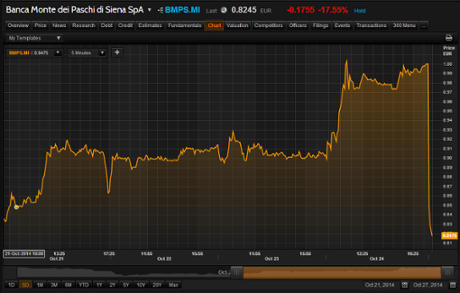
Italy bans short selling on Monte dei Paschi as shares slump 20% http://t.co/GhuO4AYwoS
— Sara Sjölin (@sarasjolin) October 27, 2014
Italy’s stock market regulator has just banned investors from short-selling Monte Dei Paschi’s shares today, or tomorrow, Reuters reports.
That means traders cannot borrow stock in MDP to sell on the stock market, and then buy it back at a lower price to book a profit.
FTW: ITALY'S MARKET REGULATOR SAYS BANS SHORT SELLING ON MONTE DEI PASCHI'S SHARES ON MONDAY AND TUESDAY
— MineForNothing (@minefornothing) October 27, 2014
Italian banks feeling sore.
Back in Italy, banking are still reeling from yesterday’s stress tests and asset quality review.
The financial sector is feeling singled out, after 9 of its lenders failed the examination. And this could fuel tensions between Italy and the rest of Europe.
Carlo Alberto Carnevale-Maffe, professor of strategy at Italy’s Bocconi University, has told CNBC that Italy has been held to a higher standard:
There was a “surgical targeting of Italian banks with asset quality review (AQR) drones .
“The ECB targeted the banks with the lowest level of transparency and governance, and the highest links with the political system.”
Italy’s stress test fail: Attack of the ‘drones’
Italy’s two biggest lenders, Unicredit and Intesa Sanpaolo, both passed.
But Monte Dei Paschi remains in the doldrums, having seen a sixth of its value wiped off this morning. Shares are trading after being suspended in a flurry of sell orders, and are down 17.5%.
Fellow Italian bank Carige is also suffering; its shares are still down 15% after it was also failed (as covered earlier, it may now launch a big rights issue.)
Updated
German confidence began sliding as the West began to hit Russia with economic sanctions over the Ukraine crisis, flags up market strategist David Scutt.
Chart: German IFO Survey. Russian sanctions started in April, unsurprisingly the high-point for both measures $EUR pic.twitter.com/zMadKc0AGz
— David Scutt (@David_Scutt) October 27, 2014
Economist: German confidence in downward spiral
This latest slide in German business confidence suggests that Europe’s largest economy could be in for a bumpy ride in the fourth quarter, analysts say.
Andreas Scheuerle, an economist at Dekabank, says that morale is now “in a downward spiral” (via Reuters).
“The original mood killers - geopolitics, euro zone weakness, German economic policy and deflation concerns - have led to big downward revisions of forecasts and the weaker economic expectations are now weighing on sentiment.”
Germany grew by 0.7% in the first three months of the year, but then shrank by 0.2% between April and June. We find out next month whether it kept contracting in the third quarter - which would mean an official recession.
Updated
German business confidence hits lowest since December 2012
Germany’s economy has suffered another blow, with business confidence falling again to its lowest level in almost two years.
The Munich-based IFO institute’s survey of 7,000 firms showed the sixth consecutive fall in business sentiment.
It found “almost no bright spots” in German industry at present, as Europe’s largest economy teeters on the edge of recession.
IFO’s Business Climate index fell to 103.2, down from 104.7, which is the weakest level since December 2012.
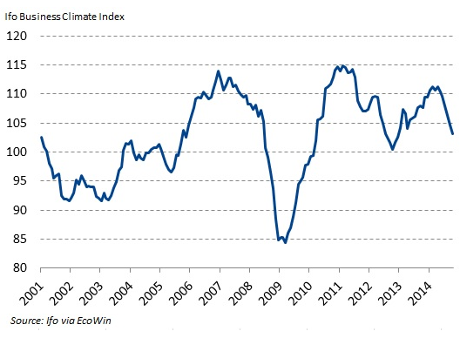
IFO found that firms are more gloomy about current conditions, and future prospects, than last month.
It now fears that Germany’s economy may not achieve any growth in the fourth quarter of this year.
More on German business confidence: sentiment at lowest level in almost 2 years. Ifo economist sees zero growth for G in fourth Q#Germany
— Gavin Hewitt (@BBCGavinHewitt) October 27, 2014
German IFO Current Conditions Index at 108.4 in October. Business expectations at 98.3. Both below TR forecasts for 110 and 98.9
— Markit Economics (@MarkitEconomics) October 27, 2014
Updated
Monte de Paschi the main stress test casualty as authorities take a sceptical line on those loans they've been rolling over since 1472.
— Five Minute Macro (@5_min_macro) October 27, 2014
The relief rally has reached Greece:
Athens market up 1.5% at 0900 GMT, banks up 3.2%, following better-than-expected #stresstest results for Greek banks. | #euro #Greece
— Yannis Koutsomitis (@YanniKouts) October 27, 2014
Troubled Monte Dei Paschi could face sale or merger
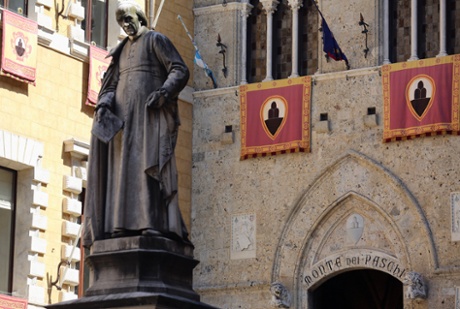
Monte dei Paschi di Siena can trace its origins back to 1472 -- 20 years before Columbus spied the New World on the horizon.
The bank was set up as a “mount of piety”, but in recent years it has been dogged by regular losses and cash calls.
Yesterday’s bank test failure could now force MPS, which is Italy’s third-largest bank by assets to be sold or merged. Thus the 15% tumble in its share price this morning.
The WSJ has a good explanation of what went wrong:
Analysts say the bank has been dogged by a series of strategic missteps—in particular its 2007 purchase of Banca Antonveneta for €9 billion—as well as interference by local politicians in Tuscany and shortsighted management by its majority shareholder, a Siena-based charitable foundation.
In March 2009, the bank turned to the Italian government for a cash infusion of €1.9 billion. In 2013 it went back for an additional €2.2 billion. Since then, problems at the bank compelled the foundation to sell down its stake to about 2%; new management at the bank has overhauled its strategy and shed assets.
Italian regulators say they would happily accept a sale or merger, if it put MPS on a more solid footing.
Updated
Italian banks, which failed the EBA stress tests, are sliding rapidly Banca Carige down 18%, Monte Paschi Siena down 15%
— Joe Lynam BBC Biz (@BBC_Joe_Lynam) October 27, 2014
Roberto Henriques, European credit analyst at JPMorgan, reckons the stress tests were rigorous enough:
“It does meet the credibility test.”
Should we be relieved, or worried, that only 25 European banks failed yesterday’s examination, with just 14 still needing extra capital?
Kit Juckes of Société Générale reckons you can view it either way:
Doctor Daghi gave the European banking system a reasonably clean bill of health, the ECB observing only that a smallish number of banks have to raise a modest amount of capital.
It’s either a reassuring or a naive picture of the banking system, depending on how you want to read it. Our equity analysts conclude that this is good news for bank stocks on the whole, while from a macro point of view it was largely a non-event that allows us to move on to bigger issues.
Analyst: UK stress tests could catch Lloyds out
Banking analyst Sandy Chen reckons Lloyds Banking Group could struggle to pass the UK’s own, tougher, stress tests, which are due in December.
That’s explains why Lloyds isn’t sharing in today’s rally; its shares are still down 2.1% despite passing the European exam.
Chen, of Cenkos Securities, explains that the stress tests from Britain’s Prudential Regulatory Authority will be tougher, and could trip Lloyds up.
A particular driver behind a weaker result would be a bigger modelled fall in UK house prices... e.g. 19% in the EBA stress scenario, versus the 34% potential fall in the house price index that was set out in the BOE’s April 2014 stress test guidelines.
And that could mean “ a difficult conversation with the regulators” about when Lloyds, bailed out in 2008, can finally start paying dividends again
Updated
Carige shares slump 17%
Shares in a second Italian bank, Carige Bank, have also slumped this morning, down 17%.
Carige, which is the largest bank in Liguria, is expected to raise at least €500m through a rights issue after European authorities found an €810m capital shortfall in its books.
Trading in Banca Carige suspended after shares opened down 17% after EBA #stresstests failed the Italian bank
— Joe Lynam BBC Biz (@BBC_Joe_Lynam) October 27, 2014
Austrian lender Raiffeisen’s shares have also surged, by 7.3%, after passing the stress tests.
Another sign of relief -- shares in Austrian bank Erste Group have jumped by 7.5%.
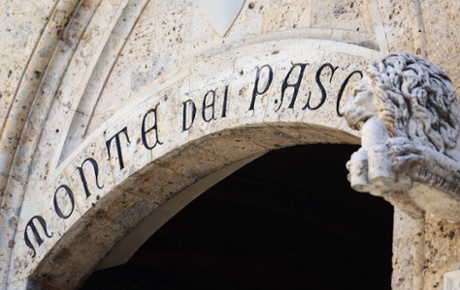
Shares in Monte Dei Paschi suspended after slumping 15%
Italy’s Monte Dei Paschi’s shares are being hammered in early trading in Milan after it became the most high-profile casualty of the bank tests.
Trading in the world’s oldest bank has just been temporarily suspended after they slumped by 15% in a rush of early selling.
BMPS -15.00% (HALTED)
— lemasabachthani (@lemasabachthani) October 27, 2014
Investors aren’t impressed to hear that Monte Dei Paschi needs an extra €2bn, just months after raising €5bn.
Michael Hewson of CMC Markets says the tests are:
raising the question of once again how much more money must be pumped into this bottomless pit of a bank that has had to raise extra capital each of the last three years.
Eurostoxx Banking Index gains 1.7%.
Most bank shares are rallying this morning, pushing the Eurostoxx Banking Index up by 1.7%.
It tracks all the main banks across Europe,
Updated
Commerzbank shares surge 9%
Shares in Germany’s Commerzbank have surged by almost 9%, over in Frankfurt.
Commerzbank opens up 9pct after stress test pass.
— George Hay (@gfhay) October 27, 2014
It comfortably passed yesterday’s stress test and asset quality review. Under the baseline scenario, Commerzbank had a Common Equity Tier 1 ratio (CET 1) of 11.4%. The ‘pass mark’ was 8.0%.
Clearly there was concern that problems could have been uncovered....
Updated
FTSE 100 jumps 50 points, but Lloyds falls
The FTSE 100 has rallied 50 points at the start of trading, up 0.79% at 6439.
Mike van Dulken, head of research at Accendo Markets, says:
sentiment is being buoyed by the European bank Stress test results.
But Lloyds, which only just passed yesterday’s stress test, are leading the fallers, down 2%. There is concern that Lloyds’ may not be able to renew its dividends as soon as previously hoped.
Updated
Opening post: Digesting the stress tests
Good morning, and welcome to our rolling coverage of the financial markets, the world economy, the eurozone and business.
There’s mild relief in Europe this morning after yesterday’s stress tests of the regions banks showed up fewer problems than feared.
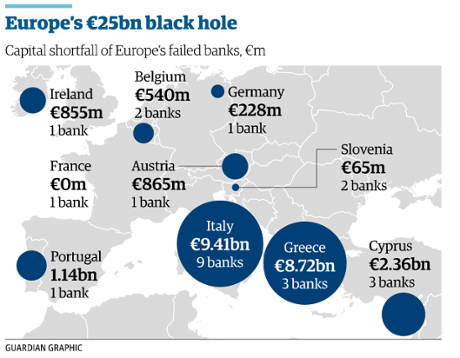
Shares are expected to climb a little in Europe today, on relief that the tests didn’t find deeper problems. Although 24 banks had capital shortfalls, 10 have raised funds since the tests were conducted. The remaining 14 banks must raise €25bn, as we reported yesterday:
Twenty-four European banks fail financial stress tests
Health check finds 24 EU banks ailing – but the UK’s pass muster
Eurostoxx50 futures up 1% now after ECB stress tests
— RANsquawk (@RANsquawk) October 27, 2014
A slightly 'Gung-ho!' stance to earning season on both sides of the pond may trigger positive opening for Europe. FTSE +20, DAX +30, CAC +19
— David Buik (@truemagic68) October 27, 2014
But there’s gloom in Italy, though, where no fewer than nine lenders flunked the comprehensive review unveiled by the European Central Bank. That included the world’s oldest bank, Monte dei Paschi, which must find €2.1bn fast.
As my colleague Jill Treanor reported:
The bank was one of nine Italian banks deemed to have failed the stress tests carried out by the European Banking Authority, which published its findings on Sunday and concluded 24 banks out of 123 it had tested across the European Union needed more capital.
Monte dei Paschi di Siena, which is already in the midst of a restructuing exercise, said it had been penalised by the methodology used by the regulators and appointed UBS and Citigroup to advise it of its options and “explore all strategic alternatives for the bank”.
Banca Monte Paschi, the main casualty of the ECB stress tests, called to open down 15%
— RANsquawk (@RANsquawk) October 27, 2014
Italy’s central bank has been griping about the tests already, saying its banks fell foul of a “very unfavourable” methodology, including another protracted recession. But the results could intensify concern over Italy’s economy.
Also coming up today.....
We get a new healthcheck on Germany’s economy this morning, with the monthly IFO survey at 9am GMT. That will show whether business confidence has recovered from last month’s tumble.
And at 2.30pm GMT the European Central Bank will announce details of its Covered Bond Purchase programme, which began last week.
Otherwise it’s a bit quiet....
Updated