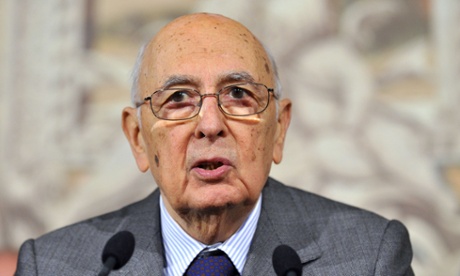
Italy’s president, Giorgio Napolitano, has resigned, formally setting off what will be a contentious election to replace him.
The 89-year-old former communist, who played a key role in the ousting of Silvio Berlusconi, was seen as a steady – even moral – presence in Italian politics at a tumultuous time. He had announced in December that he would be leaving office well before the end of his term in 2020 because of his advancing age.
Above all, the choice of who will be the next Italian head of state will test the political authority of the prime minister, Matteo Renzi, who has had to face down rebellion within his centre-left Democratic party following his rise to power in February.
It comes at a fragile time for the moribund Italian economy, which is suffering under record-high unemployment and rising public debt.
In his nine-year reign, the man known as King Giorgio oversaw the end of the Berlusconi’s era. Berlusconi, the former prime minister and media magnate, stepped down under pressure at the height of the eurozone crisis amid a swirl of prostitution and tax fraud allegations.
The Italian presidency is not just a figurehead. The role carries with it the power to dissolve governments, call new elections and shape new coalitions. This is the primary reason Renzi, who came to power in a party coup and has not formally been elected as prime minister, will want to have a loyalist in the role.
The formal voting process will begin in about two weeks, when an electoral college of 1,009 officials will begin the round of votes by secret ballot. While the first rounds require a two-thirds majority to win, from the fourth round on, when Renzi is expected to unveil his choice, the winning candidate will only require a simple majority of 505 votes.
Renzi’s Democratic party holds about 450, but he is likely to see defections by the leftwing minority that feel “mistreated” by him, according to Wolfango Piccoli, the managing director of Teneo Holdings, an advisory firm watching the election.
Renzi will have to rely on his unlikely political ally, Berlusconi, the leader of the conservative Forza Italia party, to get his candidate across the line.
His mutually beneficial relationship with the former prime minister has been controversial, particularly after Renzi quietly instituted a tax rule on Christmas Eve that decriminalised the kind of tax fraud Berlusconi had been convicted of in 2013. Outrage within the Democratic party over the stealth manoeuvre has tarnished Renzi’s image and he was forced to backtrack.
Among the candidates who have been touted as a possible successor to Napolitano are Romano Prodi, the former European commission president, Dario Franceschini, the cultural minister who is close to Renzi, and Pier Carlo Padoan, the finance minister.