As the Guardian University Awards 2016 opens for entries we caught up with last year’s winners in three popular categories to find out more about their successful ideas and what has happened since they won.
Student experience category
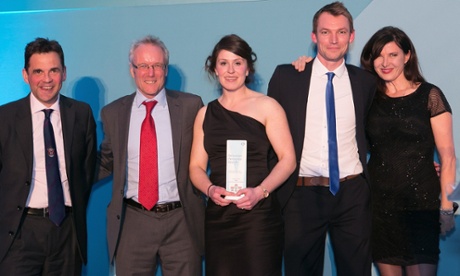
The Active Students programme at the University of Hertfordshire
“The award really cemented for us something we already thought was true - that the programme was great for student experience”
Rhian Crawford, project officer for Active Students
The aim of the project was to get students who were not interested in sports to be more active by providing activities that were fun, informal, social and convenient. Active Students provided 70-80 hours of activity per week, and at its peak there were over 1,000 students attending each week.
“Our job was to come up with activities on a weekly basis that students who were less interested in sports could do,” Crawford explains.
“We offered fun things - like ultimate frisbee and rollerskating and we did lots of dance, anything that had a social element to it and took away some of things that people hated about sport at school like being on a cold, wet football pitch.
“We recruited 12 students who attended all the sessions that we ran. We called them ‘activators’ and they promoted sessions in advance and got more students involved. They also gathered useful information about what students wanted from the activities and fed it back to us. That meant we could offer students their choice of activity at times that were convenient for them.
“The Guardian award has been immense for us and it cemented what we were already noticing on campus - which is that this project was really adding to the student experience.
“It helped people feel a part of something and gain a sense of belonging. You get that automatically if you are on a university sports team because you are competing for the university and everyone wears the same team hoodies. With this programme, we wanted to extend that sense of belonging out to more students.
“We even found the programme could take pressure off other services - for example flyers for Active Students were handed out at the university counselling services because the activities were a great way to make friends and integrate.”
The Active Students programme was funded through Sport England after the university won a grant of £359k for three years.
Impact of research category
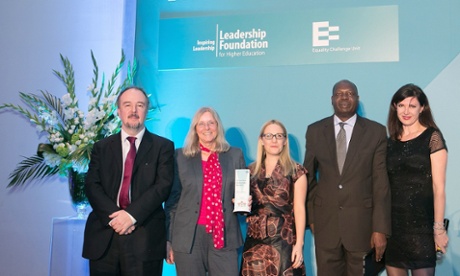
Cassava: adding value for Africa at the University of Greenwich
“Our project was 20 years in the making, I think it stood out because of the impact it’s had across five countries”
Andrew Westby, director of C:AVA
The C:AVA (Cassava: adding value for Africa) project is about adding value to cassava plants. In 2012-13 C:AVA processed 24,000 tonnes of high quality flour, increased the incomes of 90,000 farmers, and supported 300 village processing groups and 50 enterprises.
The project was started by the university’s Natural Resources Unit and is being continued by partner organisations based in the five participating countries: Ghana, Uganda, Nigeria, Malawi and Tanzania.
“Cassava is a great crop, it is drought tolerant and you can harvest it whenever you want, but it is really perishable,” the director of the research project, Andrew Westby, told me.
“It goes to market and only lasts about two days – then everyone has to discount it to try and get it to sell quickly. So we were looking for ways to make more money from it.
“One of the new market opportunities we identified was high quality cassava flour. It can be sold and exported and people can use it instead of buying expensive wheat flour. It can also be used as a substitute in the manufacture of paperboard and plywood.
”As cassava is a vegetable typically grown and sold by women, the project has helped women make more money and generate more income for their households.
“In the first phase of the project, which happened before the Guardian award, we had 90,000 households producing and selling cassava flour, across five African countries.
“Since the award, our focus has been to scale up the project and we are working with partner organisations in Africa to introduce the product to even more households and markets. We are now standing back from the project a little, but our researchers are still available for support and advice.
“I think our work stood out because the project has been a long time in the making – it was based on 20 years of basic research into cassava vegetables as we needed to find a way to process them to remove the cyanide and produce a safer flour. The project went from that basic research to a successful pilot, which then attracted the funding from the Gates Foundation and enabled us to scale up and have a huge impact.”
International projects category
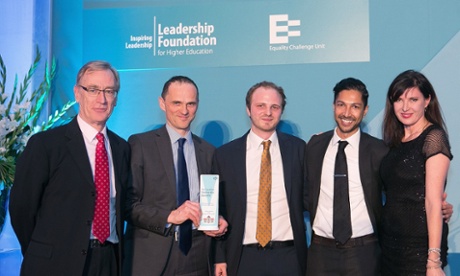
King’s Sierra Leone Partnership at King’s College London
We’ve grown and professionalised a lot over the course of the outbreak – you have to if your organisation grows tenfold in under a year.”
Max Manning Lowe, operations manager, King’s Sierra Leone Partnership
The partnership has delivered projects to strengthen medical training, clinical services and policy in Sierra Leone. In spring 2014, following the Ebola outbreak, the KSLP became involved in a major humanitarian response – and was one of the few organisations not to leave the country, eventually treating 14% of the country’s cases, despite receiving less than 1% of UK government spending on the crisis.
“We weren’t just there for Ebola – the outbreak was very much a distraction from the key bits of work. We’re a health partnership, and in some senses a partnership of partnerships. What that means is in Freetown we work in close collaboration with our partners, we follow their lead in terms of what programmes need to be undertaken.
“On the ground our volunteers work underneath or alongside their Sierra Leonean counterparts, supporting their work and priorities. This is in a wide range of areas – emergency medicine, medical education, surgery, internal medicine – with the aim of improving healthcare in Sierra Leone across the board. In return, our volunteers learn about a way of working and things going on in health that they wouldn’t get in the UK, particularly around leadership, management and use of resources, and come back and then are better clinicians in the NHS as a consequence.
“Prior to Ebola we had a really small team; one and a half staff and four volunteers. We had friends being affected by the outbreak, staff we’d known for years getting ill, we saw the town where our team lived being pulled apart – that made us stay. We saw how we could support our partners even more by having a bigger team, especially in light of the outbreak and the increased attention health in Sierra Leone is getting. To that end we’ve kept a bigger team and shifted our structure.
“We’ve grown and professionalised a lot over the course of the outbreak – you have to if your organisation grows tenfold in under a year. We’re preparing to be in Sierra Leone for at least the next 5-10 years – we all want to work ourselves out of a job, to the point where the country no longer wants our support.”
Click here to enter this year’s awards.