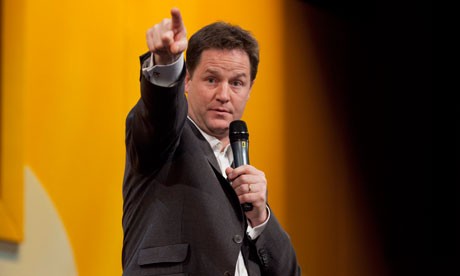
One year into the coalition government, there was a new sense of business and professionalism among the attendees at this year's Liberal Democrat conference – evidenced by the low beard and high suit counts.
Disappointingly, despite the oft-quoted rhetoric on the need for innovative solutions to public policy problems, party leader and deputy prime minister Nick Clegg was remarkably quiet about how this might be realised. Social enterprise was absent from the leader's set-piece speech to conference, which focused instead on jobs, growth and doing more to get the banks lending. The conference debate on volunteering on Saturday morning (before most attendees had arrived) was uninspiring.
One of the challenges is that with no designated voluntary or social enterprise spokesperson, there's little fresh information available about where the party stands on public service reform, procurement and citizen engagement.
With little comment from the platform about who might provide the "innovation" needed to change the way that the public sector operates, we looked to the fringe meetings for a steer on what the Liberal Democrats think about social enterprises and the role that they and charities could and should play in the brave new world of localism and smaller government.
Social enterprises did get air time in the health and trade union fringe events. Practitioners and staff groups, including the Medical Practitioners Union, TUC and others expressed concern at the "marketisation" of health care "taking money out of the system and permanently into private hands". This was a recurring theme, revealing deep-seated anxiety about the proposed changes to the NHS. A challenge not helped by the absence of the senior health minister at many events – one of the downsides of coalition. To his credit, the minister for social care, Paul Burstow, did his best – talking about the need for more attention to be paid to social care, the "Cinderella" of the health system. Appearing alongside thinktanks, private providers, charities and clinicians he was clear and coherent in his articulation of why this was necessary, but less so on how it might be achieved.
One of a handful of Conservative coalition ministers who did visit, the minister for cities Greg Clark, spoke on how the localism agenda would improve the way that local services were organised and improved. Half of a double-act with small business minister Ed Davey, they declared that acting on the analysis of the failings of the last decade was what brought the Conservatives and Liberal Democrats together. Clark added that innovation is vital for localism to work and that divestment of powers should not be uniform across all cities and councils. He urged citizens and commissioners to "be bold" in tackling problems previously handled by the government. Although there was still no sense of how this was to be achieved, who might deliver it or how it might be paid for.
Of course, there were some dissenting voices to the dramatic changes being pursued by the coalition. One such critic was Lord Oakeshott, who branded the Open Public Services white paper an "intellectual dog's breakfast" trying to "squash" many worthy objectives into a single intellectual framework. He said that the white paper was "shot through" with assertions that a privatised model was the correct one, but that there is "a lack of evidence for this". Meanwhile NUT general secretary Christine Blower said she agreed with many of the objectives in the white paper but felt that the means set out to achieve them were incorrect. Citing the issue of children excluded from schools, she said that lots of different providers was not the right approach and caution was needed before contracts were drawn up and money spent.
On the whole, it could have been a more positive conference for social investment and social enterprise. It is clear that there is a long way to go before social enterprise is accepted as a legitimate solution to some of the bigger problems around public service. Without expecting any dramatic differences, it will be interesting to see what the next two party conferences think – who will emerge as the party of social business?
Sam Dowling is Policy Manager at The Social Investment Business
This content is brought to you by Guardian Professional. To join the social enterprise network, click here.