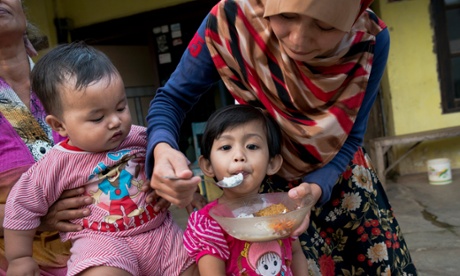
Indonesia faces major nutritional challenges. Rates of childhood malnutrition are among the highest in the world. According to UNICEF more than one third of children in the country are stunted have a low height for their age.
Recent research by the Global Alliance for Improved Nutrition (GAIN) in partnership with the London School of Hygiene and Tropical Medicine and Savica, a public health consultancy in Indonesia, found that child feeding is affected by more than just the behaviour of mother and child.
Fears of being judged
“Mothers prefer calm and quiet babies so they can go about their everyday chores, and avoid negative judgment. When a baby is not growing or behaving in a way acceptable to the community, such being thin or restless, family members and neighbours are likely to on how to fix the problem, whether mothers seek their advice or not,” says Marti van Liere, director of maternal, infant and young child nutrition at GAIN. She said authority figures such as grandparents, neighbours, midwives, or religious leaders play an important role in child feeding.
The researchers conducted a series of in-depth interviews, interactive sessions and day-long video observations about feeding practices in East Java, a region with particularly poor child nutrition. GAIN this week published the findings in a case study entitled Improving Childhood Nutrition by Changing Infant Feeding Practice in Sidoarjo, East-Java.
Breast is best
The study found that, although mothers know that breast milk is the best form of nutrition for their child, rates of exclusive breastfeeding were low because many think that formula is the perfect accompaniment to breast milk.
“Mothers retain the misconception that formula milk is the magic solution for all babies and don’t realise that using formula milk displaces the production of their breast milk. Sadly, this misconception is endorsed by most midwives who give formula to mothers to bring home as reserve food for babies right after birth, and by health cadres when the babies are perceived to be not sufficiently gaining weight,” says Damayanti Soekarjo of Savica.
Lack of confidence
However, the lack of confidence seems to be a far bigger problem than lack of knowledge. Many mothers do not feel confident in their ability to breastfeed, or the quality or quantity of their breast milk. In addition, healthcare workers may inadvertently worsen this confidence crisis by suggesting infant formula as an alternative where mothers experience difficulties with breastfeeding. A lack of confidence also leads to child-led feeding behaviour, says van Liere.
“Parents often interpret crying of children as a sign of hunger or dislike of the food offered and, to avoid this, they seek to satisfy every need immediately often with a bottle of formula milk or deep-fried or sugary snacks. This can interfere with their intake of a proper meal at mealtime.”
Evo-Eco
Researchers from the London School of Hygiene and Tropical Medicine use a new approach to behaviour change that is rooted in evolutionary psychology, called Behaviour Centred Design. The foundation of this approach is that human behaviour evolved to get us what we need from our environments. There are 15 basic motives for all human behaviour, love, for example, helps us bring up offspring in the context of a pair-bond, affiliation makes us want to belong to a group and justice makes us want to punish unfairness.
“Most mothers have heard endless messages about nutrition, but this doesn’t mean that what they actually do has improved,” says Dr Val Curtis of the London School of Hygiene and Tropical Medicine.
“What we’re doing is targeting behaviour itself rather than knowledge, by using emotion, not lecturing. So, for example, a visual demonstration of how much disgusting stuff there is in an unsuitable snack has a far more powerful impact on mothers than a lecture about nutritional values.”
Changing behaviours to improve nutrition
GAIN is using these novel insights to drive a behaviour change intervention with three primary goals: to improve breastfeeding rates by discouraging the introduction and use of infant formula, to increase the dietary diversity of the family meal by reducing the proportion of rice and to reduce unhealthy snacking between meals. The campaign uses emotional motivators rather than lecturing and has three elements: a mass-media campaign; community involvement through village road shows; and encouraging behaviour change through healthcare facilities, which includes the training of healthcare workers.
GAIN, USAID and SPRING are also bringing together thought leaders and experts at a Social and Behaviour Change Communication conference in Washington DC on 5 November to review evidence and secure commitment in promoting behaviour changes in nutrition and feeding practices.
Follow the event using #SBCC4Nutrition and read Improving Childhood Nutrition by Changing Infant Feeding Practice in Sidoarjo, East-Java: A GAIN social behaviour change case study.
Content on this page is paid for and provided by GAIN sponsor of the Guardian Global Development Professional Network.